How a window closes
India's large reservoirs are not refilled evenly from June to October. The southwest monsoon delivers most of the year's water in a few weeks, and then it leaves. After withdrawal — typically from the northwest in September and from the rest of the country by early October — inflows collapse and irrigation drawdown takes over. The filling season has a deadline. The number you hold when it passes is the number you live on until next June.
That deadline is not the same day for every dam. We know this from the weekly CWC series on this site, which for most of these reservoirs runs back to June 2023. Take each dam's reading around 14 August in 2023, 2024 and 2025, take the reading around 28 September in the same years, and average the change. That is the remaining window: how many percentage points that dam normally still adds, or loses, after the date of this bulletin.
Then compare the 13 August 2026 reading plus that remaining change with the dam's own September and October climatology (the higher of the two monthly averages on its chart). If the projection is still five or more points short, the dam has missed the window on the only evidence we have — its own history. This is a different question from the one we asked in the biggest-movers roundup, which ranked the May–August move against a normal move. Here the ranking is against time. A dam can still be rising and have already lost.
Two limits, both inherited from the seed. Most baselines are two or three prior years, not a climate normal. And twelve reservoirs whose stored volume exceeds our listed capacity are excluded from the remaining-window arithmetic, for the same reason they were excluded from the movers piece. India's limited public access to reservoir data is why the country scores low on the Reservoir Transparency Index; the CWC bulletin is still enough to do this comparison.
On 13 August, 90 of 161 reservoirs with a September/October climatology sat 15 or more points below it. Of the 133 that also have a remaining-window baseline, 57 cannot close the gap on a typical remaining gain. Weighted by the gross capacities on our dam pages, those 161 reservoirs are at about 60.5% full against an 87.1% post-monsoon climatology — a shortfall on the order of 60 km³.
The window that has already shut
A handful of southern reservoirs do not fill after mid-August. In our history they peak around now and then fall. For those dams, 13 August is not early. It is late.
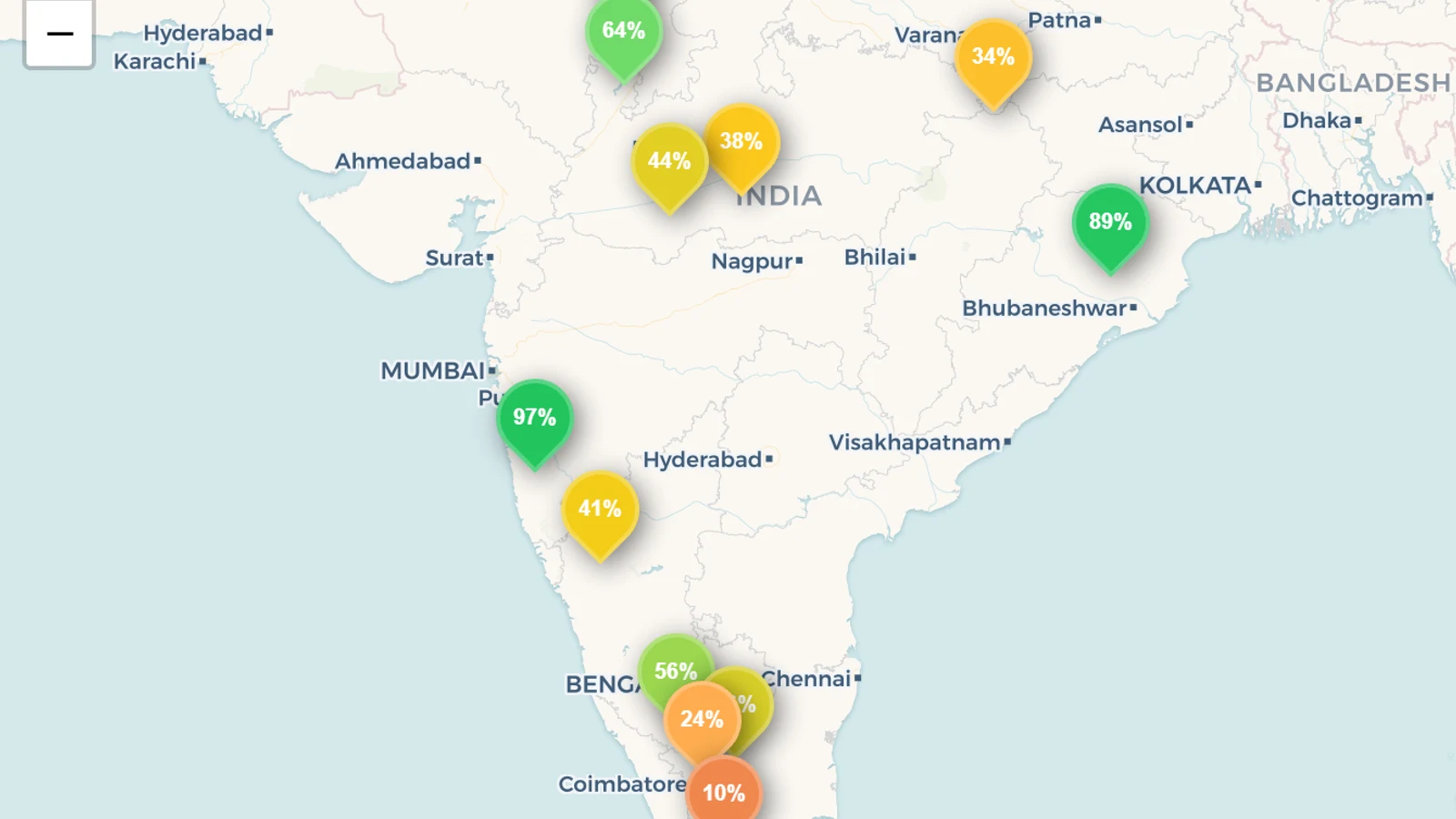
Lower Bhawani (24.1%) is the cleanest case in the country. It started the monsoon at 25.7% on 14 May, bottomed at 18.8% on 2 July, and was 24.1% on 13 August. In 2025 it was at 100% on this date; in 2024, 94%. Its August average is 76%. From mid-August to late September it lost 21 points in 2023, 17 in 2024 and almost nothing in 2025, when it was already full — a mean remaining change of −12.7 points. Add that to 24% and the projection is 11%, against a September normal of 73%. The southwest monsoon did not arrive at this reservoir. In our record, it does not get a second southwest chance.
Vaigai (9.9%) is the same pattern, smaller. August average 53%; last 14 August, 95%. Typical remaining change: −8.0 points. The number that stays is near 10%, unless the northeast monsoon — Vaigai's November average is 74% — does what the southwest did not.
Krishnaraja Sagar (KRS) (56.2%) did fill, from 6.7% on 2 July. It is still 22 points under its 78% August average and 42 points under last 14 August (98.6%). Its remaining window is also negative, about −8.7 points. KRS is the Cauvery dam that supplies Mysuru and, downstream, Mettur. If the next six weeks follow the last three years, 56% is close to the carryover. Kabini, on a different Cauvery tributary, is already at 93.2% — above last year — and also typically falls after mid-August. One catchment caught the window. The other is closing on a short year. That split is in the Karnataka August edition.
Mettur (45.2%) sits just across the Tamil Nadu border and depends on those Karnataka releases. On 25 June it was 44.1%. On 13 August it was 45.2%. The southwest monsoon, for Mettur, was a one-point season, against a 72% August normal. We flagged this risk in the June Mettur piece, when the dam was already near its April-low climatology. The recovery the June calendar implied did not happen.
Tamil Nadu has a second window. The northeast monsoon, October to December, is when several of these dams historically make a late peak — Lower Bhawani's December average is 87%, Mettur's is 73%, Vaigai's November average is 74%. That is a real second chance, and it is not in the remaining-window arithmetic above, which stops at late September. It is also not a promise: it is a different monsoon, on a different catchment. For Rajasthan, Madhya Pradesh and Uttar Pradesh there is no such second monsoon. When the southwest season ends there, the number stays until June.
The arithmetic that cannot close
Most of India's large reservoirs do still fill through September. The question is whether the remaining typical gain is larger than the hole.
| Dam |
State |
13 Aug |
Aug avg |
Typical remaining |
Projected |
Sep/Oct normal |
| Lower Bhawani |
Tamil Nadu |
24.1% |
76% |
−12.7 |
11% |
73% |
| Vaigai |
Tamil Nadu |
9.9% |
53% |
−8.0 |
2% |
60% |
| Parambikulam |
Kerala |
43.7% |
80% |
−1.8 |
42% |
98% |
| Tawa |
Madhya Pradesh |
37.8% |
83% |
+9.0 |
47% |
100% |
| Malaprabha |
Karnataka |
41.2% |
73% |
+2.9 |
44% |
83% |
| Krishnaraja Sagar (KRS) |
Karnataka |
56.2% |
78% |
−8.7 |
48% |
79% |
| Rihand |
Uttar Pradesh |
33.9% |
59% |
+5.1 |
39% |
76% |
| Indira Sagar |
Madhya Pradesh |
44.1% |
74% |
+13.0 |
57% |
94% |
| Rana Pratap Sagar |
Rajasthan |
40.8% |
71% |
+20.4 |
61% |
97% |
| Pong |
Himachal Pradesh |
53.6% |
73% |
+16.6 |
70% |
97% |
"Typical remaining" is the mean change from mid-August to late September in 2023–25. "Projected" is 13 August 2026 plus that mean. "Sep/Oct normal" is the higher of the two monthly averages on each dam's chart.
Indira Sagar is the one that moves the national total. At 12,221 hm³ it is the largest reservoir in India. It has climbed from 14.5% on 2 July to 44.1% on 13 August — a real monsoon, and a late one. In 2024 and 2025 it went from about 80% in mid-August to 94–95% by late September. This year it would need to add 50 points in six weeks to match that October climatology. It typically adds 13. The Madhya Pradesh August edition called this filling-but-behind. The remaining-window test says behind is now structural.
Tawa is the same basin, sharper. 5.1% on 2 July, 37.8% on 13 August, September/October normal 100%, typical remaining +9. The late surge we noted in the movers piece — 13.8 points in one August week — is visible. It is not a 62-point surge. Tawa irrigates a large Narmada-valley command. 47% as a projected September figure is the dry-season starting point, not a mid-monsoon checkpoint.
Rihand in Uttar Pradesh, 10,600 hm³, is 33.9% against a 76% September normal, typical remaining +5. Malaprabha gained 37 points from 2 July and still projects to 44% against an 83% September/October normal. Rana Pratap Sagar still has a generous remaining window (+20) and still finishes about 36 points short. Rajasthan's southwest season is August and September; even giving these dams their typical late fill does not rebuild 2025.
Parambikulam in Kerala is 43.7% against a 98% October normal, and its remaining window is slightly negative. Last 14 August it was at 99%. The southwest season over the Anamalais has, in our record, already done what it is going to do.
Who can still use the weeks that are left
The same test flags dams that look mediocre on 13 August and are not, because their history puts the fill in September.
Gandhi Sagar on the Chambal is 63.6% — almost exactly its 63% August average, and ahead of last 14 August (51.6%). In 2025 it then went to 94.6% by 25 September; in 2024, to 93%. Typical remaining: +32.7 points. Gandhi Sagar has not missed the window. Its window, in our three years, is September. Tawa and Indira Sagar sit in the same state and have already failed that test. One monsoon, two calendars.
Sardar Sarovar is 77.2% against a 99% October normal, typical remaining +29. The projection overshoots. Gujarat's largest dam is still in the season.
Bisalpur, which supplies Jaipur, is the edge case. It has spent the monsoon nearly flat: 74.6% on 14 May, 69.9% on 13 August, against 100% on this date last year. Typical remaining is +13.3, which would take it to about 83% against a 91% October normal — still short, but no longer a locked miss. In 2024 it sat at 56% in mid-August and was full by 26 September. The remaining Rajasthan rain is the whole question for Jaipur's carryover. Bisalpur has not missed the window in the way Lower Bhawani has. It has used almost none of it yet.
Pong and Bhakra in Himachal Pradesh still add water through September (about +17 and +9). Both remain more than 20 points short of their September climatology on a typical remaining gain. The Himalayan storages are not out of calendar. They are out of arithmetic, unless this September is wetter than the last three.
Who already has the number that stays
The inverse list is the Western Ghats and the Krishna, and it is as decisive as the misses. These dams have filled. Their remaining window is small, zero, or a spill. The post-monsoon number is already on the page.
- Koyna 96.8%, Ujjani 95.0%, Jayakwadi 95.1%, Girna 99.0% — Maharashtra's large storages, the reversal described in the Maharashtra August edition. Koyna's typical remaining change is still +11, from full. The year is banked.
- Almatti 92.4%, Narayanpur 88.3%, Ghataprabha (Hidkal) 91.8% — the Krishna giants that were at 3%, 18% and 6% on 2 July. Almatti's August average is 89%; its September/October climatology is 96%. It is there.
- Rengali 88.5%, from 0.4% on 2 July, with a typical remaining gain of +36. Odisha's large Brahmani dam is the reason the east is not on the miss list. The movers piece ranked it on the way up. The remaining-window test says it will finish the season high.
- Kabini 93.2% against a 90% August average — the Cauvery dam that caught the monsoon its neighbours missed.
Maharashtra is the state-scale version of this. Of the 32 Maharashtra reservoirs with a September/October climatology, only about 13% of tracked capacity sits 15 or more points below that mark. In Madhya Pradesh, Uttar Pradesh, Rajasthan and Tamil Nadu the share is 97–99%. Himachal Pradesh is 100% of the three large storages we track. The monsoon did not fail over India. It failed to turn into carryover in the centre, the north-west and the Tamil Cauvery, and it succeeded on the Ghats.
What to watch before the rains leave
The southwest monsoon has not withdrawn yet. A wetter-than-history September can still move Gandhi Sagar, Sardar Sarovar, Bisalpur and the Himachal pair. It cannot, on any remaining-window we have, take Lower Bhawani from 24% to 73%, or Indira Sagar from 44% to 94%. Those would need the late season to do something our 2023–25 record has not seen.
Three numbers will tell you whether this bulletin was the peak or a pause. Does KRS keep rising, against a history that says it should now fall? Does Bisalpur take any of the 13 points it usually takes in September, or does Jaipur's supply reservoir stay flat into withdrawal? Does Gandhi Sagar make its habitual September climb, which would split Madhya Pradesh into a Chambal that caught the year and a Narmada that did not?
The honest summary: the Ghats have the number that will stay; the Narmada, the Tamil Cauvery and most of Rajasthan do not; and for a list of southern dams the remaining southwest window is already behind them.
This piece sits next to the monsoon biggest-movers roundup, which ranked the May–August move, and the India August edition, which gave the national level. The live map and dam-by-dam figures are on the India reservoir levels page.