
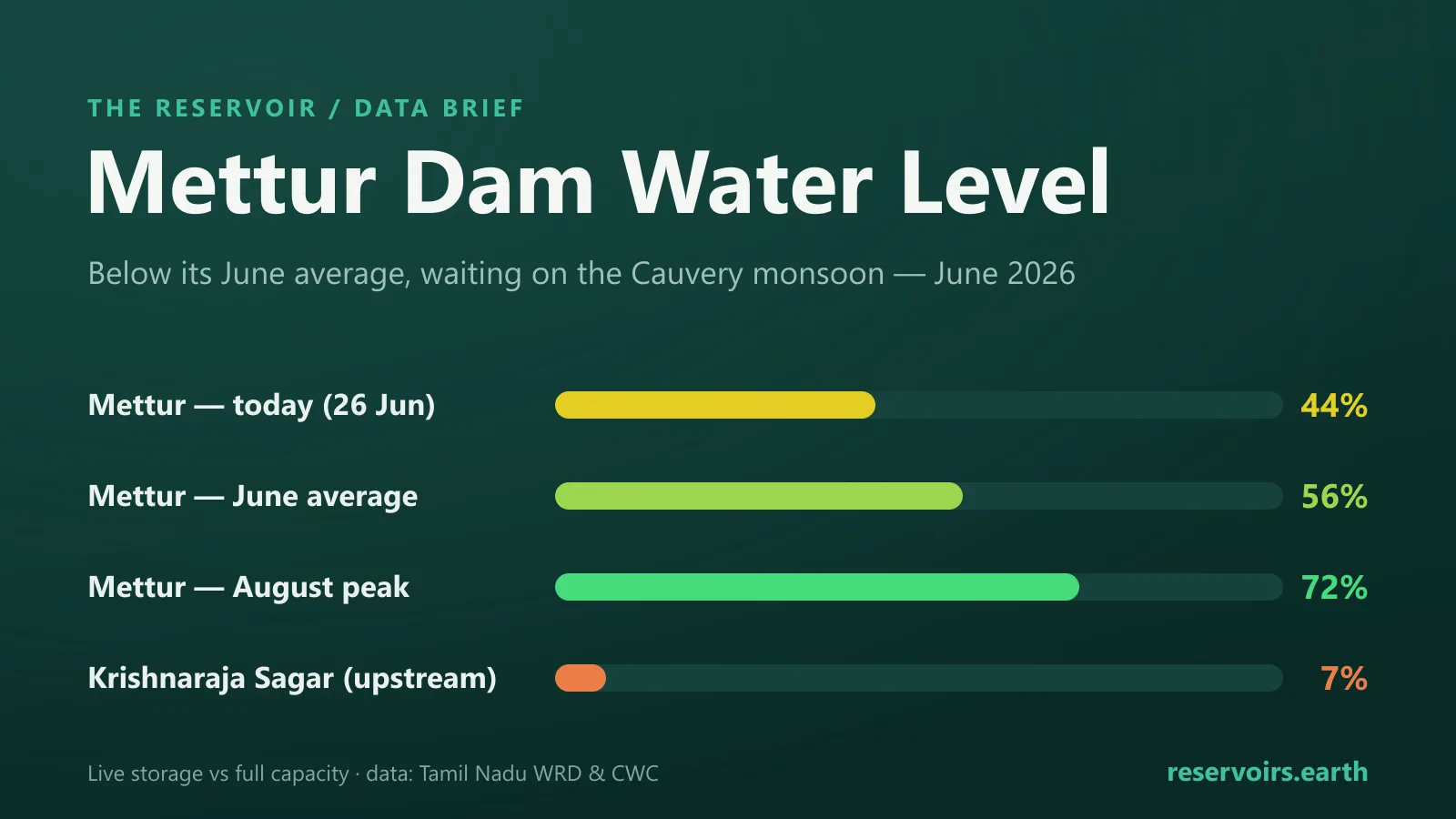
Mettur Dam, which impounds the Stanley Reservoir on the Cauvery in Tamil Nadu, is about 43.9% full as of 26 June 2026, holding 1,163 MCM of its 2,647 MCM total capacity (data: Tamil Nadu WRD via the state portal). That reading is roughly 12 percentage points below the dam's typical June fill of 56%, which means Mettur is currently running near the level it normally hits at its annual April low rather than at a normal June level. The one-line reason: the reservoir is sitting at or near its pre-monsoon floor, and its refill from here depends on the southwest monsoon over the upstream Cauvery catchment in Karnataka and on the timing and quantum of Karnataka's upstream releases — not on local Tamil Nadu rain, which arrives later. You can track the live figure on the Mettur (Stanley Reservoir) page.
Key takeaways
- Mettur Dam is about 43.9% full (1,163 MCM of 2,647 MCM) on 26 June 2026, below the typical June norm of 56%. See the live Mettur page for the latest reading.
- 44% in June is roughly the dam's usual April-low level, so Mettur is running below normal for the date but still within its seasonal pre-monsoon range, not at an unprecedented low.
- Mettur's refill depends on Karnataka, not Tamil Nadu. The upstream feeders are near-empty as of 25 June: Krishnaraja Sagar (KRS) is around 7% and Tungabhadra around 4%.
- Historically Mettur climbs from ~56% in June toward a ~72% peak by August as the southwest monsoon fills the upstream catchment — but it is starting this season below normal, so the speed of recovery is the signal to watch.
- The customary 12 June opening for the delta's kuruvai crop is a long-standing tradition, contingent on adequate storage and upstream releases — not a guarantee in any given year.
- India's national storage sits near its pre-monsoon seasonal floor in late June 2026 (around 27% of usable capacity); see the India national overview and Tamil Nadu state page.
Mettur's water level right now
Mettur Dam holds 1,163 MCM as of 26 June 2026, which is 43.9% of its 2,647 MCM total capacity (useful capacity is 2,585 MCM). That is the number to anchor on, and it comes from the Tamil Nadu Water Resources Department's state portal.
Against the dam's own seasonal pattern, 44% in June reads as below normal. Mettur's historical-average fill by month runs roughly 67% in January, dipping to a low of 44% in April, recovering to 56% in June, 59% in July, and peaking near 72% in August before a second late-year high around 73% in December.
So the current 43.9% is about 12 points under the typical June fill of 56%, and it is close to the level Mettur normally reaches at its April trough. The reservoir is roughly two months "behind" its usual seasonal calendar.
That is below normal, but it is not catastrophic on its own. Mettur is a reservoir that draws down hard before the monsoon and refills through it. Sitting near the pre-monsoon floor in June is the expected shape; the question is how quickly the curve turns upward. You can watch that turn on the live Mettur page.
Why Mettur depends on Karnataka, not just Tamil Nadu
Mettur Dam sits just downstream of the Karnataka–Tamil Nadu border, where the Cauvery enters the plains in Salem district. Its inflows are governed largely by what happens upstream, in Karnataka, rather than by rain falling on Tamil Nadu.
The Cauvery rises at Talakaveri in the Western Ghats of Kodagu (Coorg) district, Karnataka, and most of the river's annual flow is generated by the southwest monsoon (June–September) battering the Ghats. Before reaching Mettur, the river is regulated by a chain of Karnataka dams: Harangi and Krishnaraja Sagar on the main stem, plus Kabini and Hemavathi on tributaries. Because of these upstream dams, Mettur receives little water during lean seasons and can run very low pre-monsoon.
Right now, those upstream feeders are themselves near-empty. As of 25 June 2026, Krishnaraja Sagar (KRS) is around 7% full and Tungabhadra around 4%. When the Karnataka reservoirs are this low, there is little surplus to send downstream until the southwest monsoon refills them first.
Releases from Karnataka to Tamil Nadu are regulated by the Cauvery Water Management Authority (CWMA), measured at the Biligundlu inter-state gauge, and shaped by the Supreme Court's 2018 Cauvery allocation, which fixes annual water-sharing shares for each state. The structural tension is one of timing: Tamil Nadu's delta needs water in June for its early crop, while Karnataka's monsoon inflows are only just beginning to build in June.
For the wider picture, Tamil Nadu is actually the fullest major Indian state overall, because it leans on the northeast monsoon (October–December) rather than the southwest. See the India national page and the Tamil Nadu state page for that context.
The June 12 opening and the delta's kuruvai crop
By long-standing custom, the Tamil Nadu government ceremonially opens Mettur Dam around 12 June each year to begin releasing water down the Cauvery for the kuruvai (short-duration) paddy crop in the delta — the heart of the state's "rice bowl," spanning several delta districts.
The kuruvai season conventionally runs from roughly mid-June to mid-September, and the crop depends on early-season water arriving before the northeast monsoon shows up in October. That is why the June timing matters so much to delta farmers.
But 12 June is a traditional date, not a guaranteed one. The opening is contingent on adequate reservoir storage and on upstream releases, and in low-water years the release has historically been delayed — in some past years it slipped well into July, or the customary date was missed entirely when storage was inadequate.
The durable pattern: the 12 June opening is a custom calibrated to a normal water year, and it can slip when Mettur and its upstream feeders run low. We are not asserting any specific opening decision for this particular season — only the structural rule that the date depends on water being there to release.
What's expected next
The honest outlook is seasonal, not predictive. We do not have, and will not invent, a 2026 monsoon forecast or a specific release schedule. What we can say is grounded in the dam's historical shape and its structural dependencies.
In a typical year, Mettur climbs from around 56% in June toward 59% in July and a peak near 72% in August, as the southwest monsoon fills the upstream Karnataka catchment and releases flow downstream. The Indian southwest monsoon normally onsets over Kerala around 1 June and covers the country by mid-July, so the bulk of the upper-Cauvery filling happens across July–September.
The caveat this season is the starting point. Mettur is beginning the monsoon period below its June norm (43.9% vs 56%), and its upstream feeders KRS and Tungabhadra are near-empty. A reservoir at its pre-monsoon low climbs through the monsoon, but the recovery is not instantaneous — its speed depends on monsoon strength over the Western Ghats and on how much Karnataka releases once its own dams refill.
So the signal to watch is the July–August trajectory, not the June snapshot. If Mettur tracks back toward its 56%–72% seasonal band over those months, it is recovering on schedule; if it lags, the below-normal start is carrying through. Tamil Nadu then gets a second filling opportunity from the northeast monsoon (October–December), its chief rainy season, which historically helps push the reservoir to its late-year high near 73% in December.
Watch the curve, not a single day, on the live Mettur page.
How to read the number / where the data comes from
The 43.9% figure is a percentage of total capacity — current volume (1,163 MCM) divided by total capacity (2,647 MCM, about 93.4 TMC). It is a reading for 26 June 2026, sourced from the Tamil Nadu Water Resources Department via the state water-resources portal.
A few notes on interpreting it:
- A single date is a snapshot, not a trend. In June, that snapshot lands near the pre-monsoon floor; the more informative number is whether the next few weeks rise or stall.
- "Below normal" here means below the seasonal average for the date, not below the dam's all-time range. 44% in June is unusual for June but ordinary for April on Mettur's own calendar.
- Capacity figures are gross. Useful (live) capacity is 2,585 MCM; a small dead-storage portion is never available for release.
We report the same number the operator publishes, framed against Mettur's twelve-month average shape so the reading has context rather than sitting bare.
For the basin-wide picture across India this month, see our sibling edition: India reservoir levels, June 2026.