As of 25 June 2026, India's monitored reservoirs are holding only about 27% of their usable capacity — and that is not, by itself, alarming. June is when Indian reservoirs sit at their annual low, drawn down through the long dry season and waiting on the southwest monsoon that refills them from June to September. About 110 of the roughly 300 reservoirs we track are below 20% full right now. The driest states are Karnataka, Odisha and Telangana, and the lowest big reservoirs are on the Krishna and Cauvery in the south — Tungabhadra and Krishnaraja Sagar. The live national figure and the state map are on the India reservoir levels page. This is the June edition of a monthly check-in; the story over the next two months is whether the monsoon refills on schedule.
Key takeaways
- India's reservoirs are at 27% of usable capacity (25 June 2026) — the seasonal floor, not a verdict. The southwest monsoon normally refills them from June to September, so June is the annual low by design. The live figure is on the India page.
- About 110 of the 300 tracked reservoirs are below 20% full — the critical band — which is typical for this point in the year across the Deccan and the north.
- The driest states are Karnataka (10%), Odisha (14%) and Telangana (15%), followed by Uttar Pradesh and Himachal Pradesh.
- No major state is full ahead of the monsoon. The relatively better-off are the centre and west — Gandhi Sagar on the Chambal (61%) and Sardar Sarovar on the Narmada (43%) — while the southern Deccan, led by Karnataka, is the driest.
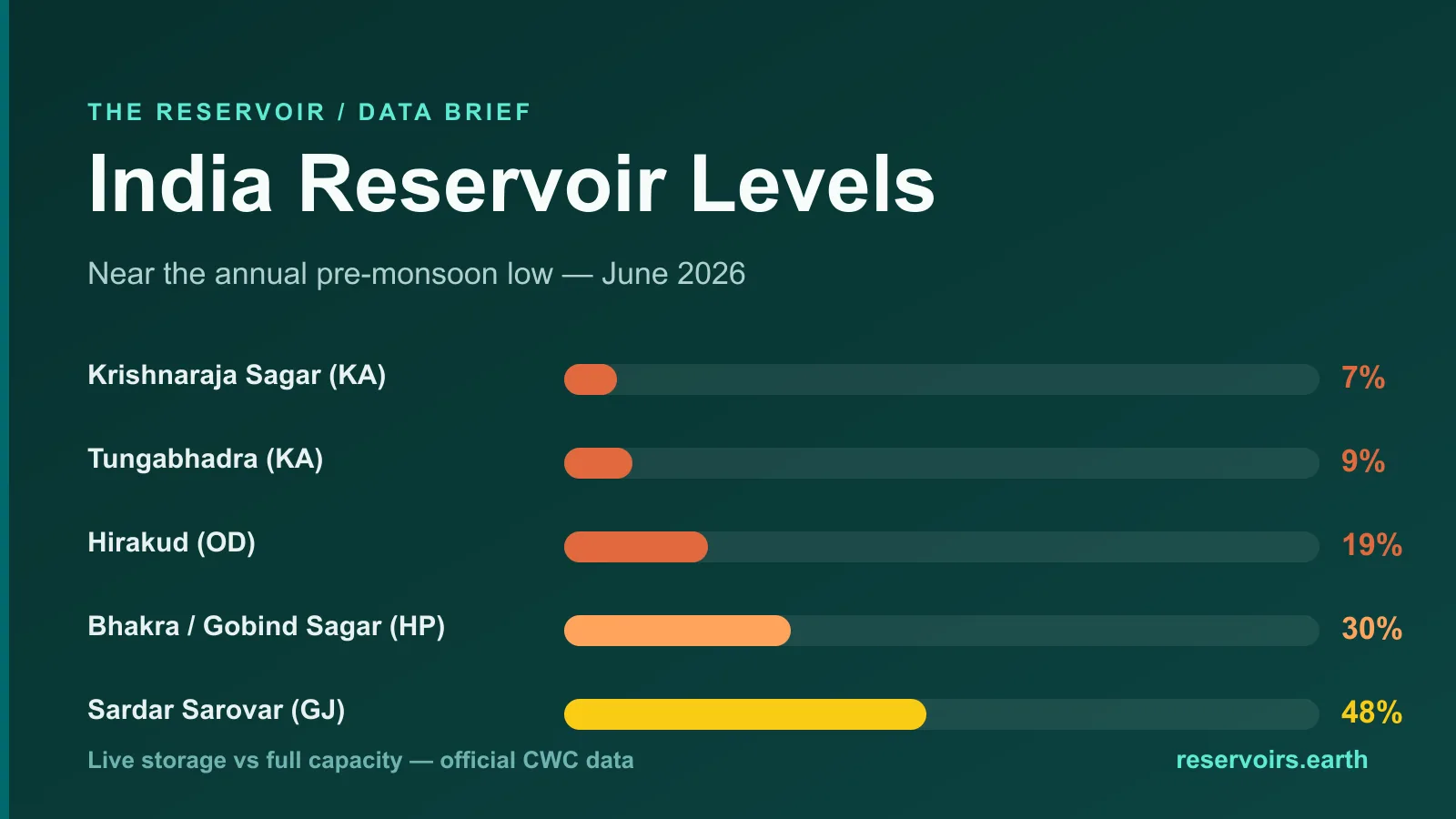
- The big southern reservoirs are lowest: Tungabhadra (4%), Malaprabha (5%) and Krishnaraja Sagar (7%) on the Cauvery–Krishna systems. The country's largest, Indira Sagar on the Narmada, is around 15%.
Where India's reservoir data comes from
India's authoritative source is the Central Water Commission (CWC), which publishes a weekly Reservoir Storage Bulletin tracking the country's major reservoirs against their full reservoir level (FRL) and against the last ten years' average. reservoirs.earth mirrors that bulletin and overlays several live state portals — Andhra Pradesh, Telangana, Kerala, Tamil Nadu, Bihar — so the most-watched reservoirs refresh more often than weekly. The latest reading in this snapshot is 25 June 2026. India scores reasonably well for openness on the Reservoir Transparency Index precisely because the CWC bulletin is public and regular; each reservoir keeps its own page with the latest reading and multi-year history on the India page.
The national picture
The reservoirs we track hold a combined usable capacity of roughly 196 km³ (196 billion m³). As of 25 June 2026 they were storing about 54 km³ — close to 27% of usable capacity, as a capacity-weighted average across the reservoirs with a live reading. That number is low because of when it is, not (mostly) because of drought: India's storage is drawn down every year through the pre-monsoon summer and refilled by the rains.
The split across the country is stark, and it tracks the monsoon calendar:
Why June is the low point — and why we'll track it monthly
India's water year runs on one event: the southwest monsoon. It reaches Kerala around the start of June, then advances north and west to cover the whole country by mid-July, and withdraws in September. Roughly three-quarters of India's annual rainfall — and almost all of its reservoir refill — comes from June to September. So a reservoir at 10% in June is usually a reservoir that did its job over the dry season and is now waiting to be topped up, not one in permanent trouble.
That is exactly why a single June reading says little on its own, and why this is a monthly series. The number that matters is the trajectory: how fast storage climbs from this floor as the monsoon advances through July and August, and whether any region is left behind by a weak or delayed monsoon. The multi-year chart on each reservoir's page (and the national page) is built for that comparison.
The driest states
Ranked by capacity-weighted fill (states with several sizeable reservoirs), as of 25 June 2026:
Tamil Nadu (41%) is among the better-off, but no major state is full this far ahead of the rains. Tamil Nadu depends on the northeast monsoon (October–December), so its cycle is out of step with the rest of the country — but it, too, enters the summer drawn down.
The reservoirs running lowest
The large reservoirs (capacity above 1 km³) holding the least relative to capacity, as of 25 June 2026. Each links to its live page with the latest reading and history:
- Tungabhadra — Karnataka/Andhra Pradesh. 4%. The lowest large reservoir in the country relative to capacity.
- Malaprabha — Karnataka. 5%.
- Krishnaraja Sagar (KRS) — Cauvery, Karnataka. 7%. The reservoir at the centre of the Karnataka–Tamil Nadu Cauvery dispute, and a key supply for Bengaluru and Mysuru.
- Linganamakki — Sharavathi, Karnataka. 10% — a major hydropower reservoir.
- Koyna — Maharashtra. 9% — one of the state's most important hydro reservoirs.
- Hirakud — Mahanadi, Odisha. 15% — one of the longest dams in the world.
- Indira Sagar — Narmada, Madhya Pradesh. 15% — India's largest reservoir by capacity.
These are seasonal lows: most of these reservoirs refill substantially once the monsoon's westerly branch reaches the Western Ghats and the Deccan. The risk is concentrated where the monsoon arrives late or weak — which is the thing to watch in the July and August editions.
What "% full" means here
A reservoir's level is reported as a percentage of its full reservoir level (FRL) — the volume it holds when filled to its design level. So 4% full means it is holding 4% of its design storage. Two cautions specific to India:
- The June number is the seasonal floor, not a steady state. Compare it to the same month in previous years (on each reservoir's chart), not to a winter or post-monsoon figure.
- Coverage is partial by design. The CWC bulletin and state portals track the major reservoirs — the ones that carry the national picture — not every minor tank and check dam. The national figure is a capacity-weighted average of the reservoirs with a live reading.
Why India's reservoir levels matter
India is the world's most populous country and one of its largest irrigated-agriculture economies, and its reservoirs do three jobs at once: irrigate the post-monsoon (rabi) crop, supply cities and industry, and generate hydropower. The pre-monsoon low is when those demands compete hardest — which is why the Cauvery and Krishna reservoirs become political (the Krishnaraja Sagar–Tamil Nadu water-sharing dispute flares almost every dry season) and why a delayed monsoon is a national-economy story, not just a weather one. Tracking the refill, reservoir by reservoir, is the clearest early read on how the year will go.
This is the June 2026 edition. We track the major water economies month by month — see the United States edition, and follow the monsoon refill on the India reservoir levels page and the Reservoir Transparency Index.