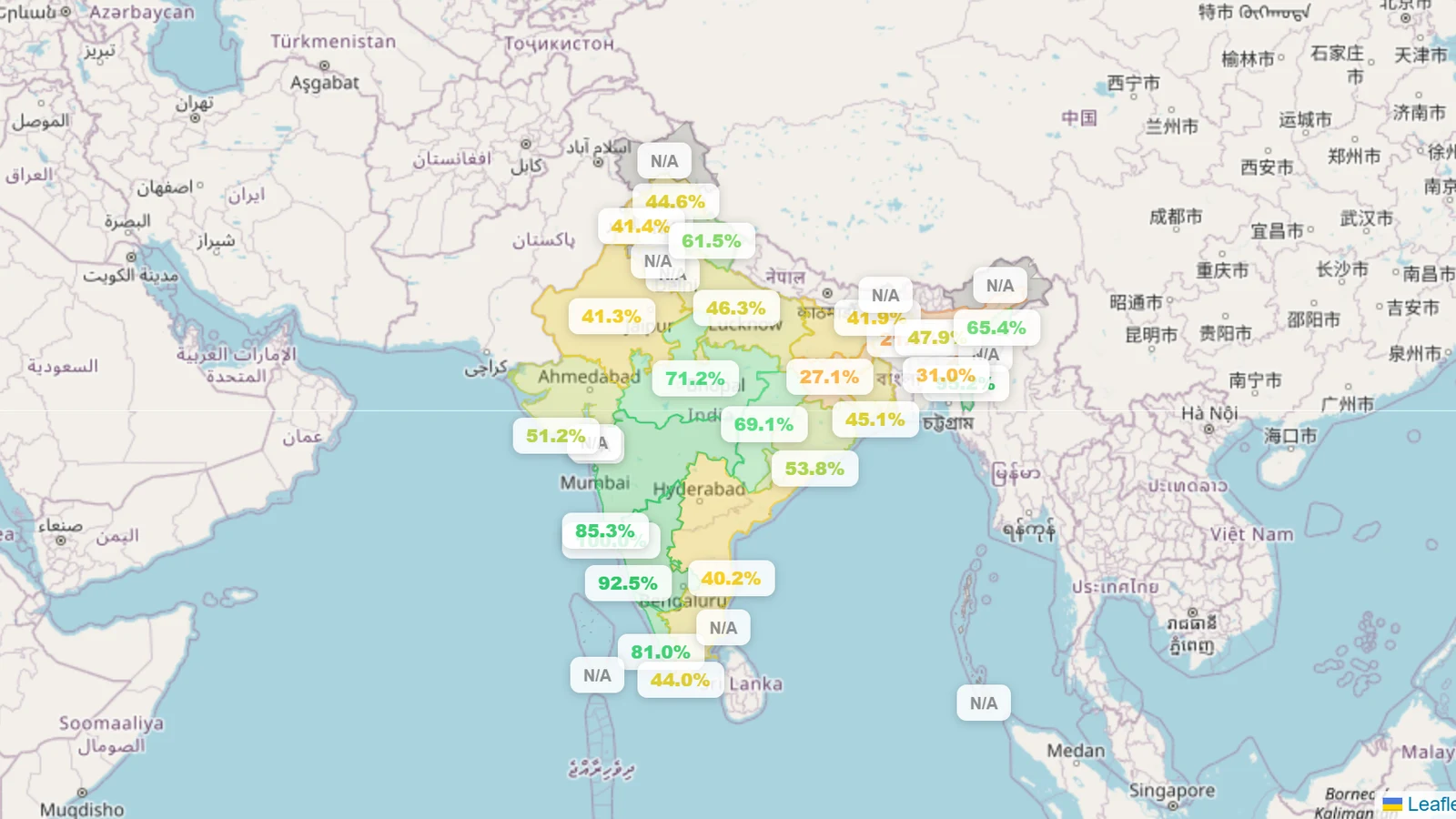
India's monitored reservoirs held 61% of capacity on 3–4 September 2026 — about 144 km³ of water across 307 reservoirs — on Central Water Commission and state-portal readings. Storage has gone from 22% in early July to 61% now. Against the same dams a year ago the country is still 10 points short. The hole that remains is no longer central India. It is the Cauvery, a few Narmada and Rajasthan dams, and Bhakra. Live figures are on the India page.
Key takeaways
- India is 61.0% full as of early September 2026 — 144 km³ stored against 236 km³ of monitored capacity, across 307 of 317 reservoirs with a current reading.
- The refill since July is 37 points on a fixed CWC basket. The same 140 reservoirs went from 22.4% on 2 July to 43.6% on 6 August to 59.5% on 3 September. This week added 2.8 points: 73 dams rose, 39 fell.
- The gap with last year has halved. In early August the same-date comparison was 20 points down. On 3 September it is 59.7% against 69.9% a year earlier, on 133 reservoirs. 85 of those 133 are still below 2025.
- Madhya Pradesh recovered. Indira Sagar is 76% after sitting at 26% a month ago. The state is at 71%, up from 38% in the August edition.
- The Cauvery did not catch up. Krishnaraja Sagara is 54% against 97% last September. Lower Bhawani is 17% against 100%. Karnataka still reads 92% because Almatti and the Krishna dams are full.
From the floor to 60% in nine weeks
The July piece caught the annual floor. August caught the turn. September is the first reading that looks filled, not mid-recovery.
On a fixed basket of 140 CWC reservoirs (182 km³ of capacity):
| Date |
Fill |
Stored |
| 2 July 2026 |
22.4% |
40 km³ |
| 6 August 2026 |
43.6% |
79 km³ |
| 27 August 2026 |
56.7% |
103 km³ |
| 3 September 2026 |
59.5% |
108 km³ |
The last week was slower than July. Koyna has sat at 100% since late August, and several Maharashtra and Odisha dams have no room left. New water went east and into the Narmada. Hirakud jumped from 68% to 80% in seven days. Tawa added 12 points, to 69%. Tehri is at 89%.
Ten points behind 2025
A rising number can still be a short year. On 104 reservoirs with a reading near 3 September in each of the last three years:
| Date |
Fill |
Stored |
| 3 September 2024 |
69.2% |
94 km³ |
| 3 September 2025 |
73.7% |
100 km³ |
| 3 September 2026 |
62.5% |
85 km³ |
2025 was an unusually wet monsoon in the south and centre. 2026 has closed on it from below and has not caught it. Against last year, on 133 reservoirs, the gap is −10 points.
Largest year-on-year gaps among dams over 500 hm³:
Indira Sagar was 56 points down in early August. It is now 76% against 91% last September. Omkareshwar, just downstream, dropped 20 points last week to 23% — a release, not a dry catchment. Hirakud is now ahead of 2025. Kopili, Panchet and Maithon are full.
Two Karnatakas
Karnataka is 92% full across 18 reservoirs because the Krishna is full: Almatti at 95%, Tungabhadra at 90%. The Cauvery behind it is another monsoon. KRS, Kabini and Hemavathy all lost ground this week. Tamil Nadu is at 44%, with Mettur at 59% on 4 September.
Maharashtra is the best-supplied large state, at 85%. Gujarat reached 51%, Sardar Sarovar 82%.
Capacity-weighted fill, current readings only:
Madhya Pradesh still holds the most water in absolute terms — about 25 km³ of a possible 35.
Figures are capacity-weighted. 61.0% is every reservoir reporting now; 59.5% is the 140 CWC dams present on both 27 August and 3 September; the year-on-year figure is a third set of 133. Percentages are against full reservoir level as the source reports it.
The southwest monsoon usually leaves the northwest in mid-September and the south later. Tamil Nadu still has the northeast monsoon; Rajasthan and the Narmada do not. The Cauvery gap is the one that will still be there when the rains stop.
Previous editions: August 2026 and July 2026. Openness score: Reservoir Transparency Index. Method: how we get our data: India.