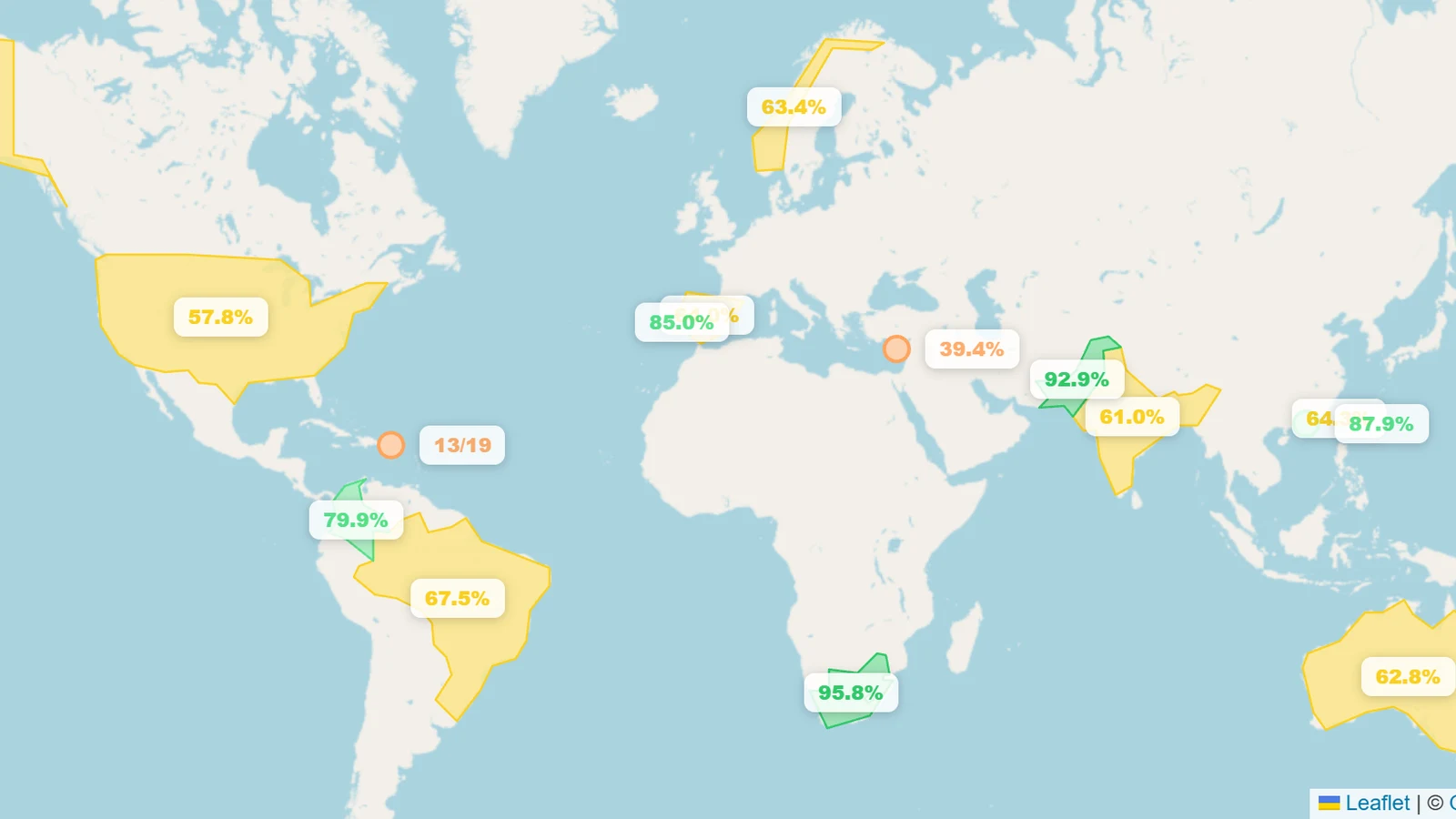
The 1,913 reservoirs we track with a current volume reading held 52.2% of capacity in early September 2026 — about 1,358 km³ of combined storage across 15 countries. That number is a network average, not a climate. South Africa is 95.8% full. Lake Powell is 20.5%. Country totals update on the home page.
Key takeaways
- The network is 52.2% full as of 4 September 2026: 15 countries, 1,999 reservoirs, 1,913 reporting. The percentage weights stored water by capacity and excludes energy-only systems (Norway, New Zealand, Colombia) and Puerto Rico, which publishes elevation, not volume.
- September is opposite seasons at once. India is closing the southwest monsoon at 61.0%. Spain is 64% at the end of the Iberian summer. The Cape is finishing winter: South Africa 95.8%, the Western Cape 79.8%.
- The emptiest large system is still the Colorado. Powell is 20.5% and Lake Mead 24.4% on 2 September. Elephant Butte on the Rio Grande is 1.3%. The United States as a whole is 57.8%.
- The full side of the map is the winter and the monsoon that arrived. South Africa 95.8%. Pakistan 92.9%, with Tarbela at 100%. Hong Kong 87.9%. Portugal 85%.
- A national figure hides the split. Norway is 63.4%, but NO2 is 45.9% and NO4 is 90.7%. Australia is 62.8%, but Tasmania is 37.8% and Western Australia is 92.4%. India is 61% and still 10 points behind last September.
What 52% actually is
1,358 km³ is the sum of every tracked reservoir that reports water, not energy. India, the United States, Brazil, Australia and Spain dominate that total. A year that is wet in Maharashtra and dry on the Colorado still averages to the middle. The 52.2% on the home page is that middle. It is useful as a snapshot of the network. It is a poor description of any one basin.
181 reservoirs in the set sit in the critical band. Some of those are flood-control lakes that are supposed to be empty in September. The figure that matters is the large, managed system that is low for the season and has no refill left.
The monsoon that did not catch last year
India went from 22% in early July to 61.0% on 3–4 September — 144 km³ stored against 236 km³ of monitored capacity, on 307 of 317 reservoirs. The recovery is real. Against the same dams a year ago it is still 10 points short. Indira Sagar refilled to 76%. Krishnaraja Sagara is 54% against 97% last September. Bhakra is 61% against 90%. The September India edition has the state table.
Across the border, the three Indus dams we track are a different monsoon. Pakistan is 92.9% on 2 September. Tarbela is full. Mangla is 79%. That is a three-reservoir sample, not a national census.
The Colorado has not moved
The United States is 57.8% full across 504 reservoirs as of 4 September. That average is the Midwest and the South. The Southwest is not in it.
On 2 September, Lake Powell was 20.5% — 7 points below the same date in 2025. Lake Mead was 24.4%, 4 points down on the year. New Mexico is 22%, Utah 29%, Nevada 27%. Blue Mesa is 23%, 38 points below last September. This is the same structural shortfall as in July, not a late-summer surprise. The cutbacks are in Colorado River water cuts, 2026.
Winter's last week at the Cape
South Africa was 95.8% full on 31 August, the last weekly bulletin of the southern winter. The national number is the summer-rainfall interior. The Western Cape, which runs on Atlantic fronts, is 79.8%. Theewaterskloof is 76%. Voëlvlei is 60%. Those two are the metro's main storages, and they are already turning down as the fronts thin.
Two Norways, two Australias
Norway publishes storage by price area, in energy. The national fill on 30 August was 63.4%. South-West (NO2) — the hydro that actually sets the Nordic price — was 45.9%. Northern Norway (NO4) was 90.7%. A single Norwegian average is the wrong unit.
Australia is 62.8% across 281 storages. Western Australia is 92.4%. Tasmania, a hydropower island, is 37.8%. That is how the island is run, not a municipal shortage. New Zealand is the same kind of number in the other direction: 3,269 GWh on 31 August, 138% of the long-run average.
Iberia after the summer
Spain is 64% full on 374 reservoirs with a year-ago reading — about 5 points ahead of early September 2025. Portugal is 85%. Cyprus is 39.4%, which is where a small Mediterranean system sits at the end of the dry season. Taiwan is 64% nationally; Zengwen is 100.6% heading into typhoon season. Brazil is 67.5%, Itaipu 90%. Colombia is 79.9% of energy storage; El Peñol–Guatapé is 86%.
None of those is a September event. They are the calendar.
The next move that will change the map is not a global one. It is whether India's remaining monsoon closes the Cauvery hole, whether the Cape's last fronts lift Voëlvlei, and whether the Colorado adds anything before the next snowpack. Those are three different years. The 52% is just where they sit on the same week.
Related: India reservoir levels, September 2026; El Niño and world reservoirs; regions closest to Day Zero; Colorado River water cuts. Openness scores: Reservoir Transparency Index.