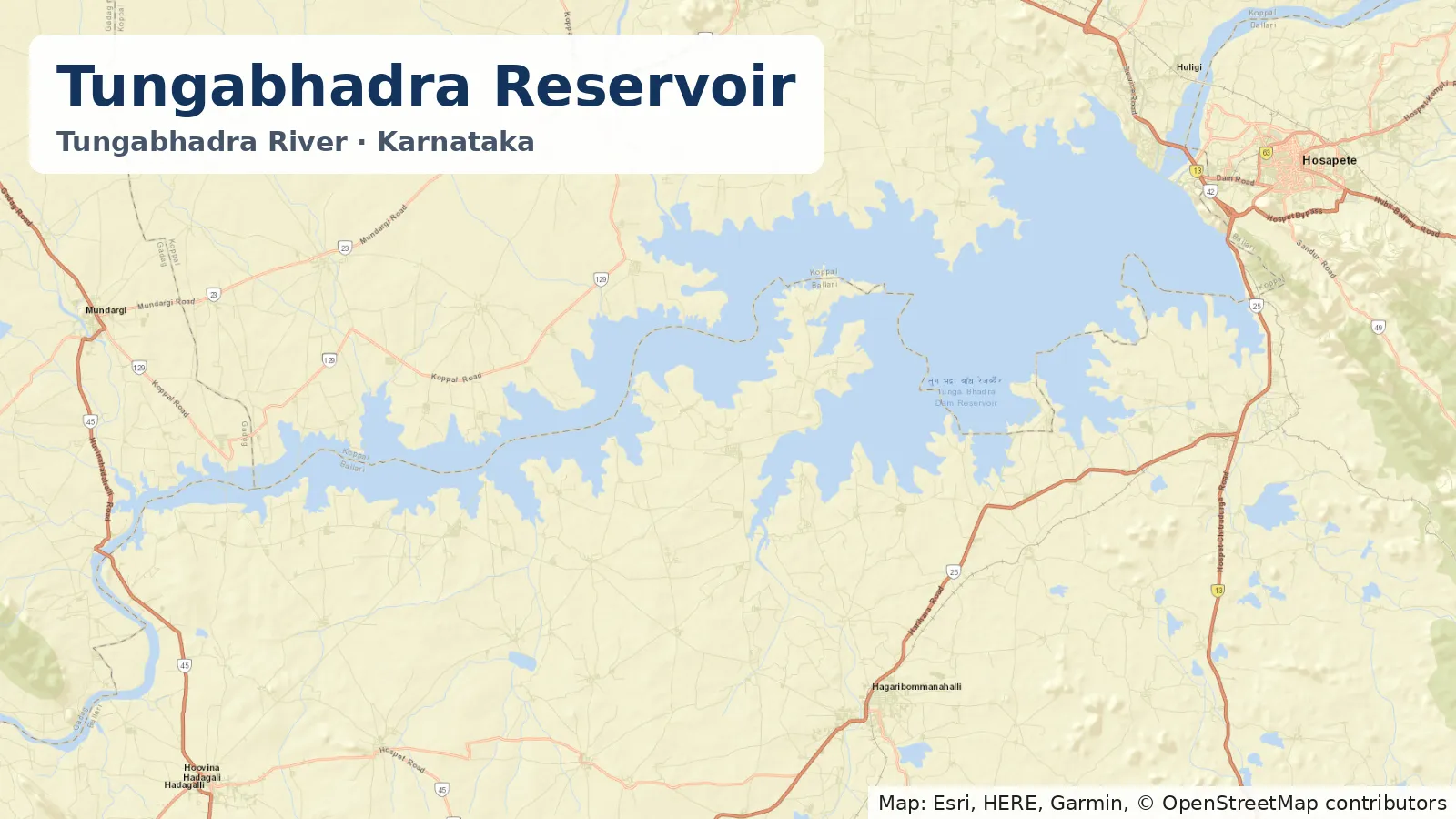
Tungabhadra Dam held 29.168 TMC at 09:10 IST on 16 November 2026, according to Andhra Pradesh's water resources information system (AP-WRIMS). AP-WRIMS published 74.775 TMC for the same point a year earlier, on 17 November 2025. For the latest official reading, see our Tungabhadra Dam water level today page, which is updated from the same AP-WRIMS feed. The reservoir is shared under the Krishna Water Disputes Tribunal (KWDT) award, which the Tungabhadra Board applies through a working table. For 2026, the press reports that the 127th Tungabhadra Irrigation Consultative Committee (ICC) allocated the water among Karnataka, Andhra Pradesh and Telangana on 19 October, and that canal supply in Karnataka was to stop from 15 November.
Quick answer: The Tungabhadra Board shares the reservoir between Karnataka and Andhra Pradesh by the KWDT allocations, canal by canal: 151.49 TMCft for Karnataka and 78.51 TMCft for Andhra Pradesh, 230.00 TMCft in all including evaporation. When storage falls "abnormally below" the working table, the Board's rule is that releases to both States are "proportionately reduced". For 2026, the Times of India reported an ICC allocation of 25.25 TMC to Karnataka, 18.5 TMC to Andhra Pradesh and 1.5 TMC to Telangana. That split has not been found in an official publication.
Data as of: AP-WRIMS daily storage through 16 November 2026, 09:10 IST. Tungabhadra Board pages and press reports as read on 16 November 2026.
Tungabhadra Dam water level today
AP-WRIMS publishes one storage reading a day for the dam, in TMC (thousand million cubic feet), together with the reading for the same period of the previous year. Its last four readings were 31.466 TMC (13 November, 08:30 IST), 30.706 TMC (14 November, 08:14 IST), 29.943 TMC (15 November, 09:50 IST) and 29.168 TMC (16 November, 09:10 IST). AP-WRIMS gives a gross capacity of 105.79 TMC.
Our data page shows the same feed converted to million cubic metres and measured against live capacity, so its percentage is not the same figure as a share of gross capacity. The full daily series is in the table further down.
Who shares the Tungabhadra reservoir
The Tungabhadra Board runs the reservoir. Its Irrigation Wing page states that under the KWDT award the Board "would continue to prepare the working table for utilization of the water of the reservoir and regulate the sharing of water between states of Karnataka and Andhra Pradesh as per the allocations made in the award".
The Irrigation Wing's listed duties include:
- reservoir operation "in accordance with the approved working table", including flood management and dam safety;
- supplying water "as per the indents placed by Government of Karnataka and Government of Andhra Pradesh" for the right bank canals, and river assistance "as per Krishna Water Disputes Tribunal award";
- rendering the water account of the reservoir and all canal systems.
The left bank canals are run differently. The Board says the regulation of the Left Bank Main Canal and the left bank High Level Canal "is entirely with Irrigation Department of Karnataka". The Board collects their drawal data to keep the water account.
The Board's page gives the area localised for irrigation under the project as 4.899 lakh ha (12.1 lakh acres), "as per project record".
The KWDT table on the Board's page names two States, Karnataka and Andhra Pradesh. Telangana appears in the 2026 allocation as reported by the press (see below). The Board's page does not set out a Telangana share.
The KWDT allocation, canal by canal
| Canal system | Karnataka | Andhra Pradesh | Total |
|---|---|---|---|
| Right Bank Low Level Canal (RB LLC) | 19.00 | 24.00 | 43.00 |
| Right Bank High Level Canal (RB HLC) | 17.50 | 32.50 | 50.00 |
| Left Bank Low Level Main Canal + Left Bank High Level Canal (LBMC + LBHLC) | 93.00 | Not allocated | 93.00 |
| Raya and Basavanna Channels (RBC) | 7.00 | Not allocated | 7.00 |
| Regulated release to Vijayanagar Channels (VNC) other than RBC | 2.00 | Not allocated | 2.00 |
| Regulated release to KC Canal (KCC) | Not allocated | 10.00 | 10.00 |
| Regulated release to Rajolibanda Diversion Scheme (RDS) | 0.49 | 6.51 | 7.00 |
| Total | 138.99 | 73.01 | 212.00 |
| Reservoir evaporation losses (ratio 12.5 K : 5.5 AP) | 12.50 | 5.50 | 18.00 |
| Grand total | 151.49 | 78.51 | 230.00 |
The figures are copied from the Board's table. "Not allocated" stands for a dash in the original. The Board adds that the High Level Canal water is split between Karnataka and Andhra Pradesh in the ratio 35:65, and that the KWDT allocated 212 TMCft to the project "for irrigation utilization excluding reservoir evaporation losses".
How the working table works, and what happens when storage falls short
The Board describes the process on its Irrigation Wing and Working Table pages:
- A Review Committee at Superintending Engineer level, with the Board's Superintending Engineer and officers of the same level from Andhra Pradesh and Karnataka, assesses water availability at the start of each water year "using the criterion of 75% dependable flows".
- It prepares a Draft Working Table "keeping in view the entitlement of water for each canal system as per KWDT award". The Board approves it.
- The Committee reviews the reservoir periodically. If necessary, the working table is modified, with the Board's approval.
The Board treats the two seasons differently. In Kharif, "a Working Table during Khariff season can at best serve as a guide". In Rabi, "it is necessary that the Working Table shall be strictly followed for the day to day operation of the reservoir".
The shortage rule, in the Board's words:
Whenever the actual reservoir level and storage goes abnormally below the anticipated, as compared to the draft working table, releases to both the States is proportionately reduced so that the anticipated reservoir level is maintained. This is followed scrupulously in Rabi season.
The Board's page describes practice. Its worked example is for the water year 1998-99, and those figures are not used here. The 2026-27 working table is not published on the Board's site. Whether the Board has applied a proportional reduction in 2026 is not stated by any source found.
2026: the 127th Irrigation Consultative Committee decision
The following figures were reported by the press. They have not been found in an official publication.
| Item | As reported | Source |
|---|---|---|
| Available storage assessed by the 127th ICC (19 October 2026) | 53 TMC, "after accounting for dead storage and evaporation losses" | Times of India, 4 Nov 2026 |
| Allocation | Karnataka 25.25 TMC, Andhra Pradesh 18.5 TMC, Telangana 1.5 TMC | Times of India, 4 Nov 2026 |
| Storage as stated by the minister | 53 TMC "including 2 TMC of dead storage and 3.50 TMC lost through evaporation" | IBC World News, 19 Oct 2026 |
| Left Bank Main Canal | 3,800 cusecs to Ganekal Reservoir, 21 Oct to 20 Nov | IBC World News, 19 Oct 2026 |
| Right Bank High Level Canal | 1,000 cusecs 21 to 24 Oct; suspended 25 to 31 Oct; 1,280 cusecs 1 to 20 Nov | IBC World News, 19 Oct 2026 |
| Right Bank Low Level Canal | 650 cusecs, 21 Oct to 20 Nov | IBC World News, 19 Oct 2026 |
| Raya Basavanna Canal | 180 cusecs until 31 May 2027, ten days on and ten days off | IBC World News, 19 Oct 2026 |
| Left Bank Vijayanagara Canal | 60 cusecs until 5 May 2027, subject to availability | IBC World News, 19 Oct 2026 |
IBC World News reported that Minister Shivaraj Tangadagi announced the schedule after chairing the committee meeting, and that water would go to Raichur, Koppal, Ballari and Vijayanagara districts until 20 November. IBC calls the body the "Irrigation Advisory Committee". The Times of India calls it the Irrigation Consultative Committee.
On 4 November the Times of India reported that a delegation led by Tangadagi asked Chief Minister DK Shivakumar for three more TMC for standing crops, to be diverted from Andhra Pradesh's share.
AP-WRIMS published 53.483 TMC for 19 October 2026 at 08:55 IST, the day of the meeting. That is the reservoir's gross storage, not the committee's assessment. The two press reports describe the assessment differently: the Times of India says the split came "after accounting for dead storage and evaporation losses", while IBC World News says the 53 TMC included them.
The canal closure from 15 November and the farmers' protest
All of the following is as reported, with the date of each report.
- 13 November. The Times of India reported that supply through the Tungabhadra left bank canal would be stopped from 15 November, five days before the ICC's 20 November date. SB Malligawad, Superintending Engineer of the Tungabhadra Project Circle, confirmed the closure, "due to the acute shortage". The paper said farmers were growing paddy on 12.60 lakh acres. It quoted storage of 31.47 TMC ft "on Friday", which "includes the allocated shares of Andhra Pradesh and Telangana", against 76.35 TMC ft on 13 November 2025, and called the present storage "the lowest recorded in the past decade". It put the combined discharge through all canals at 8,668 cusecs and said inflow had stopped from 11 September.
- 13 November. The same report said Tangadagi announced that 7 TMC ft of Karnataka's allocated water would be released into the canals until 20 November, and that the government was trying to extend the release to 30 November. Farmer organisations in Koppal, Vijayanagara, Ballari and Raichur districts had planned to lay siege to the dam and block the national highway from 16 November. Deccan Herald reported the same plan on 13 November.
- 14 November. The Kannada daily Lokadarshan reported Tungabhadra Raitha Sangha president Darur Purushottama Gowda saying that water would be released into the canals until 20 November and that farmers need not worry.
- 16 November. Hospet.online reported that the Karnataka State Farmers Association and the Green Army reached Munirabad on the night of 15 November, demanding releases until 15 December, and planned a sit-in at the CADA office on 16 November. It said Tangadagi had asked the Chief Minister to let Karnataka use four TMC feet from Andhra Pradesh's share.
No official decision on an extension to 30 November or 15 December had been found when this page was checked on 16 November 2026. This page does not say what the protests will lead to.
Storage before and after: official figures
| Reading | Storage, 2026 | Same period a year earlier, as published |
|---|---|---|
| 19 Oct 2026, 08:55 | 53.483 | Not shown |
| 22 Oct 2026, 08:24 | 50.344 | Not shown |
| 29 Oct 2026, 08:34 | 43.539 | Not shown |
| 5 Nov 2026, 08:21 | 37.925 | Not shown |
| 10 Nov 2026, 08:37 | 33.833 | Not shown |
| 12 Nov 2026, 08:29 | 32.231 | 76.740 (12 Nov 2025) |
| 13 Nov 2026, 08:30 | 31.466 | 76.352 (13 Nov 2025) |
| 14 Nov 2026, 08:14 | 30.706 | 75.966 (14 Nov 2025) |
| 15 Nov 2026, 09:50 | 29.943 | 75.612 (15 Nov 2025) |
| 16 Nov 2026, 09:10 | 29.168 | 74.775 (17 Nov 2025) |
Each value is the storage figure AP-WRIMS returns for that reading, re-checked on 16 November 2026. AP-WRIMS pairs each reading with one from the same period in 2025 and dates it. For 16 November 2026 the paired reading is dated 17 November 2025. Year-earlier values are given for the five most recent readings only. There is no calculated change column and no projection.
The Times of India's figures for 13 November (31.47 and 76.35 TMC ft) are the same as the AP-WRIMS readings for that day and for 13 November 2025, rounded to two decimals. The Times of India gives the gross capacity as 105.788 TMC ft, citing the Superintending Engineer. AP-WRIMS gives 105.79 TMC.
What is not stated
- The 2026-27 working table and any 2026 decision by the Tungabhadra Board to reduce releases proportionately: not stated on the Board's site.
- The 53 TMC assessment and the 25.25 / 18.5 / 1.5 TMC split: not found in a Board, Karnataka or Central Water Commission publication. Karnataka's KSNDMC site did not respond and the CWC page returned an error when checked on 16 November 2026.
- Whether canal supply actually stopped on 15 November, and whether the release has been extended: not stated in an official source found on 16 November 2026.
- How Telangana's 1.5 TMC relates to the KWDT table: not stated by the sources.
Other water-sharing rules
The Krishna water sharing at Srisailam article covers the downstream Krishna River Management Board and the dispute between Telangana and Andhra Pradesh. That is a different body and a different rule. The Rio Grande Compact's Elephant Butte storage rule is another legal rule set beside official storage. State thresholds across India are in India water restriction thresholds, and the monsoon shortfall is in post-monsoon India: who missed the window.
Sources and methodology
Sources checked on 16 November 2026, between 09:20 and 10:00 Europe/Madrid:
- Tungabhadra Board, Irrigation Wing (KWDT allocation table, Board role, water regulation, Review Committee).
- Tungabhadra Board, Working Table of Tungabhadra Reservoir (Kharif and Rabi practice, proportional reduction rule).
- AP-WRIMS, apwrims.ap.gov.in, daily reservoir storage for Tungabhadra Dam, queried for each date in the table. See also how we get our data for India.
- Times of India, Delegation seeks 3 TMC from Andhra's Tungabhadra share, 4 November 2026.
- IBC World News, Tungabhadra Dam water supply to continue until Nov 20, 19 October 2026.
- Times of India, Farmers plan dam siege as Tungabhadra canal supply faces November 15 closure, 13 November 2026, 16:42 IST.
- Times of India, TB canal closure from Nov 15 puts paddy across 12.6L acres at risk, 14 November 2026.
- Deccan Herald, Karnataka farmers urge dam authorities to abide by Irrigation Consultative Committee's decision, 13 November 2026.
- Lokadarshan, Water will be released into the canal until November 20, 14 November 2026 (Kannada).
- Hospet.online, Farmers reach Munirabad demanding Tungabhadra water release until December 15, 16 November 2026.
- Tried and unavailable on 16 November 2026: KSNDMC (ksndmc.org, no response) and CWC Krishna and Godavari Basin Organisation (cwc.gov.in/kgbo/dfsra, HTTP 500).
Units are as published: TMCft by the Board, TMC by AP-WRIMS, cusecs by the press. No figure has been converted, added or subtracted in the text. Press figures are attributed to the publication that reported them.
This article sets out the allocation rules as published by the Tungabhadra Board and figures as published or reported on the dates stated. reservoirs.earth is not affiliated with any government body. Where a figure was reported by the press and could not be checked against an official bulletin, it is attributed to that publication. It is general information, not legal advice.
Cite this page: reservoirs.earth, "Tungabhadra Water Sharing in a Low-Storage Year: How the KWDT Award and the Tungabhadra Board Split the Reservoir (2026)", data as of 16 November 2026, 09:10 IST (AP-WRIMS), https://reservoirs.earth/the-reservoir/tungabhadra-water-sharing-low-storage-2026.
Related: Tungabhadra Dam water level today · Karnataka reservoir levels · Andhra Pradesh reservoirs · Telangana reservoirs · India reservoir levels
Live fill level
This widget shows the reservoir's current reading on reservoirs.earth. It updates with the site's daily data and may differ from the dated figures above.
Tungabhadra Dam water level · data by reservoirs.earth