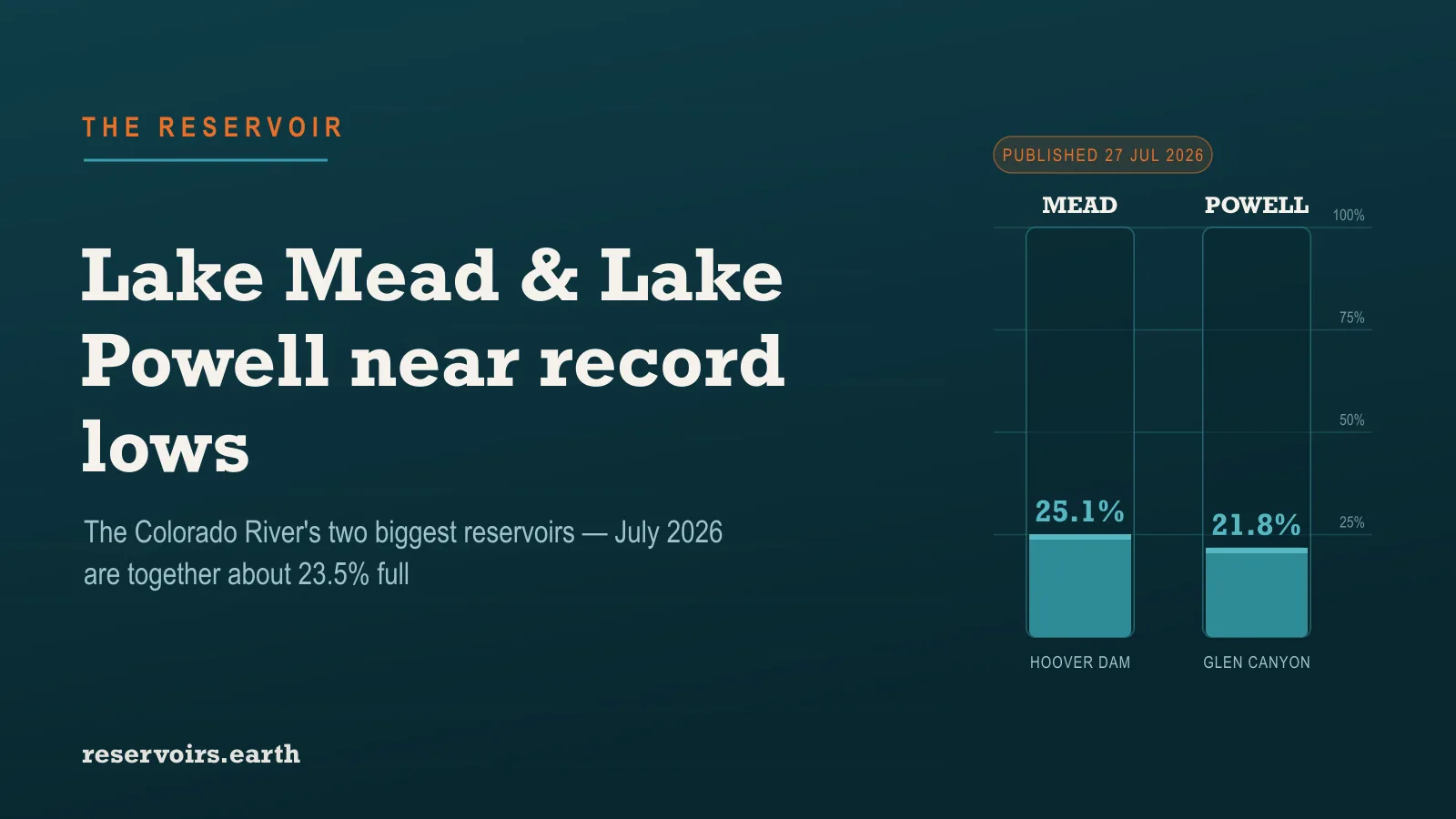
The two largest reservoirs in the United States sit on the same river, and both are running near empty. As of the 21 July 2026 reading, Lake Mead — behind Hoover Dam on the Colorado — is 25.1% full, and Lake Powell, behind Glen Canyon Dam upstream, is 21.8% full. Together they hold about 23.5% of their combined 65.7 km³ of capacity. Powell is at its lowest late-July level in our five-year record and within a point of the all-time low it set in 2023; Mead is all but tied with its own record, from the summer of 2022. These two reservoirs are the Colorado River's core storage — the water bank for roughly 40 million people across seven states and Mexico — and they are a quarter full at the moment of the year they are supposed to be fullest.
Key takeaways
- Lake Powell is the sharper emergency. At 21.8% (6.7 km³ of 30.9) on 21 July 2026 it sits about 10 points below its July norm of ~32%, lower than any late-July reading in our five-year record and within a point of the ~21% floor it hit in the spring of 2023. Live chart: Lake Powell.
- Lake Mead is low and drifting lower. At 25.1% (8.7 km³ of 34.9) it is about 3 points under its July norm and all but tied with its summer-2022 record low, easing down through the summer draw-down. Live chart: Lake Mead.
- Together they are ~23.5% full. The two biggest reservoirs in the country hold barely a quarter of the water they can — and they are the overwhelming majority of the Colorado River system's storage.
- Powell barely rose this spring. It is about level with a month ago even though July is normally its post-snowmelt peak — the signature of another weak Rocky Mountain snowpack.
- This is why Arizona reads 84% and Nevada reads 29%. The full-looking reservoirs downstream — Lake Mohave at ~105% and Lake Havasu at ~90% — are held near the top by design. Mead and Powell are where the real water is banked, and they are nearly empty.
- It is a managed shortage, not a Day Zero. No taps are about to close on the most heavily managed river on the continent — but these are the levels behind the Lower Basin's mandatory water cuts. See the Day Zero watchlist.
The two giants, by the numbers
Every figure below is the 21 July 2026 reading from the US Bureau of Reclamation, mirrored with multi-year history on reservoirs.earth. "July normal" is each reservoir's average July fill in our record.
| Reservoir |
Fill (21 Jul 2026) |
Volume |
Capacity |
July normal |
One year ago |
| Lake Powell |
21.8% |
6.7 km³ |
30.9 km³ |
~31.7% |
30.4% (−8.6 pts) |
| Lake Mead |
25.1% |
8.7 km³ |
34.9 km³ |
~28.1% |
28.4% (−3.3 pts) |
| Combined |
23.5% |
15.5 km³ |
65.7 km³ |
— |
— |
The two numbers are close, but they are not the same kind of low. Mead is sitting near a floor it has visited before. Powell has fallen through the floor it was supposed to be climbing away from.
Lake Powell: the real emergency
The alarming figure is not the percentage — it is the timing. July is when Lake Powell is normally at its highest, filled by the spring melt coming off the Rocky Mountains through the Upper Colorado Basin. In a healthy year it peaks in the high 30s or low 40s. This July it is at 21.8% and has barely moved since June, when it read 22.7% — the snowmelt that should have lifted it simply did not arrive in volume, after another thin snowpack in the Colorado headwaters. Line up the last six late-July readings and the trajectory is stark:
|
Jul 2021 |
Jul 2022 |
Jul 2023 |
Jul 2024 |
Jul 2025 |
Jul 2026 |
| Lake Powell fill |
31.7% |
25.1% |
38.1% |
39.1% |
30.4% |
21.8% |
Two good snow years — 2023 and 2024 — lifted Powell into the high 30s and made the recovery look real. The two lean years since have handed all of it back and then some: at 21.8% the reservoir is now lower than at any July in the series, and within a point of the ~21% low it reached in spring 2023, the deepest point of that crisis. Powell's job is to store the Upper Basin's water and release it downstream to Mead; a Powell this low also pushes Glen Canyon Dam toward the level below which it can no longer generate hydropower. It is the reservoir to watch, and the one furthest from where it should be.
Lake Mead: low, and drifting lower
Lake Mead — the reservoir with the famous white "bathtub ring" above Las Vegas — is the more familiar face of the Colorado's decline, and at 25.1% it is close to the record low it set in the summer of 2022. Its recent path is a slow slide rather than a collapse: 26.2% a month ago, 25.3% a week ago, 25.1% now, the ordinary summer draw-down as water is released to farms and cities downstream. Its six-Julys line looks calmer than Powell's, but it is drifting the wrong way:
|
Jul 2021 |
Jul 2022 |
Jul 2023 |
Jul 2024 |
Jul 2025 |
Jul 2026 |
| Lake Mead fill |
31.9% |
24.9% |
29.7% |
30.3% |
28.4% |
25.1% |
Mead sits downstream of Powell and lives on its releases, so a near-empty Powell caps how far Mead can recover no matter what happens locally. And Mead's elevation is not just a gauge — it is the trigger. Where Mead's surface sits on 1 January each year sets the shortage "tier" that decides how deep the mandatory cuts to Arizona, Nevada and Mexico go the following year. A quarter full is squarely in shortage territory.
Why Arizona reads 84%, Nevada 29% and Utah 32%
Here is the counterintuitive part, and the reason a single state percentage can mislead. We file each reservoir under the state where its dam physically sits: Mead under Nevada (Hoover Dam is on the Arizona–Nevada line) and Powell under Utah (Glen Canyon is on the Arizona–Utah line). Mead is about 94% of Nevada's tracked capacity and Powell is nearly four-fifths of Utah's, so those two states read 29% and 32% — essentially the fill of a single giant reservoir apiece.
Arizona, meanwhile, reads a comfortable-looking 84% — because the Colorado River reservoirs inside Arizona's tracked set are Lake Mohave (105%) and Lake Havasu (90%), "run-of-river" regulating reservoirs that Reclamation deliberately holds near the top so they can pass water downstream to California, Arizona and Mexico on schedule. They stay near full in wet years and dry years alike. So the same stretch of the same river produces three wildly different headline numbers: an empty-looking Nevada and Utah, and a full-looking Arizona — and the full-looking one is the mirage. The water all three states actually depend on is the water in Mead and Powell.
What a near-empty Mead and Powell actually means
- It is not a tap-closing Day Zero. The Colorado is one of the most heavily managed rivers on earth, and the shortage is being rationed by rule, not by crisis. What low Mead and Powell levels do trigger is the formal Lower Basin shortage that has already cut Arizona's, Nevada's and Mexico's allocations. The distinction matters — see which regions are actually closest to Day Zero.
- Hydropower is on the line before water supply is. Both Hoover and Glen Canyon are major power plants, and generation falls as the reservoirs drop; below a "minimum power pool" the turbines cannot run at all. Powell is closer to that edge than Mead.
- Recovery is a snowpack story, not a summer-rain story. Neither reservoir refills from local weather; both refill from snow melting off the Rockies far upstream. One good snow year visibly helped in 2023–24; two lean years erased it. The number that decides 2027 is next spring's snowpack, not this summer's heat.
The honest summary: the two biggest reservoirs in the United States, holding most of the Colorado River's water, are together under a quarter full — Powell at a record-low July and Mead close behind — and how far they recover rests on snow that has not fallen yet.
This is a July 2026 snapshot of the Colorado River's two largest reservoirs; for the wider picture see US reservoir levels and the driest states, the Arizona, Nevada and Utah editions, and where each figure comes from in the official reservoir-data sources. How openly the US publishes its water data is scored on the Reservoir Transparency Index.