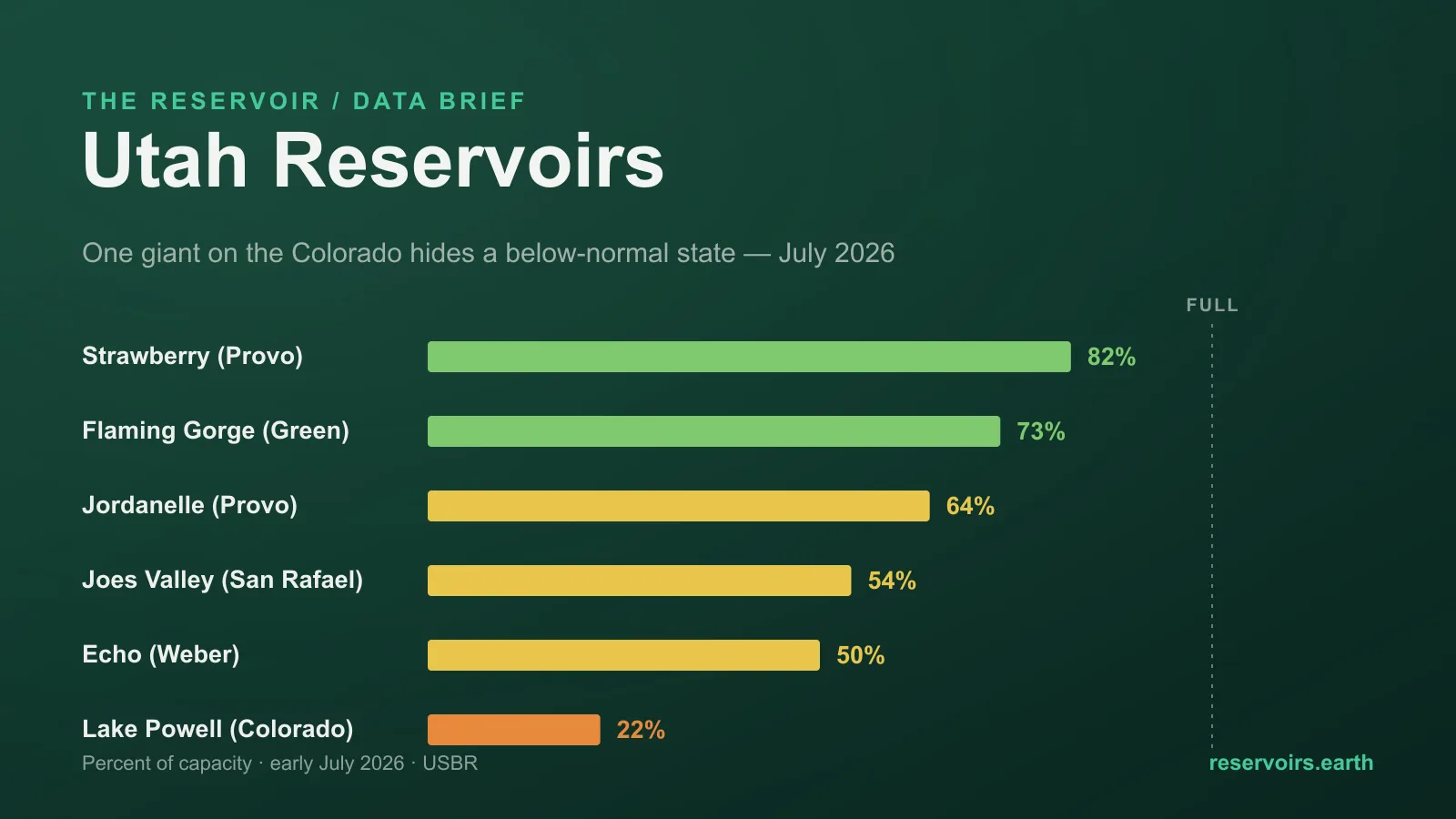
Utah's tracked reservoirs read about 32% full at the start of July 2026 — a number that looks like a crisis and, in one specific sense, is one. But almost the entire figure is a single reservoir: Lake Powell, the Colorado River giant behind Glen Canyon Dam, which holds nearly four-fifths of all the reservoir capacity we track in Utah and sits at just 22%. Take Powell out and the rest of Utah — the snow-fed reservoirs of the Wasatch, the Uintas and the mountain valleys — averages about 71% of capacity. That sounds healthier, and it is, until you notice the second signal underneath it: 22 of the 27 Utah reservoirs we track are below their normal level for early July. So the honest read is two stories at once — one enormous reservoir near its record low dragging the headline down, and a whole state of smaller reservoirs quietly running a dry year. Live figures are on the Utah page; the national picture is on the United States page.
Key takeaways
- The ~32% statewide headline is really Lake Powell. Powell is about 22% full and holds nearly 80% of Utah's tracked reservoir capacity, so it sets the state number almost by itself. Strip it out and the rest of Utah averages about 71%. Live figures are on the Utah page.
- But the rest of the state is dry too. Twenty-two of the 27 Utah reservoirs we track sit below their normal early-July level — this is a below-average year across the board, not just a Powell problem.
- The mountain reservoirs are down, not empty. Flaming Gorge is ~73% (normal ~82%), Strawberry ~82% (normal ~87%), and Jordanelle ~64% (normal ~73%) — a rung or two below where they usually are in July after a weak snow year.
- Powell is at a five-year July low. Its early-July fill has gone 26% → 38% → 39% → 31% → 22% over 2022–2026, the lowest of the five.
- The Great Salt Lake is not in these numbers. Utah's most-watched water body is a terminal lake, not a reservoir, so it isn't part of the fill figures here — but it belongs to the same drought, and reservoir storage is one of the levers that feeds it.
Where the data comes from
There is no single national US reservoir bulletin, so Utah is assembled from federal gauges. The big Colorado River storage reservoirs — Lake Powell and Flaming Gorge — come from the US Bureau of Reclamation, as do the Provo River and Weber Basin project reservoirs (Jordanelle, Deer Creek, Strawberry, Echo, Willard Bay and more). reservoirs.earth mirrors those gauges, adds multi-year history and rolls them up by state. Every figure below is dated, because reservoir levels change daily; the live numbers and each reservoir's chart are on the Utah page and on each reservoir's own page.
Why one reservoir writes the whole headline
The single most important fact about Utah's reservoir number is a matter of arithmetic, not weather: Lake Powell is so much larger than everything else that it effectively is the state average. Powell's capacity is roughly 30.9 km³; every other Utah reservoir we track, added together, comes to about 8.0 km³. When one reservoir is four times the size of all the others combined, a capacity-weighted state fill is mostly just that reservoir's fill wearing a state's name.
That is why the ~32% figure and the ~71% "rest of Utah" figure are both true and describe different things. Powell is the Colorado River's second-largest bank account, shared by seven states and Mexico, and its level reflects two decades of over-allocation and drought across the entire Upper Basin — not the snow that fell on the Wasatch this winter. The reservoirs that do reflect Utah's own winter are the mountain ones, and to read them you have to set Powell aside.
The current picture (as of early July 2026)
Sorted by size, here is the state — the one giant, then the reservoirs that actually track Utah's snowpack.
The Colorado River giant:
| Reservoir |
River / role |
Fill |
Normal (early Jul) |
| Lake Powell |
Colorado — major storage |
22% |
~33% |
| Flaming Gorge |
Green — major storage |
73% |
~82% |
The mountain-and-valley reservoirs that follow Utah's own snow:
Read the third and fourth columns together and the pattern is unmistakable: nearly every one of these reservoirs is sitting several points — in some cases twenty or thirty — below where it normally is in early July. Joes Valley is 26 points light; Echo is 23. These are not empty reservoirs, but they are reservoirs that came out of winter with less than they usually carry, which is the fingerprint of a poor snowpack rather than a single hot spell.
Powell's five-year July slide
The clearest way to see why Powell is the headline is its early-July fill over five straight years, set against a healthy Wasatch reservoir that rose and fell with better winters:
The wet winters of 2023 and 2024 pulled the mountain reservoirs to near-full and lifted Powell into the high 30s. In 2026 both have given that back: the Wasatch reservoirs slid one tier down, and Powell fell past its 2022 mark to the lowest early-July reading in the five-year record. Powell rises slowly and falls slowly because it is so vast; a single strong year barely dents its deficit, which is why it can be near its low even when Utah's own snowpack reservoirs are merely below average.
The one number that isn't drought: Great Salt Lake
Utah's best-known water story of the last few years — the shrinking Great Salt Lake — sits deliberately outside these figures. The Great Salt Lake is a terminal lake with no outlet, not a managed reservoir, so it has no "capacity" to be a percentage of and it is not part of the state fill above. But it is not a separate story either: the same rivers that fill Utah's reservoirs — the Bear, the Weber, the Provo, the Jordan — are the ones that ultimately reach the lake, and every acre-foot held back or diverted upstream is water that doesn't. A below-average reservoir year and a stressed Great Salt Lake are two readings of the same dry winter.
What reservoir levels do — and don't — tell you here
- A state average can be one reservoir in disguise. When a single reservoir holds most of the capacity, as Powell does in Utah, the "statewide" number stops describing the state and starts describing that reservoir. The useful figures are Powell on its own and the rest of Utah on its own — never the blend.
- Below-normal is the signal, not empty. Most of Utah's mountain reservoirs are still half-full or better. The news is not that they are dry; it is that they are consistently a step below their July norm, which points to a weak snowpack feeding a hotter, thirstier summer.
- Storage looks backward, snowpack looks forward. These reservoirs record the winter that just ended. Whether they refill depends on next winter's snow across the Wasatch and the Upper Colorado — something no July storage figure can forecast.
What it means for the summer
The practical read for 2026: Utah is not out of water, but it is running lean, and its single biggest reservoir is near its lowest early-July level in years. For the Colorado River — and for the downstream states, Arizona chief among them, that bank their supply in Powell and Lake Mead — Powell at 22% is the number that matters, and it is a system-wide problem no amount of Utah snow alone can fix. For Utahns, the more relevant reservoirs are the mountain ones close to home, and those are telling a quieter but consistent story: a little less water than usual, going into a summer that will ask for a lot.
The honest summary: a ~32% state figure that is really one near-empty giant on the Colorado River, sitting over a whole state of snow-fed reservoirs that are not empty, but are almost all below where July usually finds them.
This is a July 2026 snapshot of Utah; for the national picture and where drought risk actually sits across the US, see the US reservoir levels edition and the neighbouring Arizona and Colorado editions. How US water-data openness ranks is on the Reservoir Transparency Index.