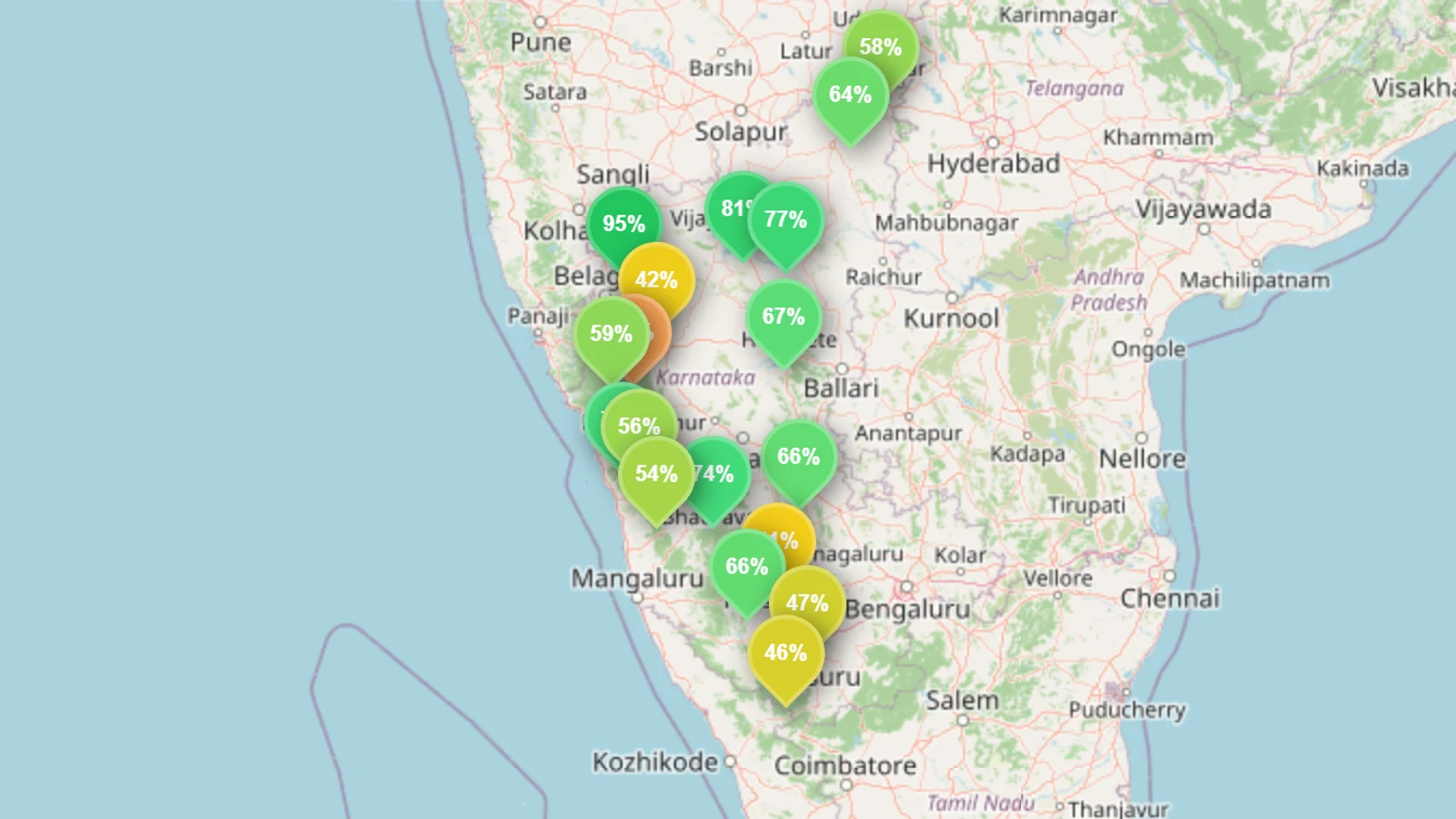
There are still two Karnatakas. On the latest readings — the CWC bulletin of 24 September 2026 for most dams, and Andhra Pradesh WRIMS on 1 October for the Krishna giants — the state's 18 major reservoirs are 64.8% full. That is down from the 69.3% we reported in the August edition. The Krishna system is still carrying the headline: Almatti is 80.7% and Hidkal is 95.2%. The Cauvery is not. Krishnaraja Sagar (KRS) is 47.0%, against 95.6% on 25 September 2025, and Kabini has fallen from 93.2% in mid-August to 45.7%. On the 13 dams with a late-September reading in both years, Karnataka is 58.7% against 93.6% a year ago. The live state figure is on the Karnataka reservoir levels page. This is the October edition: monsoon withdrawal, not refill.
Key takeaways
- Karnataka is 64.8% full across 18 tracked dams (CWC 24 September + WRIMS 1 October for Almatti, Tungabhadra and Narayanpur). The live figure is on the Karnataka page.
- The Cauvery group is 46.9% full, down from 74.4% on 13 August. KRS is 47.0% (August average at this point of year: 79%); Hemavathy 41.2%; Kabini 45.7% after sitting above 90% in mid-August.
- The Krishna group is 73.1% full. Almatti is 80.7% against a 96% October average; Hidkal is essentially full. Malaprabha is still the hole in that system: 42.0% against 100% on 25 September 2025.
- The year-on-year gap has widened, not closed. Thirteen dams with a reading near 25 September in both years are 58.7% now vs 93.6% last year (−34.9 pts). In August the same comparison was 25 points; Cauvery drawdown did the rest.
- Only Tattihalla is near 20% (21.5%). No dam is above 90% except Hidkal.
Karnataka reservoir levels, dam by dam
Capacity is gross storage, in TMC and MCM. "Fill" is the CWC live-storage percentage, except the three Krishna dams marked WRIMS. "Week" is the change since the 17 September CWC bulletin. "October average" is the mean October level on each dam's chart. Two dams have no multi-year October average yet.
| Dam |
Basin |
Capacity (TMC) |
Capacity (MCM) |
Fill |
Date |
Week |
October average |
| Almatti (LBS Sagar) |
Krishna |
129.7 |
3,673 |
80.7% |
1 Oct (WRIMS) |
— |
96% |
| Tungabhadra |
Krishna |
105.8 |
2,996 |
67.1% |
1 Oct (WRIMS) |
— |
66% |
| Bhadra |
Krishna |
66.5 |
1,882 |
73.5% |
24 Sep |
−3.5 |
84% |
| Linganamakki |
West Flowing |
53.4 |
1,512 |
56.1% |
24 Sep |
−1.5 |
80% |
| Krishnaraja Sagar (KRS) |
Cauvery |
48.4 |
1,370 |
47.0% |
24 Sep |
+0.1 |
79% |
| Supa (Kalinadi) |
West Flowing |
42.7 |
1,208 |
58.5% |
24 Sep |
−1.7 |
80% |
| Narayanpur |
Krishna |
37.6 |
1,066 |
76.8% |
1 Oct (WRIMS) |
— |
59% |
| Ghataprabha (Hidkal) |
Krishna |
37.5 |
1,062 |
95.2% |
24 Sep |
+0.2 |
96% |
| Hemavathy |
Cauvery |
37.0 |
1,049 |
41.2% |
24 Sep |
−2.9 |
78% |
| Malaprabha |
Krishna |
36.0 |
1,018 |
42.0% |
24 Sep |
−0.4 |
83% |
| Mani |
West Flowing |
31.2 |
884 |
54.4% |
24 Sep |
−1.1 |
97% |
| Vani Vilas Sagar |
Vedavati |
28.3 |
802 |
66.0% |
24 Sep |
−1.5 |
86% |
| Kabini |
Cauvery |
18.3 |
519 |
45.7% |
24 Sep |
+0.4 |
88% |
| Harangi |
Cauvery |
12.1 |
343 |
65.9% |
24 Sep |
−9.5 |
90% |
| Tattihalla |
West Flowing |
8.8 |
249 |
21.5% |
24 Sep |
+0.1 |
41% |
| Karanja |
Godavari |
7.7 |
218 |
57.5% |
24 Sep |
−0.2 |
— |
| Bennithora |
Krishna |
5.3 |
150 |
64.3% |
24 Sep |
−0.3 |
— |
| Gerusoppa |
West Flowing |
4.6 |
130 |
71.5% |
24 Sep |
−6.1 |
79% |
The national CWC bulletin has not published an October week yet; the three WRIMS readings are the only 1 October figures in this table. Almatti's CWC series through 17 September still showed 93.6%, so the WRIMS step-down to 80.7% is a change of source as well as of week — read it against the Almatti chart, not as a single-week CWC move.
Where Karnataka's reservoir data comes from
The figures come from the Central Water Commission (CWC) weekly bulletin and, for a few interstate Krishna reservoirs, from AP-WRIMS. reservoirs.earth mirrors both. The state percentage is the live-storage-weighted mean of those percentages, so Almatti and Tungabhadra move the headline more than the Cauvery headwaters dams. India's national water data is harder to access than most countries we track, which is why India scores low on the Reservoir Transparency Index; Karnataka's major dams are nonetheless in the CWC set.
From the August peak into withdrawal
The August edition caught the monsoon fill. October catches the turn:
| Bulletin |
2 Jul |
13 Aug |
3 Sep |
17 Sep |
24 Sep / 1 Oct |
| Karnataka, % full |
14.0% |
69.3% |
72.4% |
66.5% |
64.8% |
(2 July and 13 August are the published CWC editions; 3 and 17 September merge CWC with the Krishna archive; the last column is each dam's newest reading as in the table.)
The state peaked in early September and has given back about eight points. That is normal hydrology after the southwest monsoon withdraws. What is not normal is the Cauvery: those four dams were 74.4% on 13 August and are 46.9% now. KRS barely moved in the last CWC week (+0.1). Kabini and Hemavathy did the falling.
Against last year, on 13 dams, late September is 58.7% vs 93.6%. August was already a short year. Early October is a shorter one.
Krishna: still the full Karnataka, with one exception
The six Krishna-system dams we grouped in August are 73.1% full:
- Almatti (80.7%) — still the state's largest storage (129.7 TMC). Below its 96% October average, but nowhere near the 2.9% of early July. This dam is why a Karnataka headline can read ~65% while KRS is in the 40s.
- Tungabhadra (67.1%) — near its 66% October average. Downstream Andhra Pradesh and Telangana take this water.
- Narayanpur (76.8%) — above its 59% October average. WRIMS and CWC have disagreed on this dam mid-season; the six-week level is the one to trust.
- Hidkal (95.2%) — at its October average. The recovery from 6.1% on 2 July is complete.
- Malaprabha (42.0%) — still the exception. It has not moved since August (41.2%). Last 25 September it was 100%. That is a 58-point year-on-year gap, the widest among the majors with a 2025 reading.
Cauvery: the search term did not catch up
KRS is the dam people type. It supplies Bengaluru and Mysuru, and its releases toward Tamil Nadu are the politically watched number.
- KRS (47.0%) — 56.2% on 13 August, 47.0% now, 95.6% on 25 September 2025, 79% October average. It never rebuilt last year's surplus. The monsoon put water in the Ghats; it did not leave it in this reservoir.
- Kabini (45.7%) — 93.2% in mid-August, now 46 points under last year. The Western Ghats catchment filled and then ran.
- Hemavathy (41.2%) — 83.1% in August; −50 points vs 25 September 2025.
- Harangi (65.9%) — the least-bad Cauvery reading, still 25 points under last year after a 9.5-point drop in the last CWC week.
A Karnataka average near 65% is Almatti. A Bengaluru search for krs water level today is 47%. Those are not the same story.
West-flowing and the rest
Linganamakki (56.1%) and Supa (58.5%) are hydro storages, both 20-odd points under their October averages. Mani is 54.4% against a 97% October average. Tattihalla remains the lowest in the state. Vani Vilas Sagar (66.0%) is a small Vedavati reservoir, 30 points under last year.
Capacity in TMC
Indian water reporting uses TMC — one thousand million cubic feet, equal to 28.3168 MCM:
- Almatti: 129.7 TMC (3,673 MCM).
- KRS: 48.4 TMC (1,370 MCM).
- Karnataka, 18 tracked dams: about 704 TMC (19,900 MCM) of gross capacity.
Gross capacity is not usable water, and CWC percentages are live storage against live capacity. Compare each dam to the same week in earlier years on its own chart.
What to watch
Southwest monsoon withdrawal from Karnataka is under way. The next story is rabi demand and Cauvery releases, not another fill pulse unless a late depression arrives.
Does KRS hold the mid-40s, or do releases toward Tamil Nadu open a larger gap with 2025? Does Malaprabha stay the Krishna exception? And does Almatti stay near 80% so the state headline does not follow the Cauvery down? The honest summary: Karnataka is still a Krishna year. It is not a KRS year.
This is the October 2026 edition, updating the August 2026 edition and the July 2026 edition. For the national picture see India Reservoir Levels, September 2026. Follow the state between bulletins on the Karnataka reservoir levels page.