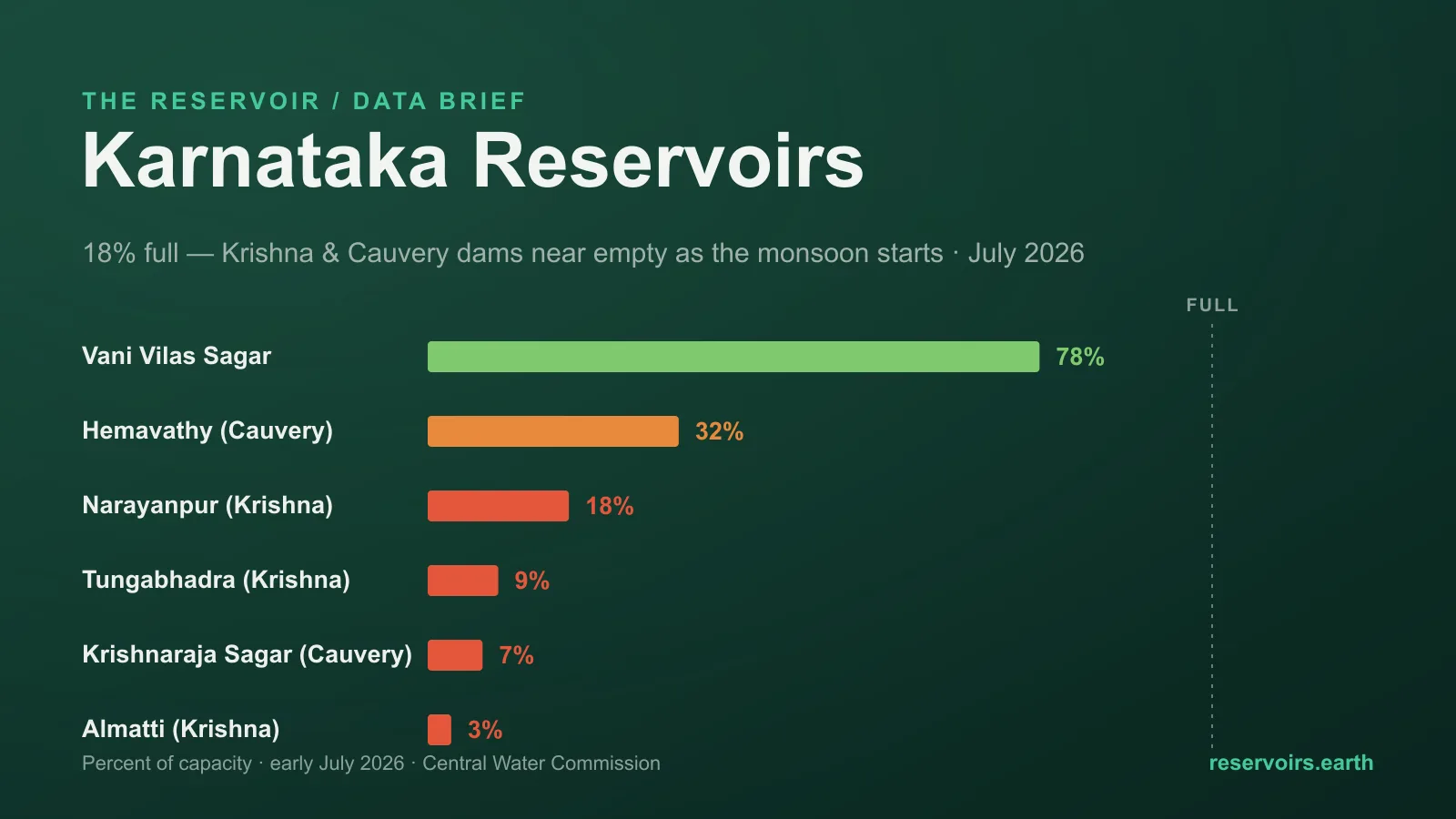
As of early July 2026, Karnataka's major reservoirs are holding only about 18% of their combined capacity — among the lowest readings of any major Indian state as the southwest monsoon begins, and even that figure is propped up by a couple of smaller dams that happen to be full. The state's biggest storages are close to empty: Almatti on the Krishna sits at about 3% and Krishnaraja Sagar — the Cauvery dam that supplies Bengaluru and Mysuru — at about 7%, each a fraction of its normal early-July level. Week over week the big dams are barely moving: the monsoon rains have not yet reached the catchments that fill them. The live state figure and dam-by-dam map are on the Karnataka reservoir levels page. This is the July edition of a monthly check-in, and for Karnataka the entire story is the wait for the rain.
Key takeaways
- Karnataka's tracked reservoirs are about 18% full (early July 2026) — with 11 of the 16 major dams below 20% of capacity, and the aggregate held up only by two full smaller dams. The live figure is on the Karnataka page.
- The Krishna basin is nearly dry. The state's Krishna-system dams — Almatti (
3%), Narayanpur (18%), Tungabhadra (9%), Malaprabha (5%) and Ghataprabha (~6%) — together hold only about 7% of their combined capacity.
- The Cauvery dams are almost as low. Krishnaraja Sagar (
7%), Kabini (9%), Hemavathy (32%) and Harangi (33%) together sit around 15% — the system that supplies Bengaluru and, downstream, Tamil Nadu.
- Levels are flat, not rising. Across the CWC bulletins through 2 July, the big Krishna dams barely moved — Almatti by a fraction of a percent and Narayanpur slightly down — so the seasonal inflow has not started in earnest.
- Two dams buck the trend. Vani Vilas Sagar (
78%) in Chitradurga and the small Gerusoppa balancing pond (72%) are the only Karnataka storages near full.
Where Karnataka's reservoir data comes from
The figures here come from the Central Water Commission (CWC), India's national water agency, whose weekly bulletin covers the country's largest reservoirs. reservoirs.earth mirrors that bulletin and keeps each dam's multi-year history; most of the readings here are from the 2 July 2026 bulletin, with a few dams updated a little more recently from state portals. India's national data is harder to access than most countries we track — which is why India scores low on the Reservoir Transparency Index — but the CWC bulletin does cover Karnataka's major dams. Every figure below is dated, because pre-monsoon levels can change quickly once the rain arrives. The live state number and map are on the Karnataka page.
Why 18% is the number to expect — and still a warning
Karnataka sits in the path of the southwest monsoon, which delivers almost all of the state's rain between June and September. That means early July is, by design, the low point of the year: the previous year's water has been drawn down through the long dry season, and the reservoirs are waiting to refill. A reading in the teens is not, by itself, a crisis — it is the seasonal floor.
What turns this year's floor into a warning is the comparison with the same week in past years. Most of Karnataka's big dams are sitting at a small fraction of their early-July norm: Almatti at ~3% against a norm near 70%, Malaprabha at ~5% against ~40%, Krishnaraja Sagar at ~7% against ~58%. And the week-over-week movement is essentially flat — so the gap is not closing yet. The reservoirs are not just low because it is July; they are low for July, and still waiting on the rain that normally would have started filling them.
The Krishna basin: running on empty
The bulk of Karnataka's storage — about 10 of its 20 km³ of tracked capacity — sits in the Krishna basin, and as a group those dams are only about 7% full. The two Upper Krishna giants tell the story: Almatti (the Lal Bahadur Shastri Sagar, ~3.7 km³) at about 3%, and just downstream Narayanpur (the Basava Sagar) at about 18% — the one Krishna dam holding meaningfully more. On the Tungabhadra sub-basin, the big Tungabhadra dam is at about 9%, while Malaprabha (5%) and Ghataprabha (~6%) in the northwest are little better.
These dams matter well beyond Karnataka. The Krishna is a shared river: the Almatti–Narayanpur system depends partly on monsoon rain falling upstream in Maharashtra, and what Karnataka stores and releases flows on to Telangana and Andhra Pradesh. A slow start to the monsoon in the upper catchment shows up here first.
The Cauvery: low, and politically watched
Karnataka's Cauvery dams are almost as depleted, at about 15% as a group — and they are the most closely watched in the state, because the Cauvery supplies drinking water to Bengaluru and irrigation across southern Karnataka, and its releases to Tamil Nadu are governed by a long-running inter-state settlement. Krishnaraja Sagar, the historic KRS dam near Mysuru, is at about 7%; Kabini at about 9%. Further up the basin, Hemavathy (32%) and Harangi (33%) are holding more, and both edged up in the last week — the faint first sign of inflow in the Cauvery headwaters of the Western Ghats.
The exceptions, and how to read them
Not every Karnataka storage is low, and the exceptions are worth understanding:
- Vani Vilas Sagar (~78%) in Chitradurga is a century-old dam on the small Vedavati catchment that fills slowly and holds its water for years; it is genuinely full, and near its early-July norm.
- The west-flowing hydro storages — Linganamakki (
10%) on the Sharavathi and Supa (20%) on the Kali — are drawn down to generate electricity, so their level reflects power operations as much as rainfall, and their catchments (the high-rainfall Western Ghats) refill fast once the monsoon lands.
- Gerusoppa (~72%) is a small downstream balancing pond on the Sharavathi kept near full for the hydro scheme, not a measure of basin storage — read it as plumbing, not supply.
What "% full" means here
Three cautions for reading these numbers, all of which July makes concrete:
- This is the seasonal floor, not a steady state. Each percentage is measured against the dam's full supply level, and Karnataka's dams are meant to be near-empty in early July — they refill through the monsoon. A low reading now is normal; a low reading relative to the early-July average, as here, is the signal.
- Every figure is a single dated snapshot. These are the levels in the 2 July 2026 bulletin; once the monsoon lands, storages in high-rainfall Western Ghats catchments can climb fast. Compare each dam to the same week in past years on its own chart, not to its full mark.
- Some dams are operated, not just filled. The west-flowing hydro storages and balancing ponds above swing with power operations, so read them against their own history rather than as a measure of basin supply.
What to watch in August
For Karnataka the whole picture turns on the monsoon's progress over the next two editions. Does inflow reach the Krishna giants? Almatti and Narayanpur depend on rain falling upstream in Maharashtra as much as on Karnataka's own; a flat reading here in July can flip to a fast fill in weeks once the upper catchment gets going. Does the Cauvery start to climb? Hemavathy and Harangi ticking up is the earliest signal. The honest summary: Karnataka is at its seasonal floor and running below normal, and the number that matters now is not the level but how fast it rises.
This is the July 2026 edition, following India Reservoir Levels, July 2026, which covers the national picture. We track the major water economies month by month — see the Australia and South Africa July editions — and follow Karnataka between editions on the Karnataka reservoir levels page.