"Which US reservoirs are at risk in October?" is not the same question as "which are emptiest." A flood-control pool kept near empty by design is not news. A snowmelt reservoir that usually sits near two-thirds full in early October and is now at one-fifth is. This piece ranks reservoirs by how far they sit below their own 4-year early-October average — the acute anomaly — then brings in the two Colorado giants that the country watches even when the raw gap looks smaller: Lake Mead and Lake Powell.
On the fixed national basket in our US Reservoir Levels, October 2026 edition, early October storage was 53.6% — tied with 2022 and 6.6 points below the 4-year October average. The sharpest individual shortfalls are upstream in the Rockies. The system that still sets Lower Basin deliveries is Mead and Powell, now at 24.2% and 20.8%.
Key takeaways
- "At risk" here means unusually low for early October, not simply low in absolute terms. We compare each dam to its own 2022–2025 early-October average on the same calendar window.
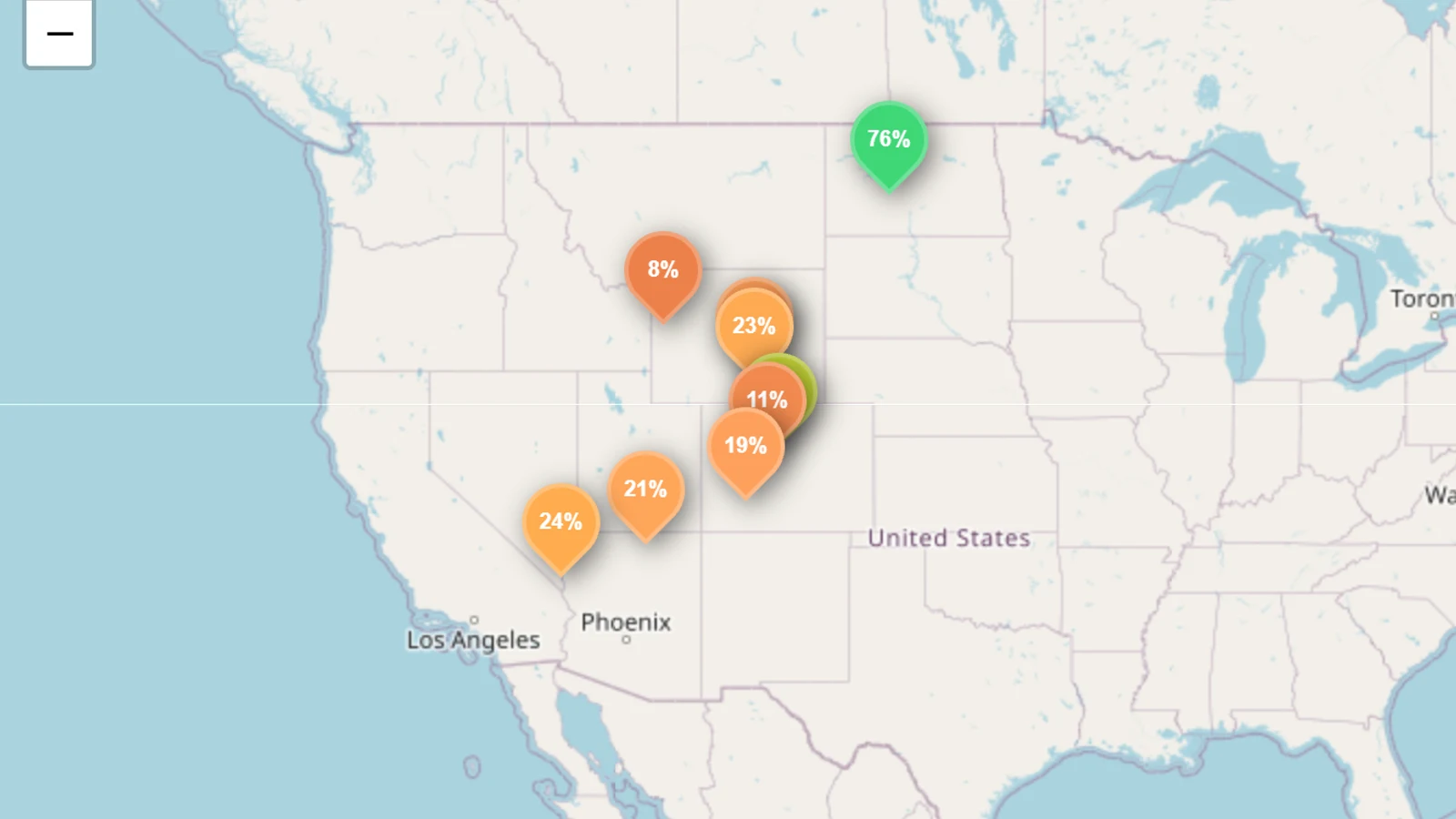
- The Rockies headwaters dominate the anomaly list. Green Mountain is 10.8% against a 65.4% 4-year October average (−54.6 pts). Jackson Lake is 8.1% against 55.9% (−47.8 pts). Blue Mesa is 19.2% against 63.0% (−43.8 pts).
- Colorado is 23 points below its 4-year October average on the state basket; Wyoming is 15 points below. That is where the year's weak snowpack still shows up as empty storage.
- Lake Mead is 24.2% full — the lowest reading in our five-year record, 5.2 points below its 4-year October average. Lake Powell is 20.8%, after a new mid-September record low of 20.3%, and 9.7 points below its October norm.
- Together Mead and Powell hold 22.6% of combined capacity (12.03 million acre-feet of 53.28 maf). The Rockies anomaly is the refill failure; the two giants are the bank that failure empties into.
How we define "at risk" here
Two numbers for every reservoir:
- Absolute fill — how full the tank is today. Right for supply; wrong for spotting what is unusual, because some dams are designed to sit low in autumn.
- October anomaly — today's fill minus that reservoir's own mean for early October across 2022–2025. A large negative gap is the early-warning signal.
Flood-control and irrigation drawdowns already sit inside each dam's October average, so a pool that is "always empty in October" does not rise to the top of this list. A storage that is usually half to two-thirds full and is now in single digits does.
Figures below use the reading nearest to 2 October (within five days) for the Rockies table, matching the October national comparison. Mead and Powell levels in the dedicated section are the 6 October readings used on their evergreen pages.
The Rockies reservoirs furthest below their October norm
Green Mountain's year path on this window is steep: 68.2% → 72.9% → 68.5% → 52.1% → 10.8%. Jackson Lake went from 64.3% a year ago to 8.1%. Blue Mesa, the largest storage on the Upper Colorado mainstem in Colorado, fell from 55.4% last October to 19.2%.
These are not flood-control empties. They are snowmelt banks that usually carry a substantial October balance into winter — and in 2026 they do not. That is the same upstream story that feeds Lake Powell and, with a lag, Lake Mead.
Lake Mead and Lake Powell — the bank behind the cuts
The Rockies gaps are larger in percentage points. The two Lower Basin landmarks still belong on any October risk list, for three reasons: absolute level, new records, and the volume of water at stake.
Lake Mead water level: 24.2% full on 6 October 2026 — about 6.82 million acre-feet of a 28.26 maf capacity behind Hoover Dam. That is the lowest reading in our five-year daily record, 5.1 points below the same date in 2025 and 5.2 points below its 4-year early-October average (29.4%). The year peaked at 31.5% on 27 February; since then Mead has given up roughly 2.06 million acre-feet. The full monthly trajectory and six-October table live on the evergreen page.
Lake Powell water level: 20.8% full on 6 October 2026 — about 5.21 million acre-feet of a 25.03 maf capacity behind Glen Canyon Dam. Mid-September set a new record low of 20.3%, below the previous floor of 21.0% from April 2023. Early October sits 0.5 points above that trough. Powell is 6.1 points down on the year and 9.7 points below its 4-year early-October average — the wider gap of the two giants. Its 2026 high-water mark was 1 January; the entire spring runoff was worth 0.4 points in May.
Read together, the two hold 22.6% of combined capacity — 12.03 million acre-feet of a possible 53.28. That is about three million acre-feet thinner than on the same date a year ago, and it is the stock against which the 20% Lower Basin cuts Reclamation finalised in July are calibrated. Powell is the reservoir being drained to hold Mead up; Mead is the reservoir whose 1 January elevation sets shortage tiers. Neither number is a seasonal quirk — both are the Colorado's multi-year savings account, sitting well under a quarter full going into winter.
Absolute fill and anomaly still diverge elsewhere
Garrison on the Upper Missouri is 75.8% full — high by western standards — yet 18 points below its 4-year October average near 94%. That is a real shortfall against a normally full system, not a crisis-looking empty pool.
The opposite trap: a reservoir that looks alarming in absolute terms may simply be on its seasonal schedule. Washington sits near 19% on the October basket and is essentially on its 4-year October average. Low seasonal operating levels are not the same as an unusual shortage.
What to watch into winter
- Whether the Rockies storages stay this thin into the snow season. Green Mountain, Jackson and Blue Mesa enter winter without the carryover they held in 2023–25.
- The 2026–27 Upper Basin snowpack — the only meaningful refill for Powell, and therefore for Mead.
- Whether Powell retests its September record low before spring runoff, and how that feeds Mead's projected 1 January elevation for the 2027 shortage tier.
Live figures stay on the United States reservoir map. The like-for-like national and state tables are in US Reservoir Levels, October 2026. Daily Mead and Powell numbers, with the full year path, are on Lake Mead water level and Lake Powell water level.
Reservoir figures: USGS NWIS, US Bureau of Reclamation, USACE CWMS and other official US feeds mirrored on reservoirs.earth. Early-October comparisons use the reading nearest to 2 October 2022–2026 within five days; Mead and Powell current levels are the 6 October 2026 readings used on their evergreen pages. The 4-year October average is the mean of 2022–2025 early-October fills on the same dams — a recent same-date series, not a 30-year climatology.