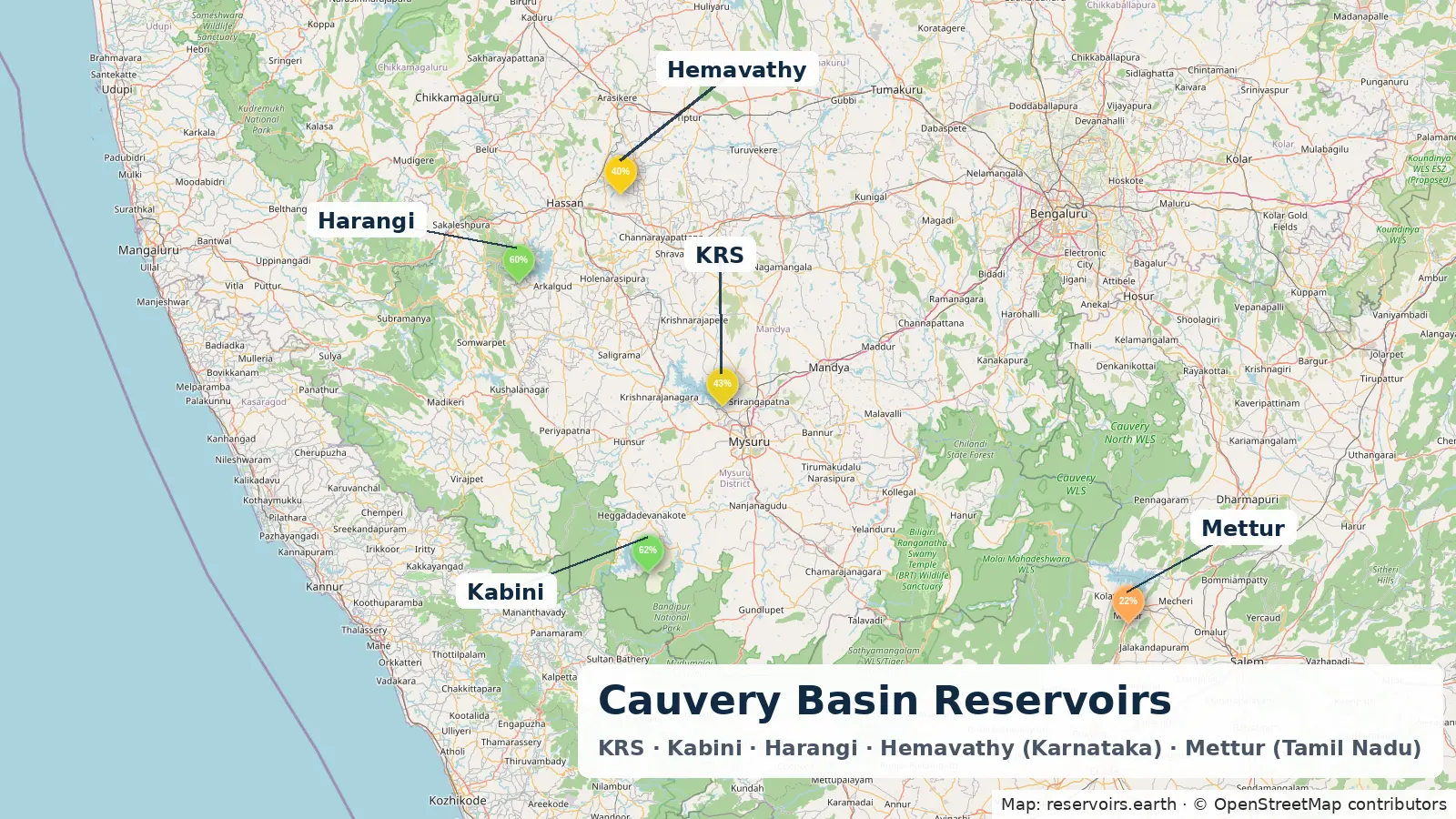
Krishnaraja Sagara (KRS) dam held 501 MCM, 43.08% of its live capacity, in the Central Water Commission (CWC) reading of 29 October 2026, as shown on our KRS dam water level today page. In October and early November the Cauvery Water Regulation Committee (CWRC) twice directed Karnataka to ensure a flow of 3,000 cusecs at the Tamil Nadu border at Billigundulu for 15 days: from 8 a.m. on 24 October 2026 and from 8 a.m. on 7 November 2026, according to press reports. On 20 November 2026, at its 147th meeting, the CWRC recommended a flow of 2,000 cusecs at Billigundulu for 16 days from 21 November 2026, as reported by The Hindu and The New Indian Express; official minutes were not available, and CWMA approval was not stated. The same day the Supreme Court dismissed Tamil Nadu's applications for additional releases, holding that the quantification of a shortfall in a distress year falls within the domain of the CWRC and the Cauvery Water Management Authority (CWMA).
Quick answer: in a normal year Karnataka must make 177.25 TMC of water available at Billigundulu, under the Supreme Court judgment of 16 February 2018. In a distress year, when the yield of the Cauvery basin is lower, the allocated shares are "proportionately reduced" among Kerala, Karnataka, Tamil Nadu and Puducherry. The Cauvery Water Management Scheme, 2018 gives the CWMA the job of determining the distress and its extent, with the CWRC watching the reservoirs and the Billigundulu gauge. Neither the judgment nor the Scheme sets out a numerical formula for the reduction.
Sources as of: the 2018 judgment, the 2018 Scheme and the Supreme Court judgment of 20 November 2026, read on 23 November 2026. Storage figures are from our data pages: CWC readings up to 29 October 2026 and Tamil Nadu Water Resources Department (WRD) readings up to 5 November 2026. The CWMA and CWRC minutes for October and November 2026 could not be read: cwma.gov.in did not respond to our server on 23 November 2026. Those meetings are reported here as the press reported them.
The legal framework in one table
| Instrument | Figure | Scope | Who sets it | Source |
|---|---|---|---|---|
| Tribunal final order, 5 February 2007 | 740 TMC | Total: 726 TMC to the party States, 10 TMC for environmental protection, 4 TMC for inevitable escapages into the sea | Cauvery Water Disputes Tribunal (CWDT) | Clauses IV and V, as reproduced in the 2018 judgment |
| Tribunal shares | Kerala 30, Karnataka 270, Tamil Nadu 419, Puducherry 7 | Annual shares | CWDT | Clause V |
| Tribunal delivery at Billigundulu | 192 TMC | Normal year: 182 TMC from Tamil Nadu's share plus 10 TMC for environmental purposes | CWDT | Clause IX |
| Supreme Court shares, 16 February 2018 | Karnataka 284.75 (270 + 14.75), Tamil Nadu 404.25 (419 – 14.75), Kerala 30, Puducherry 7 | Annual shares; environment 10 and escapages 4 unchanged; total 740 | Supreme Court, Civil Appeal No. 2453 of 2007 | Paragraph 396 |
| Supreme Court delivery at Billigundulu | 177.25 TMC | Normal year | Supreme Court | Paragraph 397 and conclusion (xviii) |
| Distress-year rule | Not stated as a figure | "In case the yield of Cauvery basin is less in a distress year, the allocated shares shall be proportionately reduced" | CWDT, applied by the CWMA | Clause VII; Scheme, clause 10(3)(iii) |
The Supreme Court's 14.75 TMC addition to Karnataka is made of two parts, in the judgment's words: "10 TMC (on account of availability of ground water in Tamil Nadu) + 4.75 TMC (for drinking and domestic purposes including such need for the whole city of Bengaluru)". The 14.75 TMC is deducted from Tamil Nadu's Tribunal share.
The monthly schedule at Billigundulu
The Tribunal ordered "tentative monthly deliveries during a normal year" at "the inter-State contact point presently identified as Billigundulu gauge and discharge station located on the common border". Its schedule, reproduced in paragraph 398 of the 2018 judgment, is:
| Month | TMC | Month | TMC |
|---|---|---|---|
| June | 10 | December | 8 |
| July | 34 | January | 3 |
| August | 50 | February | 2.5 |
| September | 40 | March | 2.5 |
| October | 22 | April | 2.5 |
| November | 15 | May | 2.5 |
Total: 192 TMC. These are the Tribunal's figures. Paragraph 400 of the judgment says that with the total at Billigundulu cut to 177.25 TMC, "there would be, logically, a proportionate decrease in the monthly releases as worked out by the Tribunal. However, the same pattern therefor, as modeled by it would be maintained for the reduced releases." The reduced month-by-month figures are not stated in the judgment. The Tribunal also said the monthly releases "shall be broken in 10 daily intervals by the Regulatory Authority".
The place name is spelled Billigundulu in the 2018 judgment and the Scheme. The press also writes Biligundlu and Biligundulu.
Who decides in a distress year
The Union Government notified the Cauvery Water Management Scheme, 2018 on 1 June 2018 (S.O. 2236(E)). It set up two bodies:
- the Cauvery Water Management Authority (CWMA), with headquarters in New Delhi;
- the Cauvery Water Regulation Committee (CWRC), with headquarters in Bengaluru. Its chairman is the Authority's whole-time Member (Water Resources). Kerala, Karnataka, Tamil Nadu and Puducherry each send one representative not below the rank of Chief Engineer. The India Meteorological Department, the CWC and the Union agriculture ministry also have one member each.
The distress rule, in clause 10(3)(iii) of the Scheme: "The Authority, through the Regulation Committee and with the help of Central Water Commission, and other Central or State organizations as necessary will identify situations of distress in the river basin. Distress caused by diminution of water flows during the period will be shared by the party States after the distress conditions and their extent is determined by the Authority, keeping in view water shares allotted to parties."
Other clauses of the Scheme that apply in a dry year:
| Clause | What it says | Body |
|---|---|---|
| 10(1)(iii) | "regulated release by Karnataka, at the inter-State contact point presently identified as Billigundulu gauge and discharge station" | CWMA |
| 10(3)(i) | At the start of the water year, 1 June, the Authority determines the residual storage in the specified reservoirs; inflows are assumed to follow a 50% dependable year (yield 740 TMC) | CWMA |
| 10(3)(iv) | Banasurasagar (Kerala); Hemavathy, Harangi, Kabini and Krishnarajasagara (Karnataka); Lower Bhavani, Amaravathy and Mettur (Tamil Nadu) are operated "in an integrated manner" for each ten-day period | States, under the CWMA's guidance |
| 10(3)(viii) | If water is short in any month, the Authority "will consider reduction in the indent of the parties in proportion to the quantities allocated to each State" | CWMA, on the CWRC's report |
| 10(3)(ix) | The CWRC watches the monsoon in each ten-day interval and reports the variation from normal; the Authority "will consider any change in the release ordered by them earlier", until the end of the water year on 31 May | CWRC and CWMA |
| 18(a), 18(e) | The CWRC collects daily levels, inflows and storage at the eight reservoirs, and daily flows at the Billigundulu gauge and discharge site | CWRC |
| 19(1) | The CWRC meets once in ten days in June and October, and at least once a fortnight after the monsoon has set in | CWRC |
How the CWMA measures distress is disputed. According to The Hindu (20 November 2026), Tamil Nadu argued in the Supreme Court that the CWMA had assessed distress from inflows into Karnataka's four major reservoirs compared with their 30-year average, whereas the 2018 notification required a yield-based assessment. The same report says Karnataka, in a counter-affidavit, also pointed to the lack of a scientific formula for proportionate sharing. The Scheme text does not define the method.
The 2026-27 orders, meeting by meeting
The orders before October are those recorded in the Supreme Court judgment of 20 November 2026. The October and November orders are as reported by the press; their official minutes were not available to us.
| Meeting date | Body | Decision | Flow at Billigundulu | Period | Source |
|---|---|---|---|---|---|
| 30 July 2026 | CWMA, 54th meeting | Releases from KRS and Kabini "put together" | 3,500 cusecs | 15 days from 29 July 2026, 8:00 a.m. | Supreme Court judgment, 20 November 2026 (para 5) |
| 8 September 2026 | CWMA, 57th meeting | Daily average flows | 6,000 cusecs | 15 days from 9 September 2026, 8:00 a.m. | Supreme Court judgment (para 18) |
| 24 September 2026 | CWMA, 58th meeting | Held that there is no backlog shortfall; directed Karnataka to maintain the daily average flows stipulated by the Court | Not stated | Not stated | Supreme Court judgment (para 24) |
| 23 October 2026 | CWRC, 145th meeting; endorsed by CWMA, 60th meeting, the same day | Release from Karnataka's reservoirs | 3,000 cusecs | 15 days from 24 October 2026, 8:00 a.m., to 6 November | The Hindu and The New Indian Express, 24 October 2026 |
| 6 November 2026 | CWRC, 146th meeting; later approved by the CWMA | Release from Karnataka's reservoirs | 3,000 cusecs | 15 days from 7 November 2026, 8:00 a.m. | Deccan Herald and Public TV (ANI), 6–7 November 2026; The Indian Express, 20 November 2026 |
| 20 November 2026 | CWRC, 147th meeting; CWMA approval not stated | Recommended release from Karnataka's reservoirs | 2,000 cusecs | 16 days from 21 November 2026 | The Hindu, 20 November 2026; The New Indian Express, 21 November 2026 |
The Hindu reported that the 3,000-cusec rate from 24 October was "equivalent to 3.88 tmcft over the 15-day period". Deccan Herald reported the same total, 3.88 tmcft, for the period from 7 November. Those are the newspapers' figures. The number of the CWMA meeting that approved the 146th CWRC direction is not confirmed: one report places the approval at the CWMA's 60th meeting, which the press dated 23 October.
The Hindu, on 20 November, and The New Indian Express, on 21 November, reported that the 147th CWRC meeting on 20 November recommended a flow of 2,000 cusecs at Billigundulu for 16 days from 21 November. Official minutes were not available, and those reports did not state that the CWMA had approved the recommendation.
What each State told the committee
These are the States' own claims, as reported by the press. They are not findings of the CWRC or the CWMA.
23 October 2026 (145th CWRC and 60th CWMA), as reported by The Hindu and The New Indian Express:
- Karnataka said inflows into its four Cauvery basin reservoirs were 122.293 tmcft against a 30-year average of 273.865 tmcft, a deficit of 55.35%. It put the combined live storage of its reservoirs at 46.510 tmcft on 22 October, and said 55 of the 56 taluks in the basin were drought-affected.
- Tamil Nadu said storage at Mettur stood at 20.887 tmcft and sought 18.402 tmcft over 15 days, including a claimed backlog of 13.829 tmcft.
- Karnataka cited a combined 29.377 tmcft in the Mettur, Bhavani and Amaravathi reservoirs.
6 November 2026 (146th CWRC), as reported by Deccan Herald and Public TV (ANI):
- Karnataka said inflows into its four major reservoirs were 53.88% below the 30-year average and that 55 of the 56 taluks in its part of the basin were drought-hit. It said Mettur, Bhavani and Amaravathi held 37.125 tmcft together on 5 November.
- Tamil Nadu claimed a backlog of 16.895 tmcft as of 4 November and sought 20.678 tmcft at Billigundulu between 5 and 21 November. It said flows had fallen below 3,000 cusecs on several days between 24 October and 4 November.
The Supreme Court judgment of 20 November 2026
The judgment is reported as 2026 INSC 1257. It decides Miscellaneous Application No. 2445 of 2026, Miscellaneous Application Diary No. 46291 of 2026 and Miscellaneous Application No. 2843 of 2026, all in Civil Appeal No. 2453 of 2007. The bench was Justices Vikram Nath and Aparesh Kumar Singh; Justice Vikram Nath wrote the judgment.
What Tamil Nadu asked for, in the words of the applications quoted in the judgment:
- MA 2445 of 2026: implementation of the CWMA's decision of 30 July 2026, so that flows of 3,500 cusecs for 15 days, "that is, 4.536 TMC", reached Billigundulu by 12 August 2026; and a direction to make good, "on pro-rata basis", a shortfall of 26.954 TMC for 1 June to 12 August 2026.
- MA 2843 of 2026: implementation of the CWMA's decision of 8 September 2026 (6,000 cusecs from 9 to 23 September 2026), and a shortfall of 16.01 TMC for 1 June to 9 September 2026, "on pro rata basis", at Billigundulu.
The Hindu reported that the 16.01 TMC claim was "later modified to 11.719 TMC", and The Indian Express reported a claimed shortfall of 11.719 TMC up to 6 October. That figure does not appear in the judgment.
What the Court held:
- The application was "misconceived, particularly when the expert body entrusted with monitoring and regulating the release of Cauvery waters is already seized of the matter" (para 9).
- "The release schedule operates on an annual cycle from June to May", so Tamil Nadu's fear that its annual allocation may not be met "appears premature" (para 11).
- "The alleged shortfall and its quantification involve an assessment of distress and the flows across the entire Cauvery basin, which fall within the domain of the CWRC and the CWMA." The Court declined to issue a separate direction "on the basis of the disputed calculations placed before us" (para 21).
- Both applications by Tamil Nadu were dismissed. The application filed by the Dravida Munnetra Kazhagam was also dismissed: the Court held that its concerns were "adequately represented by the State of Tamil Nadu" (paras 28–29).
The judgment records each side's case. Karnataka said that ten-daily and monthly releases "are not inflexible", that a shortfall can be carried forward "up to the end of the season in January", and that "in a year of distress" the 2018 obligations "may be proportionately reduced". It said it had made good an early shortfall once the Wayanad region received rain, with a flow of 86,797 cusecs recorded at Billigundulu against 45,500 cusecs stipulated under the 54th CWMA meeting (para 10). Tamil Nadu said that even with full compliance a shortfall of 5.379 TMC would remain, and alleged wilful non-compliance (para 7).
Storage in the Cauvery reservoirs on the dates of the orders
Our data pages carry one official reading a week for each reservoir. The table gives the readings closest to the decisions above, as published. Fill is the share of live capacity on our pages.
| Reservoir | State | Live capacity (MCM) | 22 October 2026 | Latest reading | Source |
|---|---|---|---|---|---|
| Krishnaraja Sagara (KRS) | Karnataka | 1,163 | 451 (38.78%) | 501 (43.08%), 29 October | CWC |
| Kabini | Karnataka | 468 | 211 (47.52%) | 274 (61.71%), 29 October | CWC |
| Harangi | Karnataka | 278 | 113 (51.36%) | 132 (60%), 29 October | CWC |
| Hemavathy | Karnataka | 859 | 334 (36.03%) | 374 (40.35%), 29 October | CWC |
| Mettur (Stanley Reservoir) | Tamil Nadu | 2,585 | 561 (21.19%) | 574 (22.205%), 5 November | CWC (22 October); Tamil Nadu WRD (5 November) |
The 22 October readings are the last before the 145th CWRC meeting of 23 October. For KRS, Kabini, Harangi and Hemavathy our latest reading is 29 October 2026; no later reading had reached our data by 23 November. For Mettur the 5 November reading, from the Tamil Nadu WRD, is the last before the 146th CWRC meeting of 6 November. Mettur's earlier Tamil Nadu WRD reading, on 28 October, was 535 MCM (20.696%).
These are our figures in million cubic metres. The States' claims above are in tmcft, as the press reported them. We have not converted one into the other, so the two sets are not directly comparable.
KRS's weekly CWC readings in October 2026 on our page were 506 MCM (1 October), 461 MCM (8 October), 423 MCM (15 October), 451 MCM (22 October) and 501 MCM (29 October).
Related rules
The Tungabhadra water sharing article covers the other inter-State rule for a Karnataka reservoir in 2026, and the Krishna water sharing article the Srisailam rules. The India water restriction thresholds article lists State-level triggers. The Karnataka reservoir levels in October 2026 and Mettur dam water level in June 2026 articles cover the basin's storage earlier in the year.
Sources and methodology
Sources checked on 23 November 2026, between 09:25 and 11:00 Europe/Madrid:
- Supreme Court of India, judgment of 16 February 2018, Civil Appeal No. 2453 of 2007, State of Karnataka v. State of Tamil Nadu and others. Tribunal clauses IV, V, VII and IX as reproduced in the judgment; paragraphs 396–400 and conclusions (xvii)–(xx).
- Ministry of Water Resources, River Development and Ganga Rejuvenation, Cauvery Water Management Scheme, 2018, Gazette of India notification S.O. 2236(E), 1 June 2018 (copy hosted by The Hindu Centre), clauses 10, 17, 18 and 19.
- Supreme Court of India, judgment of 20 November 2026, 2026 INSC 1257, MA No. 2445 of 2026 and connected applications in Civil Appeal No. 2453 of 2007.
- The Hindu, Cauvery panel directs Karnataka to release water at the rate of 3,000 cusecs to Tamil Nadu for next 15 days, 24 October 2026.
- The New Indian Express, Release 3,000 cusecs of Cauvery water for 15 days till Nov 6, Karnataka told, 24 October 2026.
- Deccan Herald, CWRC directs Karnataka to release 3,000 cusecs of Cauvery water daily for 15 days, 6 November 2026.
- Public TV English (ANI), CWRC directs Karnataka to release 3,000 cusecs daily for 15 days, 7 November 2026.
- The Indian Express, SC rejects Tamil Nadu plea for additional Cauvery water from Karnataka, 20 November 2026.
- The Hindu, Cauvery dispute: SC dismisses Tamil Nadu plea on Karnataka not making good shortfall in water share, 20 November 2026.
- The Hindu, Cauvery verdict is a reflection of the dire ground reality in Karnataka: Chief Minister D.K. Shivakumar, 20 November 2026.
- The New Indian Express, CWRC asks Karnataka to release 2K cusecs of water for 16 days, 21 November 2026.
- reservoirs.earth data pages for KRS, Kabini, Harangi, Hemavathy and Mettur, built from CWC and Tamil Nadu WRD figures. See also how we get our data for India.
- Tried and unavailable on 23 November 2026: the CWMA website (cwma.gov.in, no response), KSNDMC (ksndmc.org, no response) and the Tamil Nadu WRD website (tnwrd.gov.in, no response).
Units are as published: TMC in the judgments and the Scheme, tmcft and cusecs in the press, MCM and percentages on our data pages. No figure has been converted, added or subtracted in the text.
This article sets out the Cauvery sharing rules as written in the 2018 judgment and the 2018 Scheme, the orders as recorded in the Supreme Court judgment of 20 November 2026 or reported by the press, and storage figures as published on the dates stated. It does not take a position in the dispute between the States. reservoirs.earth is not affiliated with any government body or party to the dispute. It is general information, not legal advice. Where this page and an official text differ, the official text prevails.
Cite this page: reservoirs.earth, "Cauvery Water Sharing in a Distress Year: How Releases from KRS and Kabini to Tamil Nadu Are Decided in 2026", sources as of 23 November 2026, https://reservoirs.earth/the-reservoir/cauvery-water-sharing-distress-year-krs-biligundlu-2026.
Related: KRS dam water level today · Kabini Dam water level today · Harangi Dam water level today · Hemavathy Dam water level today · Mettur Dam water level today · Karnataka reservoir levels · Tamil Nadu reservoir levels · India reservoir levels
Live fill levels
These widgets show each reservoir's current reading on reservoirs.earth. They update with the site's daily data and may differ from the dated figures above.
KRS Dam water level · data by reservoirs.earth
Kabini Dam water level · data by reservoirs.earth
Harangi Dam water level · data by reservoirs.earth
Hemavathy Dam water level · data by reservoirs.earth
Mettur Dam water level · data by reservoirs.earth