Maharashtra's Water Resources Department ordered on 5 October 2026 that every major reservoir in the State keep at least 10% of its available live storage as an emergency buffer, to be used only for drinking water, and that every local body cut its water use by at least 10% from 16 October 2026. The order puts drinking water, water for livestock and domestic use first at every dam, and its water-planning provisions apply until 31 August 2027. At Veer Dam, the key dam of the Nira system, our data page shows 40.5% of live capacity, 108 MCM, in the Central Water Commission reading of 29 October 2026. See our Veer Dam water level today and Mulshi Dam water level today pages for the latest readings.
Quick answer: under the Government Resolution (GR) of 5 October 2026, water in Maharashtra's dams is planned in this order until 31 August 2027: drinking water first, then industry, then fodder and seed programmes, then irrigation. Irrigation is ranked again inside itself: low-water rabi food-grain and high-fodder crops, then other rabi crops, then standing perennial crops, then new perennial planting. Each major dam gets its own water-use plan, drawn up by the Superintending Engineer and finalised either by a Canal Advisory Committee chaired by the Minister (Water Resources) or by a district committee chaired by the Guardian Minister.
Sources as of: the GR and press reports read on 19 November 2026. Storage figures are from our data pages, latest reading 29 October 2026.
The Government Resolution
| Item |
As stated in the GR |
| Issuing department |
Water Resources Department, Government of Maharashtra, Mantralaya, Mumbai |
| Date |
5 October 2026 |
| Code on the GR portal |
202610051722231627 |
| Signed by |
Prakash Misal, Secretary to Government, digitally signed on 5 October 2026 |
| Language of the official text |
Marathi |
| Provisions apply until |
31 August 2027 |
The official PDF sits in the portal's "English" folder, but the text is in Marathi. All English renderings of the GR on this page are an unofficial translation by reservoirs.earth. They are not the official text.
The GR's subject line, in unofficial translation: managing the State's available water storage frugally, by priority and in a planned way until 31 August 2027, in view of El Niño, to secure drinking water.
The preamble gives the reason. Drought has been declared in 265 talukas where Trigger-1 applied in the 2026 kharif season, under a Relief and Rehabilitation Department GR of 25 September 2026. The GR says the effect of El Niño is expected to last into next year.
What the GR orders
Maharashtra GR of 5 October 2026: measures, thresholds and who applies them (unofficial translation)
| Measure in the GR | Threshold or figure | From / until | Who applies it |
|---|
| Drinking water, livestock drinking water and domestic use first, as per set norms (para 1.A.i) | Highest and first priority; reserve calculated after evaporation, silt and unauthorised lifting | Not stated / 31 August 2027 | Planning of all major dams, reservoirs and related storages |
|---|
| Buffer or emergency storage (para 1.A.ii) | At least 10% of the available live storage of each major reservoir, in addition to the drinking-water reserve | Not stated / 31 August 2027 | Not stated by name; usable only for drinking water in an emergency |
|---|
| Cut in water use by local bodies (para 1.A.iii) | At least 10%, to be increased as needed so supply lasts to 31 August 2027 | 16 October 2026 / 31 August 2027 | All municipal corporations, municipalities, nagar panchayats, gram panchayats and other local bodies; orders by the District Collectors |
|---|
| Leak-reduction drive and public awareness (paras 1.A.iii and iv) | Not stated | Not stated | Local bodies |
|---|
| Sewage treatment plants at full capacity; treated water for parks, gardens, construction, washing and other non-drinking uses (para 1.A.v) | Not stated | Not stated | Urban local bodies |
|---|
| Dead storage for drinking water (para 1.A.vi) | Where live storage is exhausted or not enough for essential drinking needs; possibility to be examined | Not stated | Not stated; structural safety, pumping, water quality and other technical points to be considered |
|---|
| Village and storage tanks reserved for drinking water (para 1.A.vii) | Not stated | Not stated | Review through the Soil and Water Conservation Department |
|---|
| Industrial reuse or recycling (para 1.B.i) | At least 30% of each industry's total water use | Not stated | Each industry concerned |
|---|
| Order of irrigation (para 1.C) | Only after drinking, livestock, industry and fodder and seed programmes are met | Not stated / 31 August 2027 | Not stated by name |
|---|
| Irrigation area, rotations and release schedule (para 2) | Set from available storage, expected inflow and demand | Not stated | Not stated by name |
|---|
| Drive against unauthorised lifting (para 3) | Not stated | Not stated | Joint teams of Revenue, Police and Water Resources officers; action under the GR of 12 December 2018 |
|---|
| Dam-wise water-use plan (para 4) | One plan for each major dam or reservoir | Not stated | Prepared by the Superintending Engineer; finalised by the Canal Advisory Committee or the Guardian Minister's committee |
|---|
| Review and revision of the plan (para 5) | When rainfall, inflow or storage changes | Not stated | Chief, Superintending and Executive Engineers; changes approved by the Canal Advisory or control committee |
|---|
"Not stated" means the GR does not give that detail. "From" dates other than 16 October 2026 are not written in the GR; the GR itself is dated 5 October 2026.
The drinking-water reserve and the 10% buffer
Paragraph 1.A.i, in unofficial translation: drinking water should be given the "highest and first priority" when planning all major dams, reservoirs and related storages, so that drinking water as per norms stays secure until 31 August 2027. Evaporation, silt in the dam and unauthorised lifting are to be taken into account when the drinking-water reserve is set.
Paragraph 1.A.ii adds a second layer. Over and above that reserve, at least 10% of the available live storage of each major reservoir is to be kept as additional buffer or emergency storage. In unofficial translation, the buffer "should not be used for general water use" and, in an essential situation, is to be used "only to meet the need for drinking water".
The GR uses the word "major" (प्रमुख) for the reservoirs covered by the buffer. It does not define the term or list the reservoirs.
The 10% cut for local bodies
Paragraph 1.A.iii tells all municipal corporations, municipalities, nagar panchayats, gram panchayats and other local bodies to cut water use by at least 10% from 16 October 2026. They are to increase the cut as needed so that supply lasts until 31 August 2027. The District Collectors are to issue the necessary orders from time to time.
Dead storage
Paragraph 1.A.vi covers reservoirs whose live storage has run out, or is not enough for essential drinking needs. In that case, the possibility of using dead storage for drinking water is to be examined. The structural safety of the dam, the technical feasibility of pumping, water quality and the pumping arrangements available are to be considered.
Industry: 30% reuse
Paragraph 1.B.i says each industry should build the infrastructure to reuse or recycle at least 30% of its total water use. It should also cut its use of drinkable water wherever treated water can be used instead.
The order of irrigation
Paragraph 1.C sets the order in which water is approved for farming, in unofficial translation:
- First, the needs for drinking water, water for livestock and industrial use are met, and then the water needed for the fodder and seed programmes of the Maharashtra State Farming Corporation and other bodies.
- If water remains, low-water rabi seasonal food-grain crops and food-grain crops that give more fodder are approved first.
- If water still remains, rabi seasonal crops are considered.
- If water remains after all of the above, standing perennial crops that were already approved are considered first, and then whether new perennial planting can be allowed.
Paragraph 2 then fixes the irrigated area, the number of rotations and the release schedule from the available storage, the expected inflow and the demand. Where little water is available, water-saving irrigation methods are to be encouraged.
Who approves each dam's plan
Paragraph 4 asks the Superintending Engineer to prepare a water-use plan for each major dam or reservoir in their area. Who finalises it depends on the project, in unofficial translation:
- Major projects whose area of operation lies in more than one district: the Canal Advisory Committee chaired by the Hon. Minister (Water Resources), under a GR of 18 March 2016, finalises the plan.
- Other major, medium and minor projects: a control committee chaired by the Guardian Minister of the district finalises the plan.
The GR sets up the district control committee on the suggestion made at the meeting of the Cabinet Sub-Committee on drought relief of 28 September 2026. Its members, as listed in the GR:
| No. |
Post |
Role on the committee |
| 1 |
Guardian Minister of the district |
Chair |
| 2 |
District Collector |
Member |
| 3 |
Chief Executive Officer |
Member |
| 4 |
All Municipal Commissioners in the district |
Members |
| 5 |
District Soil and Water Conservation Officer |
Member |
| 6 |
Superintending Engineer (of the dam concerned) |
Member secretary |
Paragraph 5 asks the Chief, Superintending and Executive Engineers to review storage and use regularly. If rainfall, inflow or storage changes, the plan is to be revised with the approval of the Canal Advisory Committee or the control committee.
The GR's distribution list names two Ministers of Water Resources: one for the Krishna and Godavari irrigation development corporations, and one for the Vidarbha, Tapi and Konkan corporations. The Indian Express, on 5 October 2026, quoted Water Resources Minister Girish Mahajan on the plan. Pudhari, on 14 November 2026, named Water Resources Minister Radhakrishna Vikhe Patil in connection with the Nira releases.
The Nira system: a preliminary plan reported in the press
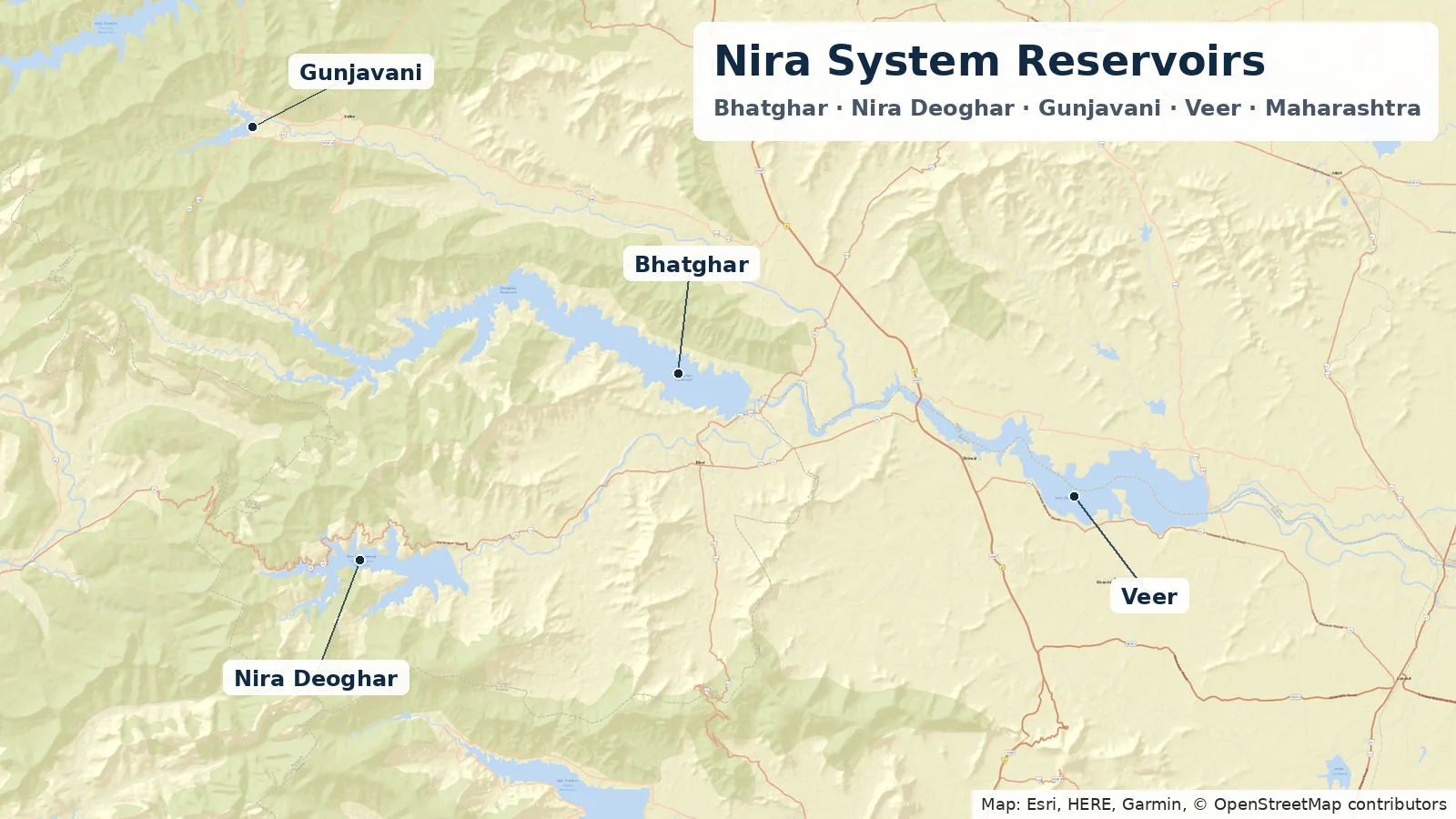
The Nira system, as the press reports below name it, is four dams: Bhatghar, Nira Deoghar, Gunjavani and Veer. The Nira Right Bank Canal and the Nira Left Bank Canal take their water from Veer, according to Lokmat and Urban Acres.
No official Nira plan was found on Water Resources Department pages read for this article. The figures below are according to a preliminary irrigation plan reported by Sarthi Maharashtracha on 23 October 2026, which says the plan was published on 5 October 2026. They have not been checked against an official document.
Nira system preliminary plan, as reported by Sarthi Maharashtracha on 23 October 2026 (TMC)
| Item, as reported | Nira Right Bank Canal | Nira Left Bank Canal |
|---|
| Total water available | 18.25 | 10.65 |
|---|
| Original drinking-water provision, to 31 August 2027 | 1.47 | 0.78 |
|---|
| Drinking water after the 10% cut under the GR | 1.32 | 0.70 |
|---|
| Industrial provision | 0.61 | 0.55 |
|---|
| Water left for irrigation | 16.32 | 9.40 |
|---|
| Rabi irrigation, two rotations, 15 November 2026 to 18 February 2027 | 13.66 | 7.00 |
|---|
| Summer drinking water, seven rotations, 1 March to 31 August 2027 | 2.66 | 2.40 |
|---|
| Summer irrigation | 0.00 | 0.00 |
|---|
The figures are copied as reported. Sarthi Maharashtracha says all figures are in TMC, that the summer drinking-water rotations are planned every 20 days, and that the plan is preliminary and may change with storage, rainfall and administrative decisions.
Releases from Veer since 10 November 2026
Lokmat, on 16 November 2026, reported that water was being released from Veer Dam into the Nira Right and Left canals for farming and drinking water in Malshiras, Sangola and Pandharpur talukas. According to Lokmat, the Nira Right Canal opened on 10 November 2026 and is planned to run until 10 February 2027, with two rotations for farming. Tarun Bharat, on 16 November 2026, reported that releases into the Nira Left Canal also began on 10 November.
The canal discharges reported in cusecs differ between Lokmat (16 November 2026) and Urban Acres (18 November 2026). They are not repeated here.
Lokmat also reported combined storage in Bhatghar, Nira Deoghar, Veer and Gunjavani of 41.387 TMC, or 85.64%, at 6:00 on 12 November 2026, and 6.942 TMC less than a year earlier. That is a press figure for the four dams together. It is a different series from the CWC readings on our data pages below.
River or canal: the dispute in November 2026
Two groups of farmers have asked for different things.
- Release into the Nira river. Pudhari reported on 14 November 2026 that farmers from Indapur and Malshiras talukas blocked the road at the Sarati bypass on 13 November, asking for water from the Bhatghar–Veer chain of dams to be released into the Nira river, which it said had been dry for months. According to Pudhari, Water Resources Minister Radhakrishna Vikhe Patil promised a meeting, set for 16 November at the Collector's office in Pune.
- Release through the canals. Pudhari and Urban Acres reported a joint meeting at Bhavaninagar on 15 November 2026 of farmers from the Shree Chhatrapati, Malegaon and Someshwar sugar factory areas. Prithviraj Jachak, chairman of the Shree Chhatrapati factory, said the Canal Advisory Committee had decided on two rabi rotations and one summer rotation for the Nira Left Canal. He opposed a river release, saying that at least 3 TMC would be lost in pits left by sand extraction, and warned of protests. Someshwar chairman Rajvardhan Shinde said the farmers' views would be taken to Deputy Chief Minister Sunetra Pawar.
The one-summer-rotation figure for the Nira Left Canal is Mr Jachak's account; the Sarthi report gives no summer irrigation rotation. The outcome of the meeting of 16 November 2026: not stated in the sources read.
Current storage on our data pages
These are the latest readings on our data pages, which are built from Central Water Commission (CWC) figures. All four readings are dated 29 October 2026. That is older than the 14-day window our pages use, so the pages mark them as stale.
| Reservoir |
Fill on our page |
Storage |
Reading date |
| Veer Dam |
40.5% of live capacity |
108 MCM |
29 October 2026 |
| Bhatghar |
98.6% of live capacity |
664 MCM |
29 October 2026 |
| Nira Deoghar |
99.8% |
331 MCM |
29 October 2026 |
| Mulshi Dam |
73.6% |
421 MCM |
29 October 2026 |
Gunjavani has no page on this site. Mulshi is on the Mula river, outside the Nira system; our page lists its primary use as hydropower and its operator as Tata. Whether the GR's 10% buffer applies to Mulshi: not stated in the GR, which does not list the reservoirs it calls major.
The percentages are the ones on our pages, from CWC. No figure here is a calculation, and none of the TMC figures from the press has been converted or compared with them.
What is not stated
- A list of the reservoirs the GR treats as "major": not stated.
- The drinking-water "norms" the GR refers to: not stated in the GR.
- The volume of the 10% buffer at any named dam: not stated in any official source read.
- An official copy of the Nira system plan, or of the Canal Advisory Committee's decision for the Nira canals: not found in the sources read.
- The outcome of the meeting of 16 November 2026 on the Nira river release: not stated.
- A start date for the measures other than the 10% local-body cut: not stated in the GR.
The India water restriction thresholds article lists the Maharashtra order alongside other State rules. The El Niño 2026 and world reservoirs article covers the wider season. The Maharashtra reservoir levels in August 2026 and post-monsoon India: who missed the window articles cover how the State's dams filled before the order.
Sources and methodology
Sources checked on 19 November 2026, between 09:20 and 10:30 Europe/Madrid:
- Government of Maharashtra, Water Resources Department, Government Resolution of 5 October 2026, code 202610051722231627, in Marathi. Every GR point on this page was read in that PDF. English renderings are an unofficial translation by reservoirs.earth.
- The Indian Express, Minimum 10% water cut in Maharashtra from October 16 amid drought, El Nino concerns, 5 October 2026 (statement by Girish Mahajan).
- Sarthi Maharashtracha, Nira system preliminary irrigation plan, 23 October 2026, in Marathi (Nira plan figures).
- Lokmat, Water released from Veer Dam into Nira Right and Left Canals, 16 November 2026, in Marathi (canal dates, four-dam storage on 12 November).
- Tarun Bharat, release into the Nira Left Canal, 16 November 2026, in Marathi.
- Pudhari, road blockade at Sarati for a Nira river release, 14 November 2026, and farmers oppose a river release, in Marathi.
- Urban Acres, Nira River Water Release Faces Farmer Opposition in Pune District, 15 November 2026. The page returned HTTP 404 to our server on 19 November 2026; its text was checked as indexed. Urban Acres, Nira Valley Water Release Brings Relief as Canals Run Full, 18 November 2026.
- reservoirs.earth data pages for Veer, Bhatghar, Nira Deoghar and Mulshi, built from CWC figures. See also how we get our data for India.
Units are as published: TMC in the press reports, MCM and percentages on our data pages. No figure has been converted, added or subtracted in the text.
This article sets out the Maharashtra Government Resolution of 5 October 2026 as read in the official Marathi text, and the Nira system plan and releases as reported in the press, on the dates stated. The English renderings of the GR are an unofficial translation; the Marathi text is the official one. reservoirs.earth is not affiliated with any government body. It is general information, not legal advice. Where this page and an official text differ, the official text prevails.
Cite this page: reservoirs.earth, "Maharashtra's 2026 El Niño Water Order: Drinking Water First at Every Dam Until 31 August 2027", sources as of 19 November 2026, https://reservoirs.earth/the-reservoir/maharashtra-el-nino-water-order-dam-priorities-2026.
Related: Veer Dam water level today · Mulshi Dam water level today · Bhatghar Dam water level today · Nira Deoghar Dam water level today · Maharashtra reservoir levels · India reservoir levels
Live fill levels
These widgets show each reservoir's current reading on reservoirs.earth. They update with the site's daily data and may differ from the dated figures above.
Veer Dam water level · data by reservoirs.earth
Bhatghar Dam water level · data by reservoirs.earth
Nira Deoghar Dam water level · data by reservoirs.earth
Mulshi Dam water level · data by reservoirs.earth