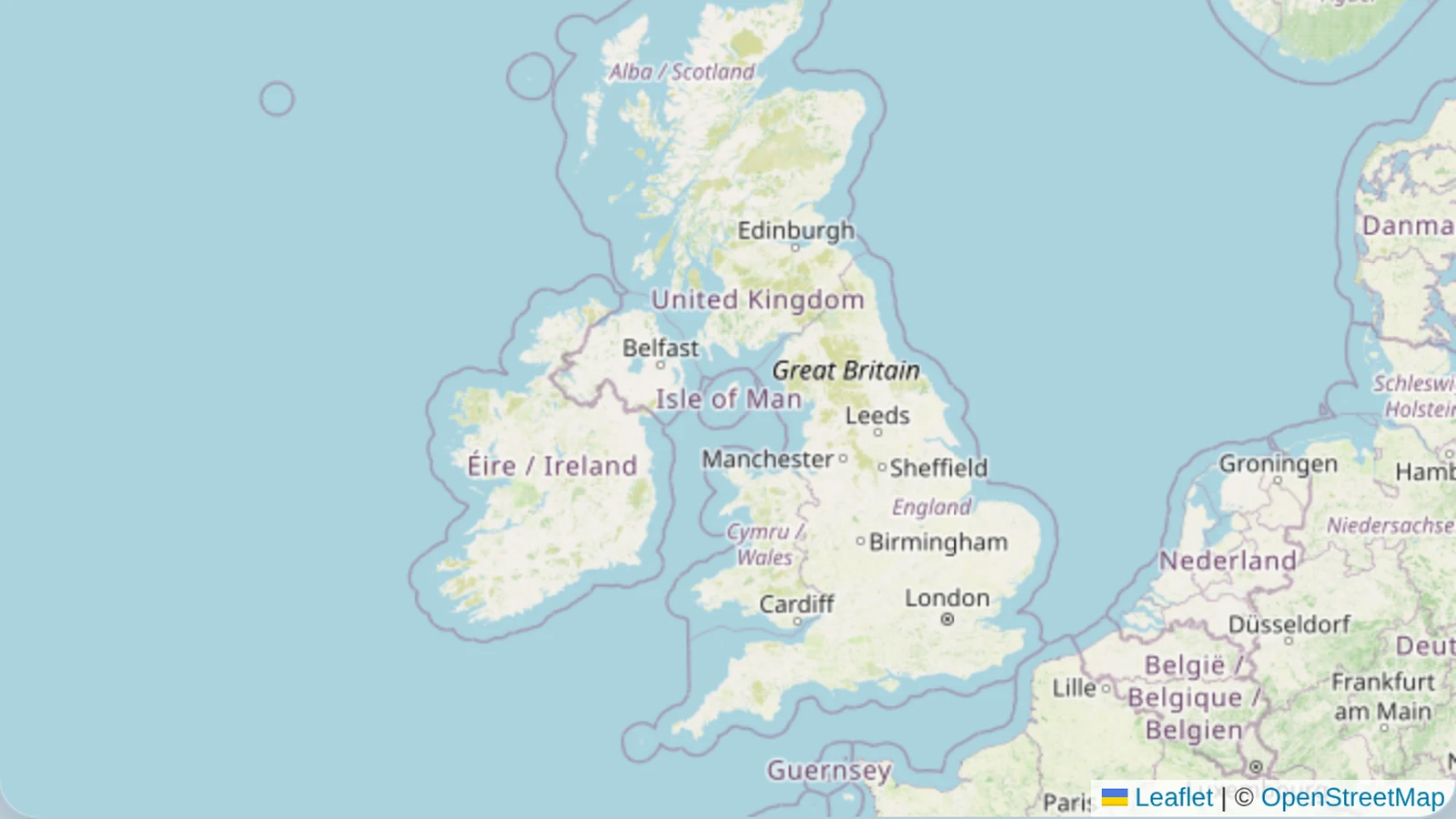
Ten water companies in England had a hosepipe ban in force in the week to 22 October 2026, according to the Environment Agency's dry weather and drought report, published on 23 October. Reservoir storage for England stood at 54% of capacity in the week ending 20 October, around 22% below the long-term average for the time of year. Thirteen reservoirs or reservoir groups were classed as exceptionally low. On 15 October the government declared severe drought in parts of Cornwall, Devon, Dorset, Somerset, East Sussex and West Sussex.
None of the five English drought plans read for this page (Yorkshire Water, United Utilities, Severn Trent, Thames Water and South West Water) puts a single percentage on a hosepipe ban. Each company draws its own drought curves for its own reservoirs, and most publish those curves as charts rather than as numbers.
How this page was put together
For each company, the trigger is quoted from its own drought plan, using the plan's wording. The storage figure is the latest one the company or the Environment Agency (EA) had published by 28 October 2026, with the date that source gives. Where a plan shows its curve only as a chart, the table says "Not stated" rather than reading a number off the chart. Where a company's site could not be read for this page, the table says so. Nothing has been converted, recalculated or projected. Percentages are percentages of usable capacity as each source defines it.
This is a summary for general information. It is not legal advice. Whether a ban applies to a particular address is set by the notice the water company publishes, and that notice is the rule that binds a customer.
The national framework
Who can ban what. Section 76 of the Water Industry Act 1991, which applies in England and Wales, lets a water undertaker prohibit specified uses of water "if it thinks that it is experiencing, or may experience, a serious shortage of water for distribution". The Act lists the uses that can be banned. They include watering a garden with a hosepipe, cleaning a private car or leisure boat with a hosepipe, filling a domestic swimming or paddling pool, filling a domestic pond, running an ornamental fountain, and hosing paths, patios, walls and windows. A prohibition has to state the date it starts and the area it covers. Breaking one is an offence, with a fine of up to level 3 on the standard scale. This is a temporary use ban (TUB), the measure most people call a hosepipe ban.
Exceptions. The Water Use (Temporary Bans) Order 2010 sets out exceptions to those bans. It also defines terms such as "health or safety reasons" and "temporary garden or flower display".
The next step up. A non-essential use ban (NEUB) needs a drought order, which the company has to apply for. The Drought Direction 2011 came into force on 31 March 2011. Its Schedule lists the purposes such an order may restrict, including:
- watering plants on commercial premises with a hosepipe
- filling non-domestic swimming pools
- operating a mechanical vehicle washer
- cleaning non-domestic windows and industrial plant
- suppressing dust with a hosepipe
Drought status. The EA declares a drought status for each of its areas. In its 23 October report:
- Severe drought: parts of Devon, Cornwall and the Isles of Scilly and Wessex, plus the areas supplied by Ardingly reservoir.
- Drought: eleven areas, including Yorkshire, Thames and the West Midlands.
- Prolonged dry weather: the North East, Cumbria and Lancashire, and Greater Manchester, Merseyside and Cheshire.
The EA says each area reviews its status against the triggers in its own drought plan. Water companies report separately on operational drought levels, from DL1 up to DL4.
National Drought Group. The EA report says the National Drought Group meets regularly to monitor risk and preparation, and that its next meeting was set for 28 October.
Reservoir classes are not triggers. The EA classes reservoirs from normal to exceptionally low against their own history. Its report adds a warning: "Classes shown may not necessarily relate to control curves or triggers for drought actions."
Company by company
Yorkshire Water
| Company | Official trigger wording/level | Measure triggered | Latest published storage + date | Source |
|---|---|---|---|---|
| Yorkshire Water | "Temporary use bans (level 2 actions) will be imposed if regional reservoir stocks, or stocks in a number of the area reservoir groups, are forecast to cross the DCL in six weeks … between April and September." DCL percentage: Not stated. | TUB (level 2) | 42.7% reservoir stocks, published 9 October 2026 (52.9% at the same point in 2025) | Drought Plan 2022; Yorkshire Water news |
The DCL is the Drought Control Line in Yorkshire Water's plan. On the day the EA moved Yorkshire into drought, Yorkshire Water said it was "not planning to introduce water restrictions for customers at this time". The EA's 23 October report lists Yorkshire Water at DL1.
United Utilities
| Company | Official trigger wording/level | Measure triggered | Latest published storage + date | Source |
|---|---|---|---|---|
| United Utilities | Drought levels are set on Haweswater Reservoir and the Dee System (Celyn and Brenig). Under "Drought: Level 2" the plan lists "Introduction of Temporary Use Ban, as appropriate". The curves vary month to month and appear only as Figures 3 and 4. Percentage: Not stated. | TUB (Level 2); NEUB at "Emergency planning: Level 3" | Regional total 62.1%, week ending 25 October 2026 (Haweswater & Thirlmere 53.1%; Dee & Vyrnwy 66.0%) | Final Drought Plan 2022; UU reservoir levels |
The plan also says actions are taken "within the range of the level and not immediately when crossing into the level". The EA's 23 October report says the Strategic Resource Zone "continues to be above DL1 in Enhanced Monitoring and Operations".
Severn Trent
| Company | Official trigger wording/level | Measure triggered | Latest published storage + date | Source |
|---|---|---|---|---|
| Severn Trent | Trigger zone E, "Notably low storage": "If storage is in this zone for more than 7 days between April and October we may be considering implementing a TUB." Percentage: Not stated. | TUB (level 2 restriction) | 58.1%, 26 October 2026 | Drought Plan 2022–2027; Severn Trent reservoir levels |
The plan assumes a 14-day "lead in" before restrictions start for household customers. Its note on zone E adds: "On average, we would not expect more than 3 of these in 100 years." In the EA's latest report Severn Trent is at DL2 in North Staffs and at DL1 in Strategic Grid North.
Thames Water
| Company | Official trigger wording/level | Measure triggered | Latest published storage + date | Source |
|---|---|---|---|---|
| Thames Water | "When reservoir storage draws down to control curve Level 2 then the measures at Level 2 of the Levels of Service are triggered." The curve is on the Lower Thames Control Diagram. Percentage: Not stated. | TUBs and enhanced media campaign (Level 2, "1 year in 10 on average") | London reservoirs 56% (West London 53%, Lee Valley 68%) and Farmoor 68%, end of September 2026 | Drought Plan 2022; Thames Water reservoir levels |
The plan says its post-2012 protocol "allows for the earlier introduction of drought measures than required by simply following the guide" on the diagram. Thames Water's hosepipe ban page, last updated 12 October 2026, says a TUB remains in place. The EA lists Thames Water at DL3 in Swindon and Oxfordshire and at DL2 elsewhere.
Southern Water
| Company | Official trigger wording/level | Measure triggered | Latest published storage + date | Source |
|---|---|---|---|---|
| Southern Water | Not quoted: Southern Water's drought plan and TUB pages were unavailable when this page was researched | TUB in force in Hampshire and the Isle of Wight (EA) | Not published in the EA report; no company figures available | EA report, 23 October 2026 |
The EA's report places Southern Water at DL1 in Hampshire and the Isle of Wight. The company applied to the Secretary of State on 31 July for a drought order on the River Test and for a non-essential use drought order, and the decision was still awaited.
South West Water
| Company | Official trigger wording/level | Measure triggered | Latest published storage + date | Source |
|---|---|---|---|---|
| South West Water | Strategic reservoir storage is split into Levels 0–4. "If reservoir storage is in Level 2, then the possible actions could include demand-side actions such as TUBs." The curves are in Appendix A2.2 as charts. Percentage: Not stated. | TUB (Level 2; level of service "1 in 20 years") | Total 35% on 27 October 2026 (51% a year earlier); Roadford 35%, Colliford 33%, Wimbleball 15% | Drought Plan, September 2022; SWW reservoir levels |
TUBs cover all South West Water customers except those in Bournemouth. According to the EA:
- Wimbleball's zone is at DL3, the Isles of Scilly at DL2, and the Colliford and Roadford zones at DL1.
- A drought permit for Wimbleball was issued on 2 October.
- A NEUB drought order application for the Wimbleball zone followed on 6 October.
Dŵr Cymru Welsh Water
| Company | Official trigger wording/level | Measure triggered | Latest published storage + date | Source |
|---|---|---|---|---|
| Dŵr Cymru Welsh Water | Not quoted: the Drought Plan 2025 could not be accessed for this page. The company's dry weather page lists six stages, from "Stage 1 - Normal Operation" to "Stage 6 - End of Drought". | Not stated on the dry weather page | Published weekly as an image only (latest dated 22 October 2026); no figure in text | Welsh Water dry weather page |
The page says "There are now no restrictions in place for Welsh Water customers". It explains that the Mid and South Ceredigion ban, brought in as a short-term emergency measure after weeks of very high demand, was lifted on 4 September 2026. Natural Resources Wales extended drought status to the whole of Wales on 30 July. On 25 September it moved south-west Wales to "recovery from drought".
Scotland and Northern Ireland
| Company | Official trigger wording/level | Measure triggered | Latest published storage + date | Source |
|---|---|---|---|---|
| Scottish Water | Not quoted: Scottish Water's resource levels page did not load when checked | Not stated | Not available | SEPA water scarcity |
| NI Water | Not published | Not published | Not published | — |
Section 76 is an England and Wales provision, so these two operate under different rules. SEPA's water scarcity page, last updated on 26 October 2026, showed:
- 34 areas at normal conditions
- 9 at early warning
- 3 at alert
- 1 at moderate scarcity
- none at significant scarcity
Sources and methodology
- Environment Agency: Dry weather and drought in England: 16 to 22 October 2026 (published 23 October 2026).
- Legislation: Water Industry Act 1991, s.76; Water Use (Temporary Bans) Order 2010, art. 2; Drought Direction 2011 (Defra and Welsh Ministers).
- Drought plans:
- Yorkshire Water, Drought Plan 2022
- United Utilities, Final Drought Plan 2022
- Severn Trent, Drought Plan 2022–2027 (Table 4 and section 3.1.5)
- Thames Water, Final Drought Plan 2022 (Table 1 and the LTCD section)
- South West Water and Bournemouth Water, Final Drought Plan, September 2022 (sections 2.3 and 3.2.2)
- Storage pages, read 28 October 2026: Yorkshire Water news, 9 October 2026; United Utilities, week ending 25 October 2026; Severn Trent, 26 October 2026; Thames Water, end of September 2026; South West Water, 27 October 2026.
- Status pages: Thames Water TUB page (12 October 2026); Welsh Water dry weather page; Natural Resources Wales (25 September 2026); SEPA water scarcity (26 October 2026).
Cite this page: reservoirs.earth, "UK hosepipe bans: the reservoir triggers for each water company", data as of 28 October 2026, https://reservoirs.earth/the-reservoir/uk-hosepipe-ban-reservoir-triggers.
Related: Australia water restriction thresholds · Spain drought water restrictions · India water restriction thresholds · How close is your city to water restrictions? (US) · Where our reservoir data comes from