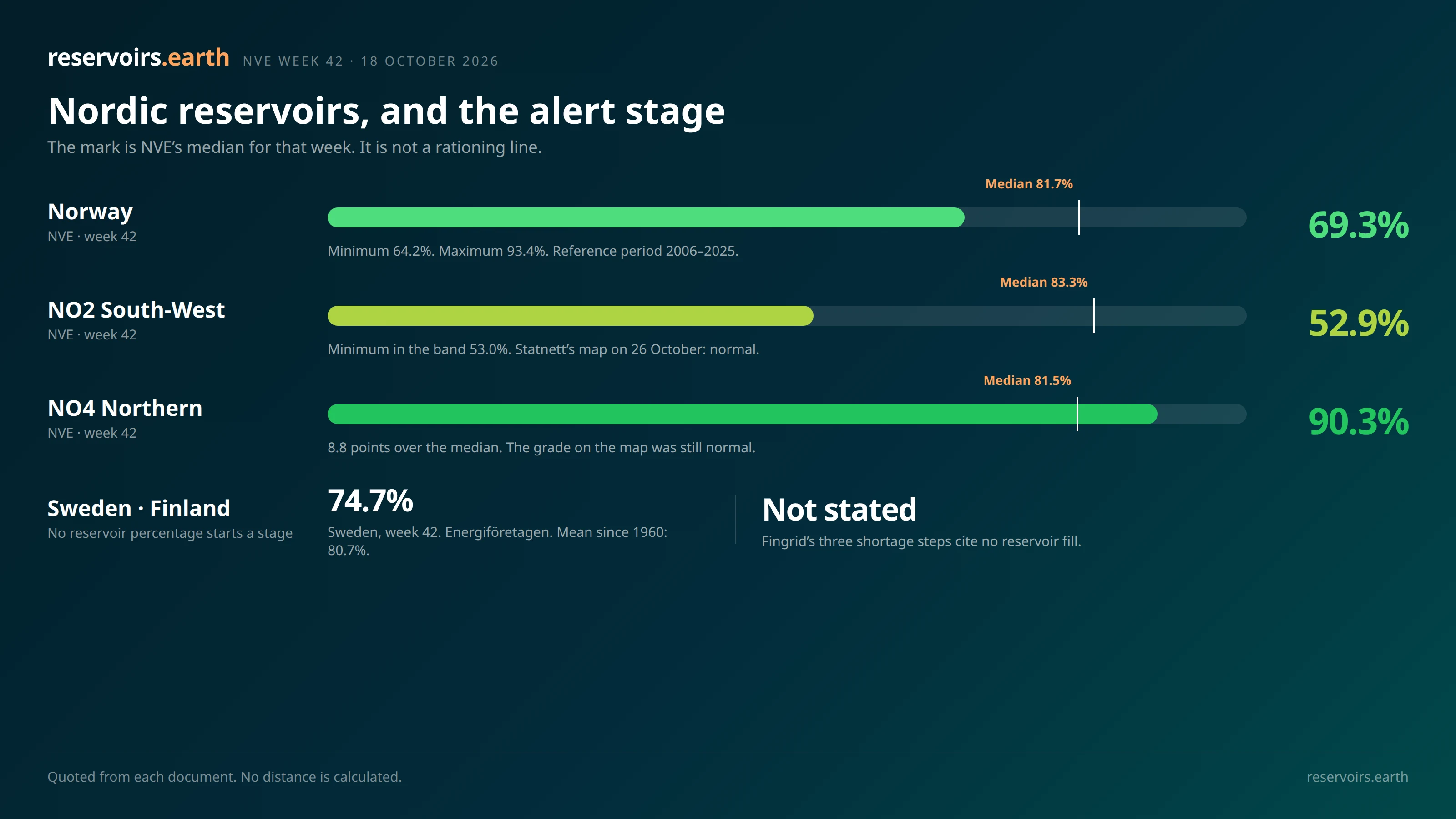
At the end of week 42, Norway's hydropower reservoirs were 69.3% full. NVE published that figure on 21 October 2026. It is the Sunday reading for 18 October. The median for the week, over 2006–2025, is 81.7%, so the country sat 12.4 points under it. The week's minimum is 64.2% and the maximum is 93.4%.
Two price areas finished under their own weekly minimum. NO1 (South-East) was 74.7%, against 80.0%. NO2 (South-West) was 52.9%, against 53.0%. On 26 October 2026 Statnett's power-situation map still classed NO1, NO2, NO3, NO4 and NO5 as normal. The line for NO2 says the situation is normal for the season. A reservoir percentage does not open any of these stages.
Quick answer
Norway's hydropower reservoirs were 69.3% full at the end of week 42, 12.4 points under the 2006–2025 median of 81.7%. NVE published that on 21 October 2026. NO1 was 74.7%, under an 80.0% weekly minimum. No reservoir percentage starts a Nordic shortage stage, and on 26 October 2026 every Norwegian zone was still graded normal.
Official alert stages (26 October 2026)
| Country | Stage | Official body | Criteria / trigger | What it triggers | Source |
|---|---|---|---|---|---|
| Norway | Normal (green) | Statnett | Reservoir fill: Not stated. English legend: rationing under 5%. Norwegian legend: no percentage. | Watching the season. NO1–NO5 were here on 26 October 2026. | Statnett map |
| Norway | Stram (yellow) | Statnett | Reservoir fill: Not stated. English legend: under 20% before extraordinary measures. Norwegian legend: Not stated. | Closer watch. NVE may plan tools under §§ 11–13. | Statnett map; NVE phases |
| Norway | Anstrengt (orange) | Statnett | Reservoir fill: Not stated. English legend: 20–50% before extraordinary measures. Norwegian legend: Not stated. | Ordinary tools. Statnett may ask to use some shortage measures early. | Statnett map; NVE phases |
| Norway | Svært anstrengt (red) | Statnett | Reservoir fill: Not stated. English legend: above 50% before extraordinary measures. Norwegian legend: Not stated. | Further measures. NVE may ask the ministry to declare rationing. | Statnett map; NVE phases |
| Norway | Rasjonering | Ministry of Energy decides; NVE carries it out | Reservoir fill: Not stated. Energy Act § 6-2: extraordinary circumstances. | A kWh quota is NVE's preferred tool. Compulsory cuts and requisition are also open. | Energy Act § 6-2; NVE |
| Sweden | Manual disconnection (MFK) | Svenska kraftnät | The hour cannot be covered, with a risk of effektbrist. Reservoir fill: Not stated. | Selected grid companies disconnect within 15 minutes. The cut can be rotated. | Svenska kraftnät |
| Sweden | Styrel | Energimyndigheten | A priority plan, not a reservoir percentage. | Used during a manual disconnection. Not a guarantee of supply. | Styrel |
| Finland | Normal (0) | Fingrid | Reservoir fill: Not stated. Code 0 on the shortage series. | No disconnection under the shortage procedure. | Fingrid dataset |
| Finland | Electricity shortage possible (1) | Fingrid | Fast reserves and imports look short of the hour. Reservoir fill: Not stated. | Fingrid and the Ministry of Economic Affairs and Employment announce it. | Fingrid |
| Finland | High risk of electricity shortage (2) | Fingrid | All Finnish production is in use, and no more can be imported. Reservoir fill: Not stated. | The same two announcements. | Fingrid |
| Finland | Electricity shortage (3) | Fingrid | Production and imports do not cover consumption. Reservoir fill: Not stated. | Rotated disconnection. For households, often an hour or two. | Fingrid |
What the Norwegian grades mean
Statnett sets the grade from inflow, reservoir filling, expected consumption and import capacity. The chances in the table are the English legend. Statnett's note of 30 September 2022 says those limits are indicative, because an exact probability of rationing cannot be calculated. The Norwegian text on the map leaves the percentages out.
On 6 October 2026 Statnett still called the situation normal, with a low chance of serious trouble this winter. End of September, it said, the country was about 15 points under the 2006–2025 median. Week 42 is the later reading, 12.4 points under.
NVE's phase guide uses those five names as a description of the season. Rationing is the one that needs a decision: NVE recommends, the Ministry of Energy decides, under § 6-2. The English map still cites the older § 5 A-2.
Week 42 by area
NVE publishes the filling degree every Wednesday at 13:00. The series page, updated 19 October 2026, says the sample is the 489 largest reservoirs and that capacity as of September 2025 is 87.4 TWh, counted as energy. The open feed dates this week to 18 October 2026, gives the national content as 60.558 TWh, and names the next publication as 28 October 2026 at 13:00.
Table 1 of the week-42 report is the fill, the median and the gap. The footnote dates the median to 2006–2025. Minimum and maximum are the min/median/max feed, to one decimal. The handbook of 16 August 2023 sets the Sunday reading and the 20-year window. The charts are on the Norway page.
| Area | Week 42, 18 October 2026 | Median | Minimum | Maximum | Points vs median |
|---|---|---|---|---|---|
| Norway | 69.3% | 81.7% | 64.2% | 93.4% | −12.4 |
| NO1 South-East | 74.7% | 88.0% | 80.0% | 97.0% | −13.3 |
| NO2 South-West | 52.9% | 83.3% | 53.0% | 94.3% | −30.4 |
| NO3 Central | 72.5% | 83.3% | 67.1% | 95.4% | −10.8 |
| NO4 Northern | 90.3% | 81.5% | 67.0% | 95.5% | +8.8 |
| NO5 Western | 73.2% | 86.3% | 64.4% | 92.9% | −13.1 |
NO4 is the area above its median, at 90.3%, 8.8 points over it. The country rose 0.3 points on the week, from 69.0% to 69.3%. A July note, Norway's levels in early July 2026, used a five-year average worked out here, which is not this median.
Who can order rationing
Section 6-2 lets the ministry start rationing, including compulsory cuts or requisition of production, when extraordinary circumstances call for it. NVE's rationing page, updated 25 November 2025, says the Ministry of Energy starts and stops it on NVE's recommendation.
The working rules are the regulation on energy shortage and power rationing of 19 December 2023. Section 33 brought it into force on 1 January 2024, except sections 5 to 16 and section 27. An amendment of 20 June 2024 put those sections into force on 1 July 2024, and repealed the 2001 rationing regulation the same day. Those sections are the duties of NVE and Statnett, the shortage tools, and requisition.
If rationing is declared, NVE prefers a kWh quota. Use above it is priced on top of the power price, the grid tariff and the taxes, and households keep their supply. The page names no fill that would start it. NVE says a rationing would not arrive in the coldest weeks: if it comes, in April or May. Another passage puts it at the end of winter, when the reservoirs are lowest.
Sweden
Sweden publishes no reservoir percentage that starts a shortage stage. When the hour cannot be covered, Svenska kraftnät can order a manual disconnection. Grid companies have 15 minutes. Styrel names who to protect, and it is not a promise the power stays on. Energimyndigheten says a disconnection for an imbalance has not been ordered yet, though it has been close.
The weekly storage figures are Energiföretagen's, not an alert. For 12–18 October 2026 the magasinsläge puts Swedish reservoirs at 74.7%, down from 75.3%. Energy content 25,062 GWh, with 100% set at 33.7 TWh. The mean for that point in the year, 1960–2025, is 80.7%. By zone: SE1 70.0% (10,366 GWh), SE2 82.0% (12,848 GWh), SE3 63.5% (1,806 GWh), SE4 19.1% (42 GWh). Inflow was 1,059 GWh, 91% of the 1960–2025 median. The sheet is preliminary, posted from Kraftläget.
NVE's week-42 table also lists Sweden at 74.7%, median 77.8%, 3.1 points under. The 2006–2025 footnote covers Norway, not that Swedish median, and Energiföretagen's 80.7% is a 1960–2025 mean. Kraftbalansen of 15 October 2026 says winter supply looks good and the risk of effektbrist is low, though prices can still be high. This site has no Sweden data page. The score is the Reservoir Transparency Index for Sweden.
Finland
Finland publishes no reservoir percentage that starts an electricity-shortage stage. Fingrid runs three steps, numbered 1, 2 and 3 on an open series that uses 0 for a normal hour and updates every three minutes. They follow the hour, from thin reserves to a rotated disconnection, and none of them mentions a reservoir.
The overview at vesi.fi showed no date on 26 October 2026, so no Finnish level is taken from it. Readings held here are on the Finland page. The score is in the Reservoir Transparency Index.
Market context
Nord Pool runs the day-ahead auction for NO1–NO5, SE1–SE4 and Finland. For week 42, 12–18 October 2026, its weekly average was 146.11 EUR/MWh in NO1, 152.62 in NO2, 113.56 in NO3, 23.45 in NO4 and 141.20 in NO5. Sweden ran from 35.41 in SE1 to 154.69 in SE4. Finland was 53.32. Those are auction prices. They do not open a shortage stage.
Method
Checked on 26 October 2026. No fill was turned into a stage. Fills, medians, gaps and the 0.3 point rise are Table 1 of the week-42 report and the note of 21 October. Minimum and maximum are the min/median/max feed. The 1 January and 1 July 2024 dates are section 33, as amended on 20 June 2024. The indicative probability limits are Statnett's note of 30 September 2022. Swedish storage is Energiföretagen's week-42 sheet. The line that a disconnection has not been ordered yet is Energimyndigheten's Styrel page. Nord Pool's week-42 prices are its own weekly day-ahead aggregate, in EUR/MWh. Fingrid's steps are its questions page and dataset 336.
Related
The same kind of page, where a storage line is published: Australia, Spain, India. Where the numbers on this site come from: the source list. Country series: Norway, Finland. Index: Norway, Sweden, Finland.
Cite this page: reservoirs.earth, "Nordic Reservoir Levels & Power-Rationing Alert Stages", data as of 26 October 2026, https://reservoirs.earth/the-reservoir/nordic-hydro-reservoir-alert-levels.