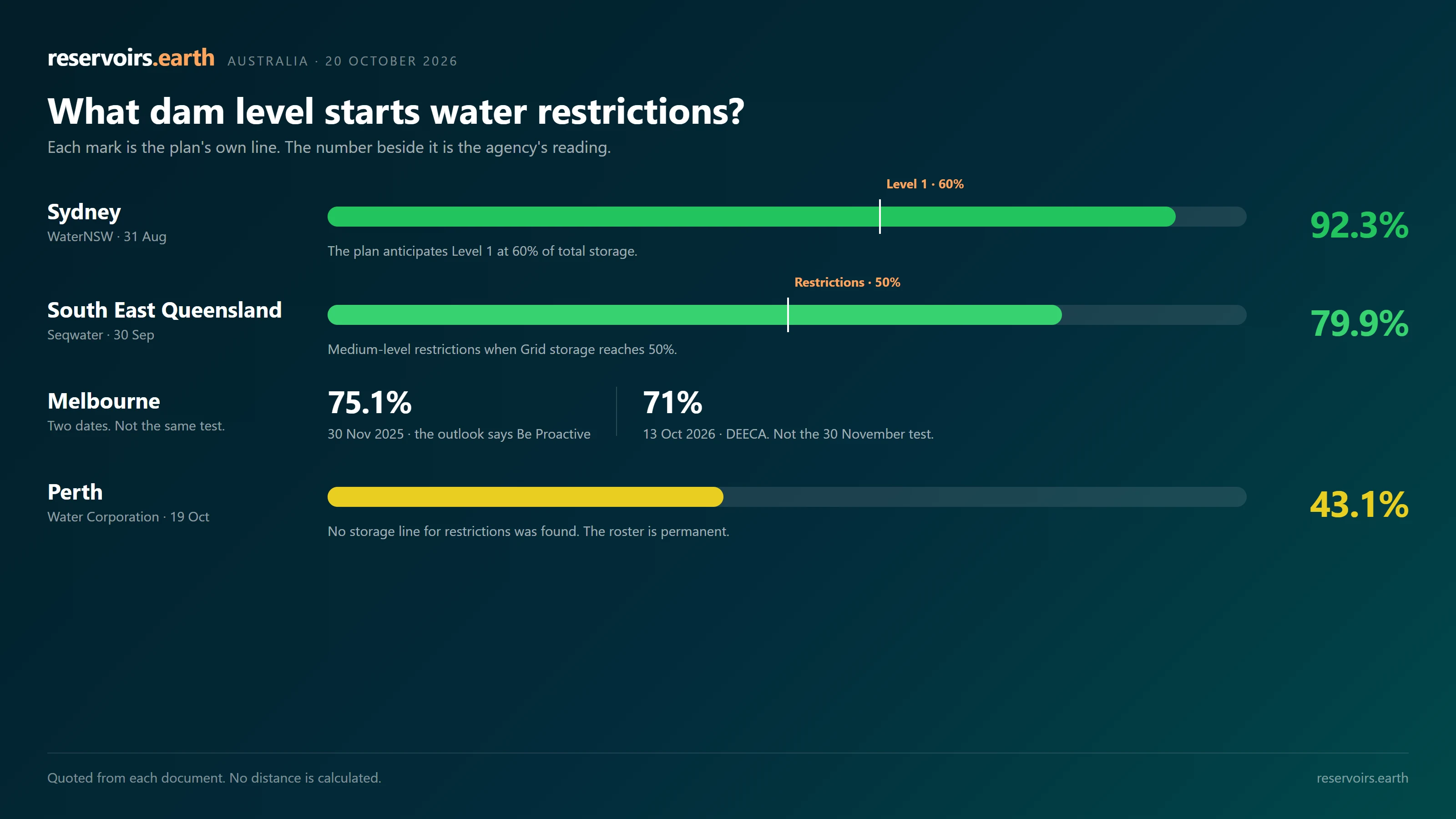
Three of Australia's eight capital cities publish a storage line that starts restrictions: Sydney (Level 1 anticipated at 60% total storage), South East Queensland (restrictions at 50% of Water Grid storage) and Melbourne (zones tested on 30 November). Perth's metropolitan dams were at 43.1% on 19 October 2026, but its water plan sets no storage line for restrictions. Adelaide, Hobart, Canberra and Darwin publish no numeric storage trigger in the documents used here.
This page does not decide whether a restriction applies, and it does not estimate when one will start. It quotes two things separately. The first is the storage line written in each city's drought plan or water security program. The second is the latest storage figure published by the agency that owns that figure. A stage is named only when the utility, the state agency or the Bureau of Meteorology has stated it. A news report is not used, and an undated figure is not used. Units are those of the source document.
Australia has no national trigger scale. A "Level 1" in Sydney and a "Stage 1" in Hobart are different rules. Where a plan says what a stage requires of a household, that rule is quoted in a sentence. Quoting the rule is not a finding that it applies to a particular address today. The utility's own by-law or order is the rule that binds a customer.
Key takeaways
- The Greater Sydney Drought Response Plan (overview, January 2026) anticipates Level 1 restrictions at 60% total storage, Level 2 at 45%, Level 3 at 35%, Level 4 at 25% and Level 5 at 15%. WaterNSW's August 2026 operations report gives total storage of 92.3% on 31 August.
- Seqwater's Water Security Program 2023 declares drought, with medium-level restrictions, when SEQ Water Grid storage reaches 50%. Its pre-drought phase starts at 70%. Seqwater's September 2026 update gives Grid storage of 79.9% on 30 September.
- Melbourne's retailers test total system storage on 30 November each year against four zones: Be Responsible (75% and above), Be Proactive, Act Now and Critical Water Use Only. Melbourne's Annual Water Outlook 2026 reports 75.1% on 30 November 2025 and 745 billion litres available, and says that places Greater Melbourne in the Be Proactive zone. DEECA reported 71% on 13 October 2026, and every Melbourne town is on Permanent Water Saving Rules.
- Perth's metropolitan dams held 271.69 GL (43.1%) on 19 October 2026. The rule in force is a permanent roster with a legislated winter sprinkler switch-off. No storage line for further restrictions was found.
Capital cities at a glance
| City | Agency | What is measured | Plan's storage line | Latest quoted figure | Source |
|---|---|---|---|---|---|
| Sydney | Sydney Water / WaterNSW | Total storage, Greater Sydney dams | Level 1 anticipated at 60% | 92.3% (31 Aug 2026, WaterNSW) | GSDRP overview, Jan 2026 |
| Brisbane / SEQ | Seqwater | SEQ Water Grid storage | Restrictions at 50% | 79.9% (30 Sep 2026, Seqwater) | Water Security Program 2023 |
| Melbourne | Melbourne retailers / Melbourne Water | Total system storage on 30 November | Be Proactive below 75%; Act Now below 60% | 75.1% and 745 GL available (30 Nov 2025); zone stated: Be Proactive | Drought Preparedness Plan; Annual Water Outlook 2026 |
| Perth | Water Corporation | Metro dam storage | Not stated | 43.1%, 271.69 GL (19 Oct 2026) | Water Corporation dam levels |
| Adelaide | SA Water | Metro reservoir storage | Not stated | 166.1 GL of 198.7 GL, 84% (19 Oct 2026) | SA Water reservoir data |
| Hobart | TasWater | Streamflow and dam levels against internal trigger levels | Not stated | Not stated | TasWater water supply status |
| Canberra | Icon Water | Storage, forecasts and use | Not stated | Not stated (Icon Water pages unavailable on 20 Oct 2026) | Icon Water |
| Darwin | Power and Water | Darwin River Dam | Not stated | Not stated (dam-level page shows data unavailable, 20 Oct 2026) | Power and Water |
Current rule named by each agency
| City | Rule named | Who states it | Date of the statement |
|---|---|---|---|
| Sydney | WWG (Water Wise Guidelines) | Bureau of Meteorology, national water restrictions list | Undated listing, read 20 Oct 2026 |
| Brisbane / SEQ | No restriction | Bureau of Meteorology list (Urban Utilities) | Undated listing, read 20 Oct 2026 |
| Melbourne | Permanent Water Saving Rules | DEECA current water snapshot | Restrictions data updated 1 Oct 2026 |
| Perth | Rostered watering days; winter sprinkler switch-off 1 June–31 August | WA Department of Water and Environmental Regulation | Page updated 21 May 2026 |
| Adelaide | Water Wise Measures | Bureau of Meteorology list | Undated listing, read 20 Oct 2026 |
| Hobart | Stage 1 in the Bureau list; Greater Hobart not named on TasWater's status page | Bureau of Meteorology list | Undated listing, read 20 Oct 2026 |
| Canberra | Permanent Water Conservation Measures | Bureau of Meteorology list | Undated listing, read 20 Oct 2026 |
| Darwin | No restrictions | Bureau of Meteorology list | Undated listing, read 20 Oct 2026 |
The Bureau's list does not carry a date for each entry. Where it is the only source for a status, that is stated in the row.
Sydney
The Greater Sydney Drought Response Plan is published by Sydney Water and WaterNSW. Its January 2026 overview ties actions to total storage in the Greater Sydney dams:
- Preparing for drought: starts as storage approaches 75%, and Shoalhaven transfers begin at 75% total storage (or earlier, subject to Ministerial approval).
- Responding to drought: starts as total storage approaches 60%. The plan anticipates Level 1 at 60%, Level 2 at 45% and Level 3 at 35%.
- Extreme drought: the plan anticipates Level 4 at 25% and Level 5 at 15%. By 40% storage, the Drought Executive Committee is to advise the Minister and Cabinet on further restrictions.
The plan uses the word "anticipated" for each level. It places decisions on restrictions with the Minister and Cabinet, on advice from the Drought Executive Committee, and allows the response to start above 60% when supply risks warrant it.
WaterNSW's Greater Sydney Operations Report for August 2026 gives 2,416,194 ML in storage on 31 August, 92.3% of 2,618,706 ML. The Bureau of Meteorology's national list names Sydney Water's current rule as WWG (Water Wise Guidelines).
Brisbane and South East Queensland
Seqwater's South East Queensland Water Security Program 2023 sets its drought response triggers on SEQ Water Grid storage:
| Grid storage | Phase in the program | What the program lists |
|---|---|---|
| 70% | Pre-drought | Preliminary actions that incur costs above business as usual; the program's figure shows Gold Coast Desalination Plant production increasing at 65% (±5%) |
| 50% | Drought declared | Medium-level water restrictions, targeting regional residential use of 140 litres per person per day |
| 40% | Drought | Purified recycled water into Wivenhoe |
| 25% | Extreme drought | Contingency supplies and high-level restrictions, targeting 120 litres per person per day |
| 10% | Essential Minimum Supply Volume | EMSV-level restrictions |
Seqwater's Water Security Update for September 2026 gives Grid storage of 79.9% on 30 September. The same update reports two local, non-Grid communities in Trigger 1 – Drought Readiness: Dayboro, and Linville from 21 September. The Bureau of Meteorology's list names no restriction for Urban Utilities customers.
Melbourne
Melbourne's retailers (Greater Western Water, South East Water and Yarra Valley Water) and Melbourne Water use four water outlook zones. South East Water's Drought Preparedness Plan defines them on total system storage (TSS) on 30 November:
| Zone | Total system storage on 30 November |
|---|---|
| Be Responsible | 75% and above |
| Be Proactive | below 75%, and 60% or more |
| Act Now | below 60%, and 45% or more |
| Critical Water Use Only | below 45%, and 25% or more (minimum operating level) |
Melbourne's Annual Water Outlook 2026 also gives the zone lines in volume: 760 GL, 530 GL and 300 GL. The plan says Stage 1 and/or Stage 2 restrictions may be used in the Be Proactive zone, and Stage 3 and/or Stage 4 restrictions in the Act Now zone. The plan lists these as measures that may be included, not as automatic steps.
The Annual Water Outlook 2026 (December 2025) reports storage of 75.1% on 30 November 2025 and 745 billion litres available for Greater Melbourne, and states that this places the city in the Be Proactive zone. The next test date in the plan is 30 November 2026. DEECA's current water snapshot reported Melbourne's combined storage at 71% on 13 October 2026, and states that all towns are on Permanent Water Saving Rules except the Forest Hill system (Central Highlands Water), which is on Stage 3. The 13 October figure is not the 30 November test.
Perth
Water Corporation reported Perth metropolitan dam storage of 271.69 GL (43.1%) on 19 October 2026, against 312.62 GL (49.6%) a year earlier. Dams are one of several sources for Perth. Water Corporation's page also lists desalination, groundwater and groundwater replenishment. No storage line for temporary restrictions was found in the documents used here.
The rules in force are permanent. The WA Department of Water and Environmental Regulation describes a legislated sprinkler switch-off from 1 June to 31 August each year in Perth and Mandurah (Area 3). The Bureau's list names Area 3 rostered watering days. Outside the switch-off, sprinklers may be used only on rostered days and not between 9 a.m. and 6 p.m. Hand watering is permitted. The fine for a proven breach is $100.
Adelaide
SA Water's reservoir page reports 166.1 GL in metropolitan Adelaide reservoirs on 19 October 2026, 84% of 198.7 GL, against 130.9 GL on the same day a year earlier. The page notes that reservoirs can also store River Murray water. No storage line for restrictions was found. The Bureau's list names Water Wise Measures for SA Water. The documents used here do not state a dam level at which a stricter regime would start.
Hobart
TasWater says it assesses water security by comparing streamflow and dam levels in its catchments against trigger levels. The trigger values are not published on its pages. Its restriction guidelines define:
- Stage 1: reduce non-essential use by about 20%. Handheld watering is allowed any time; manual watering only from 6 to 8 a.m. and 8 to 10 p.m.; automatic watering from midnight to 4 a.m.
- Stage 2: reduce non-essential use by about 50%, with allocated watering days and no lawn watering.
- Stage 4: only essential public-health use.
The Bureau's list names Stage 1 for TasWater's Hobart entry. TasWater's water supply status page, read on 20 October 2026, lists restrictions for other towns (Oatlands, Orford, Triabunna, Lady Barron) and does not name Greater Hobart. No current stage is stated here for Greater Hobart.
Canberra
The Bureau's list names Permanent Water Conservation Measures for Icon Water. Icon Water says it forecasts storage levels across climate scenarios to evaluate the risk of entering water restrictions. No numeric storage trigger was found in its current documents. Icon Water's storage pages returned errors on 20 October 2026, so no storage figure is quoted.
Darwin
Power and Water's Darwin Region Water Security Annual Update (August 2025) states that up to 95% of Darwin's water comes from Darwin River Dam. It says the reservoir reached 97% capacity during the 2024/25 wet season, "meaning we are unlikely to have water restrictions for the coming year". It sets no storage percentage for restrictions; it describes restrictions as a response to a series of below-average wet seasons. On 20 October 2026, Power and Water's dam page showed the level as temporarily unavailable. The Bureau's list names no restrictions.
How this compares with the US
The US equivalent of this page, How close is your city to water restrictions?, quotes 44 American drought plans in the same way.
Sources and methodology
Sources were last checked on 20 October 2026. Where a row carries an earlier date, that is the date of the reading. A sentence that describes what a stage requires is taken from the utility's plan or guidelines. It is not a finding that the rule binds a particular customer today.
Each storage line is quoted from the plan, in that document's own units. Nothing is converted, no gap is computed, and no date is estimated. A stage or rule is named only when the utility, the state agency or the Bureau of Meteorology has stated it.
- Sydney: Sydney Water and WaterNSW, Greater Sydney Drought Response Plan overview, January 2026; WaterNSW, Greater Sydney Operations Report, August 2026 (31 August).
- South East Queensland: Seqwater, South East Queensland Water Security Program 2023, Figure 10 and the drought phases; Seqwater, Water Security Update, September 2026 (30 September).
- Melbourne: South East Water, Drought Preparedness Plan (water outlook zones); Melbourne's Annual Water Outlook 2026, December 2025 (30 November 2025); DEECA, current water snapshot (storage 13 October 2026; urban restrictions data 1 October 2026).
- Perth: Water Corporation, dam levels (19 October 2026); WA Department of Water and Environmental Regulation, Sprinkler switch off (updated 21 May 2026).
- Adelaide: SA Water, reservoir data (19 October 2026).
- Hobart: TasWater, water restriction guidelines and water supply status (read 20 October 2026).
- Canberra: Icon Water, Permanent Water Conservation Measures and operating rules pages.
- Darwin: Power and Water, Darwin Region Water Security Annual Update, August 2025; Darwin River Dam page (read 20 October 2026).
- Status lists: Bureau of Meteorology, Water Restrictions (read 20 October 2026).
Cite this page: reservoirs.earth, "What dam level starts water restrictions in Australia's capital cities?", data as of 20 October 2026, https://reservoirs.earth/the-reservoir/australia-water-restriction-thresholds.
Related: How close is your city to water restrictions? (US) · Australia reservoir levels, July 2026 · Day Zero: the cities that nearly ran dry