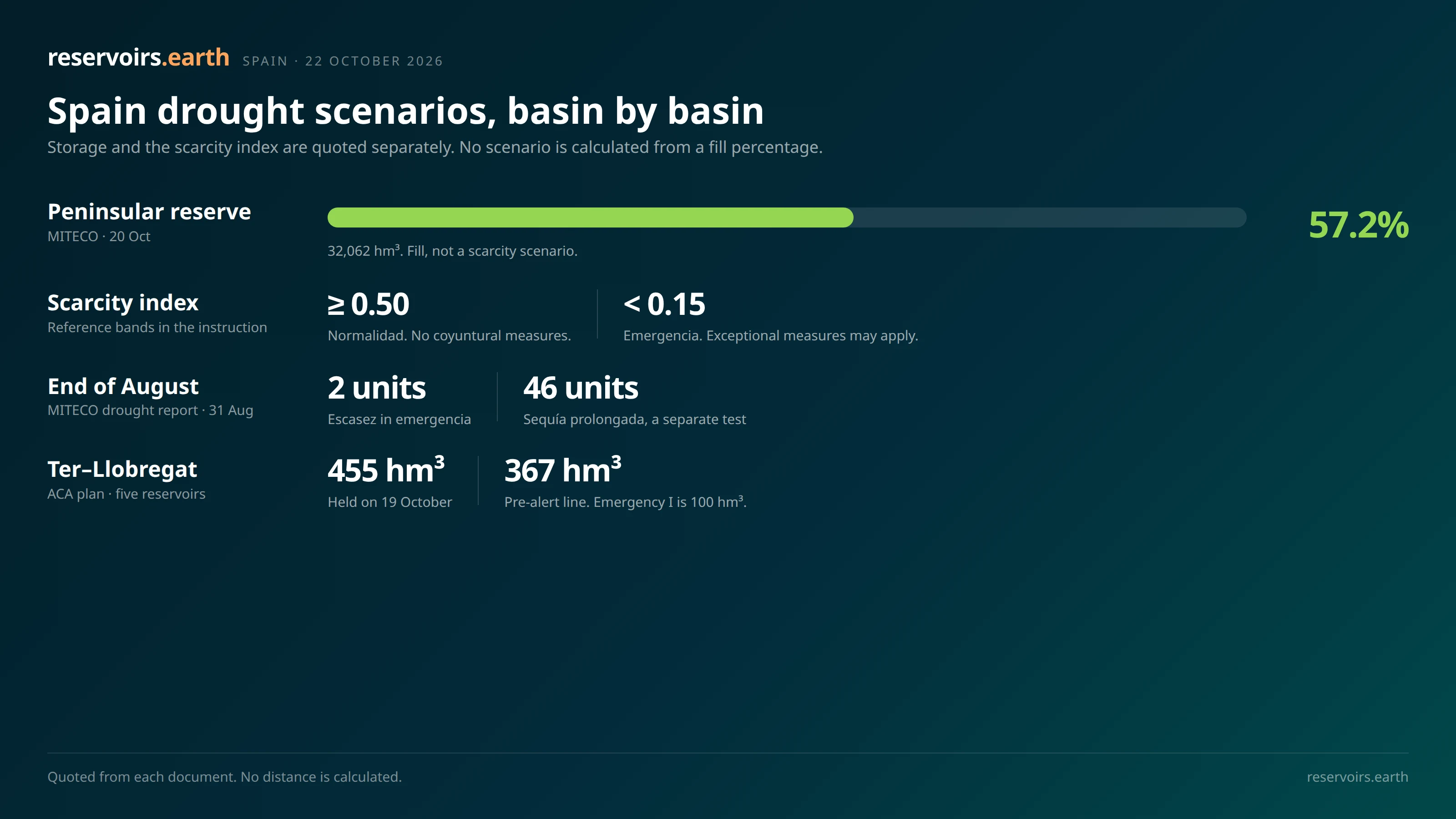
On 19 October 2026 the reservoirs with a current reading on the Spain page were 57.2% full — 32,052 hm³ stored against 56,043 hm³ of their capacity. The Ministry for the Ecological Transition's note the next day put the peninsular reserve at the same 57.2%, 32,062 hm³. A fill percentage does not start a restriction. Spain's drought plans use a separate scarcity index, scored from 0 to 1, and Catalonia runs a third system of its own.
This page quotes two things separately. One is the line written in the drought plan or in the ministry's scenario report. The other is the storage figure, with its date. It does not decide whether a restriction binds a particular address. It does not turn a reservoir percentage into a scenario.
Key takeaways
- The tracked reservoirs were 57.2% full on 19 October 2026, 32,052 hm³ in the 374 reservoirs with a current reading. The ministry's note of 20 October reported 32,062 hm³, also 57.2%, down 352 hm³ on the week. Live figures are on the Spain page.
- At the end of August, 46 drought units were in prolonged drought, and 2 scarcity units were in emergency. Thirteen more scarcity units were in alert. Those counts are from the ministry's September drought report, data to 31 August. They are not a reading of the 57.2%.
- The reference bands for the scarcity index are 0.50, 0.30 and 0.15. Above 0.50 is normality. From 0.30 to 0.50 is pre-alert. From 0.15 to 0.30 is alert. Below 0.15 is emergency. Moving into a more severe scenario generally takes two consecutive months. A basin plan can adjust that.
- The Guadiana's reservoirs were 71.8% full on 19 October, and its Mancha Occidental unit was in emergency at the end of August, with a scarcity index of 0.133. Storage in the dams and the scarcity scenario are different measurements.
- Catalonia does not use those four names. The Catalan Water Agency's plan adds an exceptionality phase and splits emergency into three steps. On the Ter–Llobregat reservoirs the pre-alert line is 367 hm³ and emergency I is 100 hm³. The five reservoirs in that test held 455 hm³ on 19 October. That comparison is not a declaration.
At a glance
| Place | What is measured | Line in the plan or the report | Latest quoted figure | Source |
|---|---|---|---|---|
| Spain, peninsular reserve | Reservoir storage | No national storage line for restrictions | 57.2%, 32,062 hm³ (20 Oct 2026) | MITECO weekly note |
| Spain, this site | Capacity-weighted fill of reservoirs with a current reading | Same: storage is not the scenario | 57.2%, 32,052 hm³ (19 Oct 2026) | Spain page |
| Scarcity index | Index from 0 to 1, per scarcity unit | 0.50, 0.30 and 0.15 | Not one national number | 2017 technical instruction |
| Prolonged drought | Separate natural-drought test, per drought unit | In prolonged drought, or not | 46 units, 31 Aug 2026 | MITECO September report |
| Scarcity scenarios | Normality, pre-alert, alert, emergency | Measures attach to the scenario, not to a fill % | 2 units in emergency, 13 in alert, 31 Aug 2026 | MITECO September report |
| Segura | Index, and the declared scenario | A unit can sit in the pre-alert band and still be declared normality | Global index 0.732, scenario normality (1 Oct 2026) | Confederación Hidrográfica del Segura |
| Catalonia, Ter–Llobregat | Combined reserves in five reservoirs, hm³ | Pre-alert below 367; alert below 210; exceptionality below 145; emergency I below 100 | 455 hm³ (19 Oct 2026) | ACA plan; readings on this site |
| Catalonia, urban cap | Litres per person per day, once a phase is declared | Alert 250; exceptionality 230; emergency I / II / III: 200 / 180 / 160 | Phase is the agency's resolution | ACA plan, consolidated April 2024 |
Storage, prolonged drought, and scarcity
Spain's special drought plans (Planes Especiales de Sequía, PES) are written per river-basin district (demarcación hidrográfica). The inter-community districts — the rivers that cross more than one autonomous community — are run by the river-basin confederations under the ministry. Galicia-Costa, the internal basins of the Basque Country, the Andalusian intra-community basins, and the Catalan river-basin district have their own administrations. The BOE of 15 June 2026 published Order TED/601/2026, of 1 June, approving the revised plans for the inter-community districts. The September drought report is the first national picture drawn on those revised plans.
Each plan keeps two tests.
Prolonged drought (sequía prolongada) is the natural test. It tracks precipitation and flows close to the natural regime, on drought units (unidades territoriales de sequía, UTS). A unit is either in prolonged drought or it is not. When it is, the plan can apply the less demanding ecological flows already written into the river-basin plan, and a temporary deterioration of a water body can be justified after the fact. The September report is explicit: prolonged drought is a natural situation, and demand does not define it.
Scarcity (escasez coyuntural) is the management test. It asks whether the system can keep meeting the demands on the books. The indicator is built from reservoir volumes, inflows, groundwater levels, snow, or — where supply depends on desalination or reuse — from whether those plants are operating. The variables are combined into one index per scarcity unit (unidad territorial de escasez, UTE) and scaled from 0 to 1. The September report's annex says a basin-wide index is published for information only. It does not switch measures on.
The two maps therefore diverge. August 2026 rainfall on the peninsula was 22.9 mm, close to the 23.4 mm average for August in 1991–2020, and the drought report still counted 46 drought units in prolonged drought: 3 in Cantábrico Oriental (Nervión, Bidasoa and Ríos Pirenaicos), 2 in Cantábrico Occidental (Porcía and Villaviciosa), 5 in the Duero (Támega–Manzanas, Órbigo, Esla, Carrión and Pisuerga), 1 in the Tajo (Bajo Tajo), 14 in the Guadalquivir, 9 in the Ebro, 3 in the Cuencas internas del País Vasco (Oka, Lea and Artibai), all 4 units of Tinto, Odiel y Piedras, and 5 of the 6 units of Guadalete-Barbate.
The four scenarios
The technical instruction for the drought plans, November 2017, sets the reference cuts on the scarcity index:
| Index | Name in the plans | What the instruction says may be applied |
|---|---|---|
| Above 0.50 | Normality (normalidad) — absence of scarcity | No coyuntural measures |
| 0.30 to 0.50 | Pre-alert (prealerta) — moderate scarcity | Saving measures and short-term control of demand |
| 0.15 to 0.30 | Alert (alerta) — severe scarcity | Plus conservation, mobilisation of resources, supply reductions, temporary water-rights exchanges, and closer watch on high-value environmental sites |
| Below 0.15 | Emergency (emergencia) — grave scarcity | Plus the exceptional measures that can be applied |
The same instruction says that, as a general rule, entry into a more severe scenario takes two consecutive months with the index in that band or worse. A return to a milder scenario can be diagnosed in the month it happens. Each plan may justify a different entry and exit rule for a given unit. A scenario more severe than the index may not be diagnosed, aside from those persistence rules.
The Segura report of 1 October 2026, drawn under that basin's 2026 plan, still uses the labels this way. Its UTE III, the left-bank rivers (ríos de la margen izquierda), had an index of 0.465, a situación of pre-alert, and a declared escenario of normality. The index had entered the pre-alert band. The declared scenario had not followed it yet.
Where alert or emergency coincides with prolonged drought, the president of the confederation can declare an exceptional situation due to extraordinary drought (situación excepcional por sequía extraordinaria). The basin's governing board can then ask the government for measures on the use of the public water domain. That declaration is a further step. It is not automatic at 0.15.
Household rules in most of Spain are not a single national percentage. The basin plan lists the measures for each scenario. Urban suppliers carry their own emergency plans, which the basin body checks against the special drought plan. A stage named in one city is that city's rule.
Basin by basin, end of August and mid-October
The scenario column is the ministry's report for 31 August 2026. The fill column is the capacity-weighted storage on this site for reservoirs with a current reading. The newest reading in a row is 19 October 2026 except where the row says otherwise. The 20 October ministry note gives the same one-decimal percentage for every district in the table except Cantábrico Occidental, where the note says 55.9%.
| District | Fill on this site | End-of-August scarcity |
|---|---|---|
| Tajo | 52.6% | Every unit in normality or pre-alert |
| Guadiana | 71.8% | Mancha Occidental in emergency; 16 units in normality, 4 in pre-alert |
| Guadalquivir | 68.5% | One unit in alert (Guardal); the rest in normality or pre-alert |
| Ebro | 44.9% | Two units in alert (Gállego–Cinca and Aragón–Arba) |
| Duero | 46.5% | Támega–Manzanas in emergency; Tuerto, Torío–Bernesga and Carrión in alert |
| Miño-Sil | 51.7% | One unit in alert (Limia) |
| Júcar | 52.0% | One unit in alert (Marina Baja) |
| Guadalete-Barbate | 74.6% | Every scarcity unit in normality or pre-alert |
| Cuenca Mediterránea Andaluza | 62.9% | Every scarcity unit in normality or pre-alert |
| Segura | 48.5% | Every unit in normality or pre-alert |
| Cuencas internas de Cataluña | 73.0% | Every unit in normality or pre-alert, on the ministry's scarcity scale |
| Galicia Costa | 46.8% | Two units in alert |
| Cantábrico Occidental | 55.3% | Every unit in normality or pre-alert |
| Tinto, Odiel y Piedras | 61.1% | Every scarcity unit in normality or pre-alert. Newest reading 13 October |
| Cantábrico Oriental | 53.4% | Every unit in the state-competence area in normality or pre-alert |
| Cuencas internas del País Vasco | 71.4% | Three units in alert (Oka, Lea and Artibai). Newest reading 13 October |
The report's summary: 2% of the territory sat in scarcity units in emergency, and 2% in alert. The rest of the scarcity map was normality or pre-alert. Fourteen Guadalquivir drought units were in prolonged drought at the end of August. On 19 October the Guadalquivir reservoirs on this site read 68.5%. Prolonged drought describes the rain and the natural flow. Reservoir storage describes the water behind the dams.
Duero
The September report says the Támega–Manzanas unit passed into emergency in August. Annex 3 prints its August scarcity index as 0.071. Tuerto (0.157), Torío–Bernesga (0.153) and Carrión (0.293) are the three units it places in alert. The Duero's own basin-wide scarcity index for August is 0.502. That figure is above 0.50, so on the reference bands it is normality, and the report's footnote says a basin-wide index does not trigger measures. The emergency is the unit, not the river.
On 19 October the Duero reservoirs on this site were 46.5% full. Barrios de Luna held 70 hm³, 22.5% of 311. Almendra, the largest, held 1,371 hm³, 51.8% of 2,649. Those are storage readings. They are not the Támega–Manzanas index.
Guadiana
Mancha Occidental stayed in emergency. Annex 3 prints its August scarcity index as 0.133, inside the band below 0.15, and the monthly values from October 2025 through August 2026 are all in that band. The other Guadiana units were in normality (16) or pre-alert (4).
The Guadiana reservoirs were 71.8% full on 19 October. La Serena, Spain's largest reservoir, held 2,628 hm³, 81.6% of 3,219. The emergency unit and the largest dam are in the same district and they are not the same number.
Ebro, Tajo, Segura
The Ebro was the lowest large system on 19 October, at 44.9%. Yesa held 59 hm³, 13.2% of 447. The August alert units named in the report are Gállego–Cinca and Aragón–Arba. Yesa's percentage is not that scenario.
The Tajo was 52.6%, with every scarcity unit in normality or pre-alert at the end of August. Alcántara was 49.4% (1,561 hm³ of 3,160). Buendía was 46.7% and Entrepeñas 59.7%.
The Segura report of 1 October 2026, under its 2026 drought plan, gives a global scarcity index of 0.732 and a declared scenario of normality. By unit: Principal 0.732 (normality), Cabecera 0.763 (normality), left-bank rivers 0.465 (pre-alert on the index, normality as the declared scenario), right-bank rivers 0.544 (normality). All four drought units were in the absence of prolonged drought. The global prolonged-drought index was 0.645. On 19 October the Segura reservoirs on this site were 48.5% full. The index, the declared scenario, and the fill are three columns.
Catalonia
The internal basins are a separate district. The Agència Catalana de l'Aigua (ACA) manages them under its own special plan (Pla especial d'actuació en situació d'alerta i eventual sequera), approved in January 2020. The consolidated text used here is the April 2024 edition published by the agency. The territory is divided into 18 exploitation units. The ministry's August map still folds Catalonia into the four national scenario names and reports every Catalan unit in normality or pre-alert. The rules that bind a user are the ACA phases, declared by a resolution of the agency's director.
The phases are normality, pre-alert, alert, exceptionality, and emergency. Pre-alert carries preparatory measures and, in the plan's own words, no limitations on users. Alert, exceptionality, and emergency do. Emergency is split into steps I, II and III. Entry and exit use different volumes, so a unit does not flicker across a line: the exit threshold sits higher than the entry threshold. For emergency, the plan uses the exceptionality exit rather than a separate one.
Ter–Llobregat volumes
For the Ter–Llobregat reservoir unit the plan watches three indicators and takes the worst: the five reservoirs combined (Sau, Susqueda, La Llosa del Cavall, Sant Ponç, La Baells), the Ter pair, and the Llobregat three. The entry lines below are the same in every month. Exit lines move with the month. In October, leaving alert requires the combined reserves to reach 240 hm³, against an entry line of 210.
| Indicator | Pre-alert | Alert | Exceptionality | Emergency I | Emergency II | Emergency III |
|---|---|---|---|---|---|---|
| Five reservoirs combined | 367 | 210 | 145 | 100 | 67 | 33 |
| Ter (Sau and Susqueda) | 200 | 120 | 85 | 65 | 43 | 14 |
| Llobregat (Llosa, Sant Ponç, La Baells) | 100 | 65 | 40 | 30 | 20 | 7 |
Figures are hm³, from Table 3-4 of the consolidated plan. The plan states a combined maximum of 612 hm³.
On 19 October the same five reservoirs on this site held:
| Reservoir | Volume | Capacity on this site | Fill |
|---|---|---|---|
| Sau | 114 hm³ | 165 | 69.1% |
| Susqueda | 184 hm³ | 233 | 79.0% |
| La Llosa del Cavall | 59 hm³ | 80 | 73.8% |
| Sant Pons (Sant Ponç in the plan) | 21 hm³ | 24 | 87.5% |
| La Baells | 77 hm³ | 109 | 70.6% |
The five sum to 455 hm³. The Ter pair sums to 298 hm³. The Llobregat three sum to 157 hm³. Listed capacities here sum to 611 hm³, one hm³ under the plan's stated maximum of 612. Each of the three sums sits above the pre-alert line in the table. The phase in force is the one in the latest resolution, not this arithmetic. The plan also says the unit takes the worst of the three indicators.
Once a phase is declared, the plan caps the water delivered for urban supply, including what a municipality takes from its own sources:
| Phase | Maximum | Section of the plan |
|---|---|---|
| Alert | 250 litres per person per day | 5.4.1 |
| Exceptionality | 230 litres per person per day | 5.5.1 |
| Emergency I | 200 | 5.6.1 |
| Emergency II | 180 | 5.6.1 |
| Emergency III | 160 | 5.6.1 |
In alert, the plan also limits how the water is used. Private gardens may be watered on at most two days a week, between 8 p.m. and 8 a.m., and garden irrigation may not exceed 450 m³ per hectare per month. Filling ornamental fountains is prohibited. Pool filling is limited to listed cases, including topping up a pool that recirculates, to replace evaporation and filter washing. In exceptionality those alert limits remain, lawn watering is prohibited except on surfaces used for federated sport, and garden watering is limited to survival irrigation of trees and plants. Emergency keeps the earlier limits and adds its own.
What the resolutions list
ACA's drought-declarations page, read on 22 October 2026, lists no resolution later than 24 April 2026. Resolution TER/1294/2026 of that date returns exploitation unit 11, the Riudecanyes reservoirs, from pre-alert to hydrological normality. The page states that a resolution stays in force until a later one changes the unit.
The resolution before that on the same list is TER/1728/2025, of 13 May 2025. It returns the Ter reservoirs, the Llobregat reservoirs, the Ter–Llobregat unit, Darnius-Boadella, and several other named units to hydrological normality. No later resolution on the list changes those units. This page records that list. It does not inspect every municipal by-law.
Darnius-Boadella held 38 hm³ on 19 October, 62.3% of 61. The plan's October pre-alert line for that reservoir is 37 hm³, and its October alert line is 23 hm³. Riudecanyes held 1 hm³, 20% of 5. The plan's threshold for that unit is a combined Siurana-plus-Riudecanyes volume, so the 1 hm³ is not placed against a line here. The April resolution is the document that sets the unit's declared state.
On this site the internal basins read 73.0%: 494 hm³ of 677 hm³ across the 7 reservoirs with a current reading. Catllar's last reading in the dataset is 30 October 2012 and Foix's is 1 March 2011, so both are outside the fill. The ministry's 20 October note also gives the Catalan internal basins at 73.0%.
Figures on this site
The Spain page lists 401 reservoirs and 56,480 hm³ of capacity. The 57.2% uses the 374 reservoirs with a reading inside the freshness window: 32,052 hm³ stored against 56,043 hm³. Twenty-seven reservoirs are left out of the percentage. The newest reading in the set is 19 October 2026. Spain's publication of these figures is scored in the Reservoir Transparency Index.
The ministry's note of 20 October is the weekly peninsular reserve: 32,062 hm³, 57.2%, a fall of 352 hm³ (0.6% of capacity) on the week. Castellón recorded the largest rainfall in that week, 59.6 mm. The 10 hm³ between 32,062 and 32,052 is the gap between the ministry's total and the sum of current volumes on this site. Both are reported. Neither is adjusted to the other.
Sources and methodology
Sources were last checked on 22 October 2026. Where a row carries an earlier date, that is the date of the reading or of the report. A sentence that describes what a phase requires is taken from the plan. It is not a finding that the rule binds a particular customer today.
The scarcity bands are quoted from the November 2017 technical instruction. The September 2026 report is the source for which units were in which scenario at 31 August, and for the statement that Order TED/601/2026 revised the inter-community plans. This page does not re-derive a 2026 entry threshold for every basin. Where a 2026 document was read — the Segura report of 1 October, and the Catalan plan — the figure is that document's. Storage on this site is the MITECO series held in the reservoir dataset, with the same freshness rule the Spain page uses: a reading older than 45 days is left out of the fill.
Nothing on this page converts a fill percentage into a scarcity index, subtracts a volume from a threshold to produce a "gap", or estimates a date on which a phase will be declared.
- Peninsular reserve, 20 October 2026: MITECO, "La reserva hídrica española se encuentra al 57,2% de su capacidad".
- Scenarios at 31 August 2026: Informe de seguimiento de la sequía y la escasez, septiembre de 2026, including Annex 3. Index of reports: Informes y mapas de seguimiento.
- Reference bands and the measures attached to each scenario: Instrucción técnica para la elaboración de los planes especiales de sequía, November 2017, articles 9, 15, 16 and 18.
- Segura, 1 October 2026: Estado de la demarcación hidrográfica del Segura, PES 2026.
- Catalonia: Pla especial d'actuació en situació d'alerta i eventual sequera, consolidated April 2024, Tables 3-3 and 3-4 and sections 5.4 to 5.6. Declarations list, read 22 October 2026: ACA, Declaracions de sequera. Plan overview: El pla especial de la sequera.
- Basin bulletins linked from the September report: the confederations of the Miño-Sil, Cantabrian, Duero, Tagus, Guadiana, Guadalquivir, Segura, Júcar and Ebro, plus Augas de Galicia, ACA, the Basque Water Agency and the Junta de Andalucía.
- This site: MITECO reservoir readings held in the dataset, as shown on the linked pages on 22 October 2026.
Cite this page: reservoirs.earth, "Spain Drought Water Restrictions: The Thresholds That Trigger Cuts, Basin by Basin", data as of 22 October 2026, https://reservoirs.earth/the-reservoir/spain-water-restriction-thresholds.
Related: Spain reservoir levels · Reservoir Transparency Index — Spain · What dam level starts water restrictions in Australia? · India water restriction thresholds · How close is your city to water restrictions?.