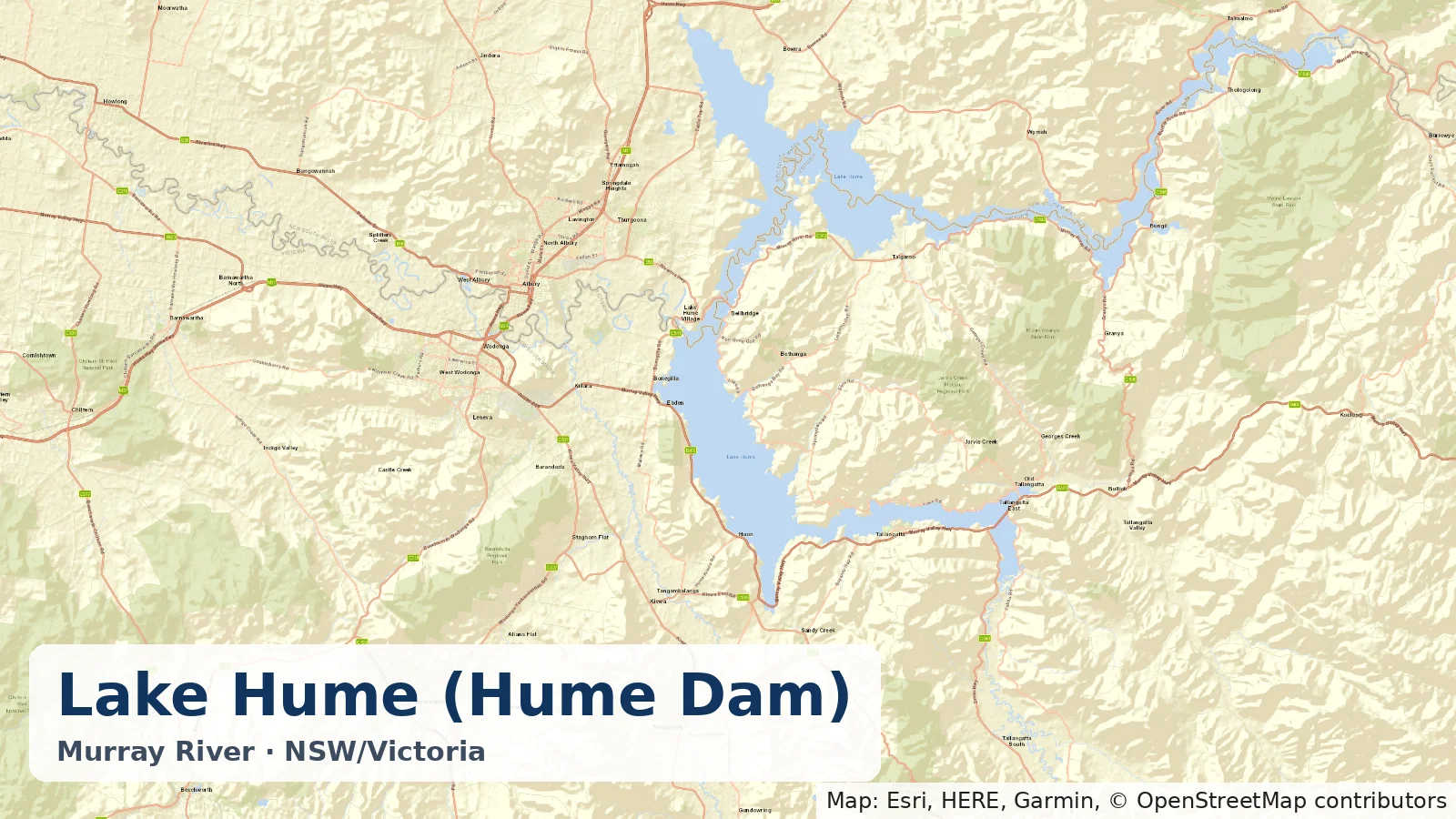
Northern Victoria's Murray system was at 85% of high-reliability water shares (HRWS) on 2 November 2026, according to the Northern Victoria Resource Manager (NVRM). That is a seasonal determination: a percentage of entitlement announced by a state body, not an automatic full share. It depends on storage, inflows, reserves and water-sharing rules. NSW Murray general security last stepped to 30% on 1 October 2026. On our mirrored series, Hume Dam storage stood at 84% full and Dartmouth Dam storage at 79% on 1 November 2026. Live Lake Eppalock storage is on its data page. Physical fill is not the same as an irrigator's allocation percentage.
Quick answer
In northern Victoria, NVRM announces seasonal determinations as a percentage of high-reliability water shares (HRWS) and low-reliability water shares (LRWS). NVRM is the Resource Manager role held by Goulburn-Murray Water. Determinations are updated on the 1st and 15th of every month, or the next business day, until they reach 100% HRWS (NVRM, Seasonal determinations). In New South Wales, the NSW Department of Climate Change, Energy, the Environment and Water (DCCEEW – Water Group) issues Available Water Determinations for high and general security. The Murray–Darling Basin Authority (MDBA) calculates each state's share of River Murray water, and states then use this advice to set allocations (MDBA, How River Murray water is shared, updated 26 October 2026). MDBA does not set individual irrigator allocations. 100% means the full entitlement for that category for the water year, subject to account and carryover rules. 0% means none of that category has been credited yet.
Entitlement vs allocation (and why storage matters)
The MDBA allocations page (last updated 20 May 2026) draws a clear line:
- A water entitlement or licence is the ongoing right to take up to a stated volume from the river system. Ownership can be permanent or temporary via trading.
- A water allocation is the percentage of that entitlement that the relevant state government announces as available within a given water year.
MDBA lists the factors that drive how much is allocated: water held in storages; catchment and river condition; forecast inflows; water kept for Critical Human Water Needs; the volume needed to run the river and provide end-of-system flows; carryover from the previous year where relevant; and the licence category (for example high, medium or low).
Allocated water can be used, traded, carried over (where the licence allows) or left unused. MDBA says leaving water unused "means it stays in the dam and returns to the state’s pool for re-allocation". On carryover, MDBA says the water is considered un-used, "but that doesn’t mean it is available for re-allocation. It is still owned by the irrigator."
Hume and Dartmouth are the major headwater storages whose New South Wales and Victorian shares feed River Murray resource assessments under the Basin Agreement. Live Australia pages (including Victoria, New South Wales and New South Wales and Victoria) show physical fill. Physical fill is an input to resource assessment, not the announced allocation percentage.
Who announces allocations, and how often
Victoria: NVRM / GMW Resource Manager
Northern Victoria's seasonal determinations for the Murray, Goulburn, Broken, Campaspe, Loddon and Bullarook systems are announced by NVRM (Goulburn-Murray Water as Resource Manager). Determinations are updated on the 1st and 15th of every month, or the next business day, until they reach 100% HRWS (NVRM, Seasonal determinations).
NVRM's How Seasonal Determinations Work page describes a water budget: water in the dams plus expected inflows over a planning period, after commitments such as losses and water already in entitlement holders' accounts (current-season allocations and carryover). Allocations continue until determinations reach 100% of HRWS.
In the Goulburn, Murray, Campaspe and Loddon systems, once 100% HRWS is possible, the budget runs over a two-year period so reserves can support next year's HRWS if conditions turn dry. Victoria's stated policy is to secure next year's HRWS before allocating to LRWS. In Broken and Bullarook, once 100% HRWS is achieved, additional resource goes to LRWS up to 100%. Current figures: NVRM current determination. Next 2026/27 announcement flagged there for Monday 16 November 2026.
New South Wales: Available Water Determinations
In NSW, regulated-river allocations are set through Available Water Determinations published by the NSW Department of Climate Change, Energy, the Environment and Water (DCCEEW – Water Group). Opening allocations are announced around 1 July; further assessments follow as resources improve.
The live summary is Summary of current water allocations. That page shows megalitres-per-unit-share allocations as percentages and states that 1 ML per unit share equals 100%. Carryover rules vary by water source and licence category; towns, domestic and stock, and most high-security categories cannot carry over, according to the same page.
MDBA's role
Bulk water sharing between New South Wales, Victoria and South Australia on the River Murray is set by the Murray–Darling Basin Agreement. MDBA is "responsible for calculating each state’s share of water" from the River Murray, and "States then use this advice to help them determine water allocations" (MDBA, How River Murray water is shared, updated 26 October 2026). MDBA does not announce individual irrigator allocations. The Commonwealth frame is the Water Act 2007, cited here at a high level only; this is not legal advice. South Australia receives a bulk share; its state announcements are separate from the Victorian NVRM and NSW tables below.
Which reservoirs feed which systems
River Murray
Hume Dam and Dartmouth Dam are the principal shared NSW/Victoria headwater storages for the River Murray system. Their fill feeds the resource assessments that underpin state Murray allocations. Yarrawonga Weir sits further downstream. Under the Basin Agreement, NSW and Victoria each receive 50% of water entering the Menindee Lakes when they operate as a shared River Murray resource: MDBA may direct releases when their volume rises above 640 GL, until it drops below 480 GL (How River Murray water is shared).
Goulburn
Lake Eildon is the main headwater storage for the Victorian Goulburn system (61% full on 1 November 2026 on our series). Goulburn HRWS/LRWS figures come from NVRM, not from converting Eildon's fill percentage.
Campaspe
Lake Eppalock is the headwater storage for the Victorian Campaspe system.
NSW inland context
Wyangala Dam (67% full on 1 November 2026 on our series) is the principal storage for the Lachlan regulated system. Blowering Dam sits in the Murrumbidgee / Tumut context referenced in NSW valley statements. Further north, Chinchilla Weir on the Condamine is a Queensland data page; Queensland allocation announcements under Queensland water plans are not Victorian NVRM or NSW Available Water Determinations. See the Queensland hub.
High-reliability vs low-reliability (Victoria) and high security vs general security (NSW)
Victoria and New South Wales use different frameworks. Victorian HRWS and NSW high security are separate state categories.
Victoria (NVRM). HRWS is allocated first. LRWS follows only after the HRWS path and reserve rules NVRM describes, including the two-year budget once 100% HRWS is possible in Murray, Goulburn, Campaspe and Loddon. See NVRM's Low-Reliability Water Share Explained.
New South Wales. High security is generally credited early (often at or near opening on 1 July). General security builds as Available Water Determinations improve under each water sharing plan. On the NSW summary, NSW Murray high security stood at 97% (1 July 2026) while general security stood at 30% (1 October 2026).
What 0% and 100% allocation mean for irrigators
- 100% for a licence category means the full entitlement volume for that category is available for the water year, subject to account balances and carryover rules stated by the announcing body.
- 0% means none of that category has been credited yet. Higher-priority categories on the same system may already be positive (for example Victorian Murray at 85% HRWS / 0% LRWS on 2 November 2026).
Carryover is separate from the seasonal determination. Allocation may be carried over or traded under state rules where the licence allows. This page does not give farm-level advice. Urban drought stages are a different track; see Australia water restriction thresholds. Mid-2026 storage snapshots: June 2026 and July 2026.
Latest official determinations at a glance (as of 5 November 2026)
Figures below are copied from the announcing body's page on the date shown. Physical reservoir fill on reservoirs.earth is not converted into these percentages.
| System | State | Announcing body | Latest allocation (as stated) | Date | Source |
|---|---|---|---|---|---|
| Murray (Vic seasonal determination) | Victoria | NVRM (GMW Resource Manager) | 85% HRWS / 0% LRWS | 2 November 2026 | NVRM current |
| Broken | Victoria | NVRM | 100% HRWS / 93% LRWS | 2 November 2026 | same |
| Goulburn | Victoria | NVRM | 68% HRWS / 0% LRWS | 2 November 2026 | same |
| Campaspe (Eppalock system) | Victoria | NVRM | 100% HRWS / 74% LRWS | 2 November 2026 | same |
| Loddon | Victoria | NVRM | 68% HRWS / 0% LRWS | 2 November 2026 | same |
| Bullarook | Victoria | NVRM | 100% HRWS / 100% LRWS | 2 November 2026 | same |
| NSW Murray | New South Wales | NSW DCCEEW – Water Group | 30% general security (97% high security, 1 July 2026) | GS: 1 October 2026 | NSW summary |
| Murrumbidgee | New South Wales | NSW DCCEEW – Water Group | 47% general security | 2 November 2026 | same NSW summary |
| Lachlan (Wyangala) | New South Wales | NSW DCCEEW – Water Group | 10% general security | 8 September 2026 | same NSW summary |
Where to check official data
- NVRM: Current determination; How Seasonal Determinations Work.
- NSW: Summary of current water allocations.
- MDBA: Allocations; How River Murray water is shared. Legislation: Water Act 2007 (Cth), high-level cite only.
- reservoirs.earth: Hume, Dartmouth, Lake Eppalock, Lake Eildon, Wyangala, Blowering, Yarrawonga Weir, Chinchilla Weir. Broader list: Official reservoir data sources.
Sources and methodology
Sources consulted on 5 November 2026 (Europe/Madrid) unless a source carries its own earlier date: NVRM current determination (2 November 2026; next flagged 16 November 2026); Seasonal determinations; How Seasonal Determinations Work; LRWS explained; NSW summary of current water allocations; MDBA Allocations (updated 20 May 2026); MDBA How River Murray water is shared (updated 26 October 2026); Water Act 2007. reservoirs.earth mirrored readings used here: Hume 84%, Dartmouth 79%, Lake Eildon 61%, Wyangala 67% (reading date 1 November 2026).
Method: rules and percentages are copied from the announcing body, with that body's date; no own resource calculations or projections.
This article explains official allocation rules for general information; it is not legal advice. Allocations are subject to announcements by the Northern Victoria Resource Manager, NSW DCCEEW – Water Group, the Murray–Darling Basin Authority, and applicable water sharing plans under the Water Act 2007.
Cite this page: reservoirs.earth, "Murray–Darling Water Allocations Explained (2026–27)", data as of 5 November 2026, https://reservoirs.earth/the-reservoir/murray-darling-water-allocations-explained.
Related: Australia water restriction thresholds · Australia reservoir levels, June 2026 · Australia reservoir levels, July 2026 · Official reservoir data sources · Australia · Victoria · New South Wales · New South Wales and Victoria · Queensland · South Australia · Hume Dam · Dartmouth Dam · Lake Eppalock