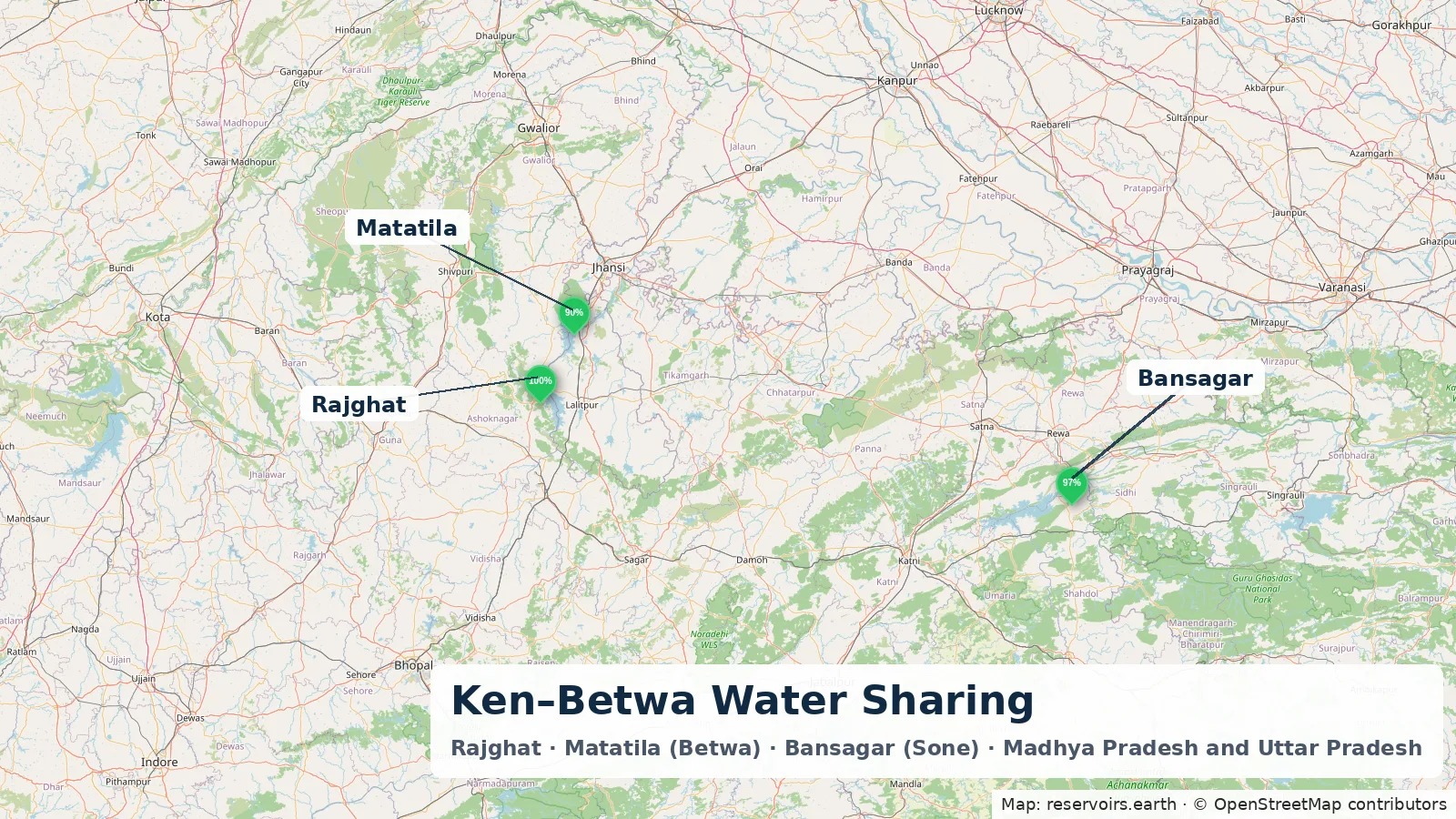
Under the Ken–Betwa Link Project, the annual gross yield of the Ken basin up to Daudhan dam is 6,590 MCM, and Madhya Pradesh "shall utilise total of 2350 MCM (83 TMC)" and Uttar Pradesh "total of 1700 MCM (60 TMC) annually from Ken system", according to the National Water Development Agency (NWDA) Project at a Glance page, last updated on 28 June 2023. A Memorandum of Agreement (MoA) for the project was signed on 22 March 2021. In the Betwa basin, the project's second phase is planned "within allocated water to MP at Rajghat Dam". For the latest readings, see our Matatila Dam water level today and Rajghat Dam water level today pages.
Quick answer: NWDA gives an annual figure for each State. ThePrint, citing the MoA, reported a November–May figure of 1,834 MCM to Madhya Pradesh and 750 MCM to Uttar Pradesh; we did not find it in an official text. Surplus Ken water reaches the Betwa upstream of Parichha Weir, and an NWDA executive summary says the release pattern of upper Betwa projects was kept for "least adverse impact" on Rajghat, Matatila and Dukwan.
Sources as of: official texts read on 25 November 2026. Storage figures are from our data pages, latest reading 29 October 2026.
Three instruments, two States
| Instrument | Figure | Scope or period | Who set it | Source |
|---|---|---|---|---|
| Inter-State agreement, 10 December 1981 | UP: 1047.84 MCM (37 TMC), "including share of Rangwan Dam" | UP's share "under Ken system"; MP's share Not stated | Governments of MP and UP, at a meeting with the Secretary, Irrigation, Government of India | NWDA, DPR Phase I, Executive Summary, section 2.0 |
| Ken–Betwa link: annual use | MP: 2350 MCM (83 TMC); UP: 1700 MCM (60 TMC) | Annual, from the Ken system; annual gross yield up to Daudhan 6590 MCM | Not stated on the page | NWDA, Project at a Glance, 28 June 2023 |
| Memorandum of Agreement, 22 March 2021 | Full text Not stated in official sources found | Implementation of the project; land acquisition and R&R by each State | Union Minister of Jal Shakti and the Chief Ministers of MP and UP (PIB) | PIB, 21 March 2021; Lok Sabha, 6 August 2026 |
| Lean-season release (as reported) | MP: 1,834 MCM; UP: 750 MCM | November to May, from storage in Daudhan reservoir | The MoA, according to ThePrint | ThePrint and The Hindu, 22 March 2021; no official text found |
This rule is not the one for Rajghat Dam itself. Rajghat's cost and benefits are shared equally by the two States under the Betwa River Board Act, 1976, a separate instrument covered in our Bansagar and Rajghat interstate water sharing article.
The MoA of 22 March 2021
The Press Information Bureau (PIB) announced on 21 March 2021 that the "Memorandum of Agreement between the Union Minister of Jal Shakti and the Chief Ministers of Madhya Pradesh and Uttar Pradesh to implement the Ken Betwa Link Project, the first project of the National Perspective Plan for interlinking of rivers" would be signed the next day, in the presence of the Prime Minister.
The Lok Sabha answer of 6 August 2026 calls it the "Memorandum of Agreement dated 22.03.2021 between the Governments of Madhya Pradesh and Uttar Pradesh". It cites the MoA for one rule: land acquisition and rehabilitation and resettlement (R&R) "within their respective jurisdictions are to be undertaken by the State Governments", under the 2013 land acquisition Act "or the respective State policies".
We did not find the MoA's text on nwda.gov.in, pib.gov.in or sansad.in, so its water-sharing clauses are quoted here only as the press reported them.
The lean-season figures, as reported
ThePrint reported on 22 March 2021, citing the new MoA, the same annual figures as NWDA and: "During the lean season (November to May), the water released to MP and UP from the storage in Daudhan reservoir shall be 1,834 mcm and 750 mcm, respectively."
The Hindu reported the same day: "From November-May, the non-monsoon period, M.P. would get 1,834 MCM and Uttar Pradesh 750." It added that "U.P. had demanded nearly 900 MCM and M.P. was prepared to release only 700 MCM".
The lean-season figures do not appear in NWDA's Project at a Glance, the PIB release of 21 March 2021 or the Lok Sabha answer of 6 August 2026. They refer to releases from Daudhan in November to May, not a second annual total.
What the 1981 agreement said
The Executive Summary of the Phase I Detailed Project Report (DPR), on NWDA's Ken Betwa Link Project Phase I page, states: "As per existing interstate agreement between Govts. of M.P and U.P States, signed in the meeting with Secretary, Irrigation, Govt. of India, held at New Delhi on 10.12.1981, the share of U.P. under Ken system is 1047.84 MCM(37 TMC) including share of Rangwan Dam."
It continues: "However, as per the proposed water sharing (agreed by both M.P. and U.P.) for Ken-Betwa link project, UP will now be entitled for enhanced allocation of 1700 MCM(60 TMC) based on 75% dependable yield of 6188 MCM at Daudhan dam. Rest of the water in Ken system will be utilized by M.P. including environmental releases."
The summary also records a "tripartite Memorandum of Understanding" of 25 August 2005 for preparing the DPR. The summary itself carries no date; NWDA's Phase II DPR, Chapter I, says the Phase I DPR was completed in April 2010. Its yield basis (6188 MCM, 75% dependable) differs from the 6590 MCM annual gross yield on the 2023 page; we report each as published.
Daudhan dam and the link canal
| Component | Figure | Note |
|---|---|---|
| Daudhan dam | 77 m high, on the Ken | About 2.5 km upstream of the existing Gangau Weir |
| Reservoir levels | Dead 240 m; full 288 m | As published |
| Storage | Dead 169 MCM; gross 2853 MCM | As published |
| Power | Two power houses | At the toe of the dam and at the outlet of the lower level tunnel |
| Link canal | 221 km | Including a 2 km tunnel |
| Use from Daudhan | 4543.52 MCM | Includes domestic and industrial use and environmental releases |
The page sets out how the water is used:
- "Out of 2035 MCM of balance water available, 436 MCM is proposed to be utilised directly from reservoir for Panna and Damoh district of MP to proposed Saleha Lift Irrigation Scheme."
- "The surplus water to be diverted through the link is 1377 MCM annually", including 220.77 MCM at a pumping station at RD 18 km. "The remaining 222 MCM of water in extreme monsoon season will be available as spill water in the river."
- 1010.51 MCM to irrigate an en-route command area of 1,93,899 ha, and 94.79 MCM for drinking water en route.
- "The remaining 50.93 MCM of water is released to Betwa river through link canal in the upstream of Parichha Weir which will be used in Lalitpur district of UP for drinking and irrigation purpose."
The Phase II DPR, Chapter I, gives earlier DPR-stage figures: 1074 MCM to be diverted and 591 MCM transferred to the Betwa upstream of Parichha weir. They are not the current summary.
Rajghat, Matatila and Dukwan
The link canal delivers its water to the Betwa upstream of Parichha Weir. Two official statements speak to the existing dams on the river.
- Rajghat. NWDA's Project at a Glance says: "In Phase-II, Lower orr dam, Kotha Barrage and Bina Complex Projects were included to meet the water requirement of water short areas of Betwa basin within allocated water to MP at Rajghat Dam."
- Rajghat, Matatila and Dukwan. The Phase I Executive Summary says: "There are few existing major projects on Betwa river, viz. Rajghat Dam, Matatila Dam, Dukwan dam, Parichha Weir." The link water is dropped into the Betwa upstream of Parichha weir, and "attempt has been made to transfer water to Betwa river as per the requirement pattern of Parichha weir command to the extent possible. Even the release pattern of Upper Betwa Projects has been kept in such a fashion that there is least adverse impact on the downstream projects such as Rajghat, Matatila & Dukwan."
The upper Betwa projects in that DPR-stage summary are Makodia, Kesari and Barari; the 2023 page names Lower Orr, Kotha and Bina Complex for Phase II. A quantified effect of the current plan on storage at Matatila or Dukwan is Not stated in the sources we read. We have no data pages for Dukwan, Parichha or Daudhan.
Project status in 2026
From the Lok Sabha answer to Unstarred Question No. 2994, answered on 6 August 2026 by the Minister of State for Jal Shakti:
| Item | Figure or statement |
|---|---|
| Works | "have been commenced" |
| Approved cost | ₹44,605 crore; Central Assistance ₹39,317 crore (Grant ₹36,290 crore, Loan ₹3,027 crore) |
| Expenditure | ₹12,381.94 crore up to June 2026 |
| Cost escalation | "No cost escalation has occurred in the Project since its approval in 2022" |
| Forest land | 6,017 ha, of which 5,578.92 ha in the Panna Tiger Reserve |
| Displacement | Daudhan dam and land transfer to the reserve: 22 villages, 4,443 families (Chhatarpur: 14 villages, 3,212 families; Panna: 8 villages, 1,231 families) |
| Link canal land | 116 villages: 54 in Chhatarpur, 41 in Tikamgarh, 10 in Niwari (MP) and 11 in Jhansi (UP) |
The answer says construction of the Daudhan Dam and Link Canal "has biodiversity implications", with mitigation through the Integrated Landscape Management Plan (ILMP) monitored by the Greater Panna Landscape Council (GPLC). Madhya Pradesh approved a Special Rehabilitation and Resettlement Package on 13 September 2023. Alternatives were examined during the DPR, and "the Ken–Betwa Link was identified as the most viable option".
PIB reported on 8 December 2021 that the Union Cabinet had that day approved the project at ₹44,605 crore "at 2020-21 price levels". NWDA's 2023 page says the project "will be constructed in a period of 8 years in two phases". Neither source gives a completion date.
Storage at Rajghat, Matatila and Bansagar
| Reservoir | River | Storage (MCM) | Date | Source |
|---|---|---|---|---|
| Rajghat | Betwa | 1,945 | 29 October 2026 | CWC |
| Matatila | Betwa | 637 | 29 October 2026 | CWC |
| Bansagar | Sone | 4,998 | 29 October 2026 | CWC |
Central Water Commission (CWC) weekly readings as published on our pages; no later reading had reached our data by 25 November 2026. Bansagar is on the Sone, outside the Ken and Betwa basins, and has its own 1973 agreement, covered in the Bansagar and Rajghat article.
Related rules
Other inter-State sharing rules on The Reservoir: Tungabhadra water sharing, Krishna water sharing at Srisailam and Cauvery water sharing in a distress year. For storage across the State, see Madhya Pradesh reservoir levels in September 2026.
Sources and methodology
Sources checked on 25 November 2026, between 09:25 and 09:45 Europe/Madrid:
- NWDA, Project at a Glance, Ken–Betwa Link Project, last updated 28 June 2023.
- NWDA, Ken Betwa Link Project Phase I (page last updated 22 July 2022): Executive Summary, sections 2.0 and 4.0.
- NWDA, DPR of Ken–Betwa Link Project Phase II, Chapter I.
- Lok Sabha, Unstarred Question No. 2994, answered on 6 August 2026, Ministry of Jal Shakti.
- PIB, 21 March 2021, PRID 1706407.
- PIB, 8 December 2021, PRID 1779306.
- ThePrint, After nearly 40 years, India's first river-linking project Ken-Betwa could finally begin, 22 March 2021.
- The Hindu, Centre, MP, UP sign MoU to implement Ken-Betwa river interlinking project, 22 March 2021.
- reservoirs.earth data pages for Rajghat, Matatila and Bansagar, built from CWC figures. See also how we get our data for India.
- Tried and unavailable on 25 November 2026: the Betwa River Board website (brb.nic.in).
Units are as published: MCM and TMC in the NWDA texts, MCM or mcm in the press, MCM on our data pages. No figure has been converted, added or subtracted in the text. Where NWDA writes "uptoDaudhan" or "Lower orrdam", spacing has been corrected; figures are unchanged.
Cite this page: reservoirs.earth, "Ken–Betwa Water Sharing: How Madhya Pradesh and Uttar Pradesh Split Ken Water, and What the Project Says About Rajghat and Matatila", sources as of 25 November 2026, https://reservoirs.earth/the-reservoir/ken-betwa-link-water-sharing-rajghat-matatila.
Related: Matatila Dam water level today · Rajghat Dam water level today · Bansagar Dam water level today · Madhya Pradesh reservoir levels · Uttar Pradesh reservoir levels · India reservoir levels
This article sets out the Ken–Betwa water-sharing figures as published by NWDA, the Lok Sabha and PIB, and as reported by the press where no official text was found. It does not take a position in any dispute between Madhya Pradesh and Uttar Pradesh or in the debate over the project's environmental effects. reservoirs.earth is not affiliated with any government body or party. It is general information, not legal advice. Where this page and an official text differ, the official text prevails.
Live fill levels
These widgets show each reservoir's current reading on reservoirs.earth. They update with the site's daily data and may differ from the dated figures above.
Matatila Dam reservoir level · data by reservoirs.earth
Rajghat Dam reservoir level · data by reservoirs.earth
Bansagar Dam reservoir level · data by reservoirs.earth