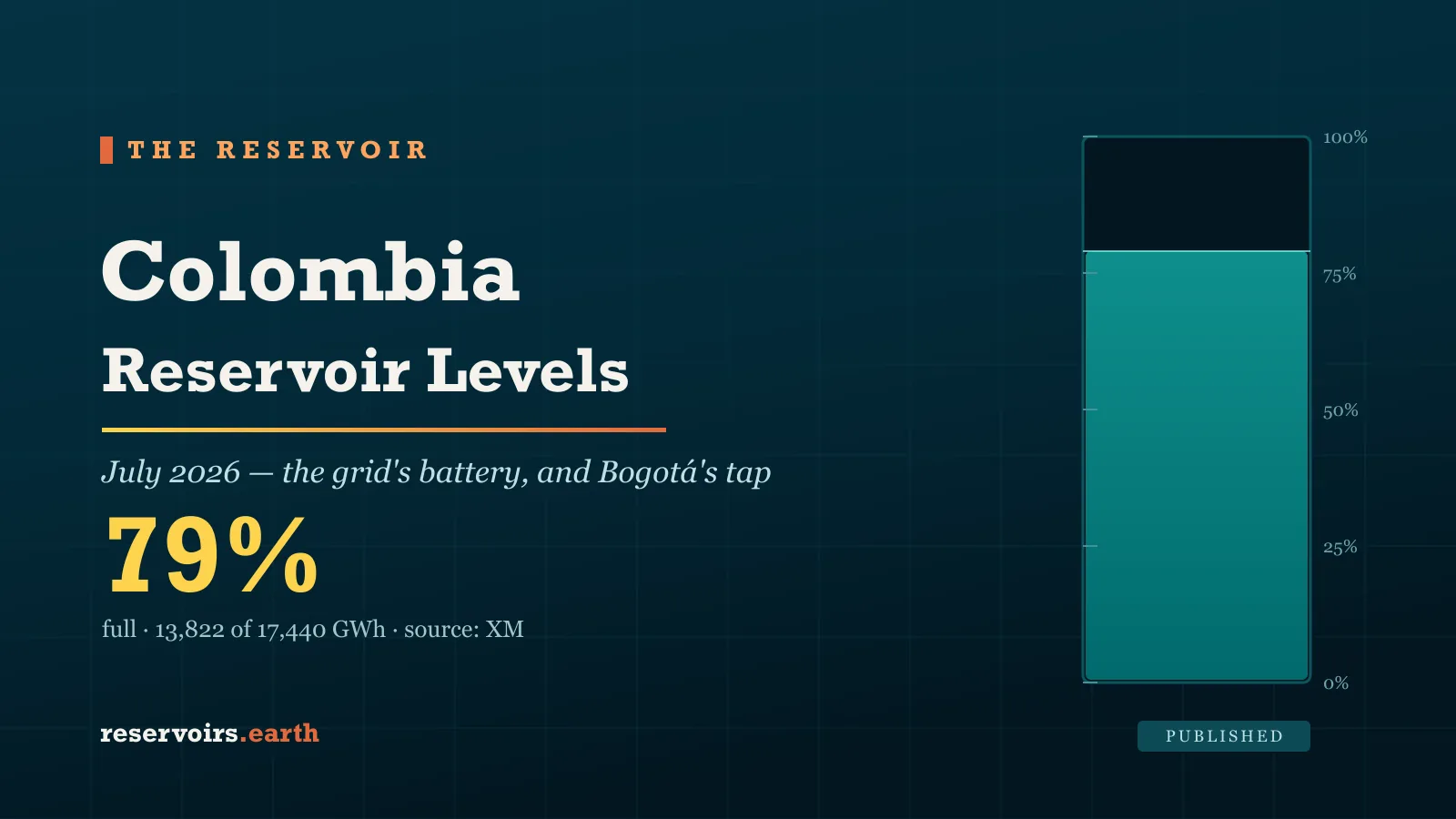
Colombia's hydropower reservoirs are 79% full as of July 21, 2026 — holding 13,822 of a possible 17,440 gigawatt-hours of storable electricity, a shade above the ~77.5% typical for mid-July and about 1.5 points below where they stood a year ago. In Colombia that percentage is a power-price gauge before it is a water gauge: hydropower supplies roughly two-thirds of the country's electricity, so the national reservoir figure is effectively the charge level of the grid's battery, published daily by the market operator XM. The two giants that carry the number are near full — El Peñol–Guatapé, the country's largest store, at 90.5%, and Guavio at 97.3%. The clear soft spot is the Chingaza system that supplies Bogotá's drinking water, sitting in the 60s. Live figures for all 24 reservoirs are on the Colombia page.
Key takeaways
- Colombia's reservoirs are 79% full (July 21, 2026) — about 1.8 points above the five-year mid-July norm and 1.5 below a year ago. Comfortable, near-normal, and measured in energy: 13,822 of 17,440 GWh. Live data on the Colombia page.
- This is a power-price gauge. Hydropower is roughly two-thirds of Colombian generation, so the reservoir level sets the spot price on the wholesale market; when it falls, the grid dispatches costly thermal plants — the mechanism behind the 2023–24 El Niño scare.
- Two giants hold the number up. El Peñol–Guatapé (90.5%) and Guavio (97.3%) together are a quarter of national storage and both near full.
- The soft spot is Bogotá's water. The Chingaza system — Chuza at 69.9% and the Bogotá aggregate at 62.7% — is the lowest of the large storages, and it is the capital's drinking water as well as its power. Bogotá imposed rotating water rationing in 2024 when this system fell.
- Low individual dams, healthy departments. Antioquia's Hidroituango (39%), Punchiná (33%) and the Porce dams (~41%) read low, but they are small: Antioquia as a whole is 85% full, carried by El Peñol–Guatapé.
- El Niño is the risk to watch. XM flagged renewed El Niño alerts in May 2026 as the probability reached 82%; a dry end to 2026 is what would turn today's comfortable number into a price story.
Why a reservoir level is an electricity price in Colombia
Colombia runs its grid on water. Hydropower is about two-thirds of national generation, so the reservoir system is the country's battery, and its charge level is a direct, public read on where power prices are heading. When the reservoirs are full, cheap hydro covers demand and the wholesale (bolsa) price stays low; when they fall, the system operator dispatches expensive gas, coal and liquid-fuel plants, and that cost works through to tariffs.
That link is not abstract. The 2023–24 El Niño drew the reservoirs down hard, pushed spot prices up, and put the country within sight of electricity rationing — the government leaned on public conservation appeals rather than cuts, but the margin was thin. It is why the daily reservoir bulletin is front-page news in Colombia in a way it rarely is elsewhere, and why XM, the operator of the Sistema Interconectado Nacional, publishes the level every single day under a regulatory mandate that dates to 1995.
Because the system is hydroelectric, Colombia reports storage as energy (GWh) rather than cubic metres — the megawatt-hours the stored water can generate above each dam's technical minimum. reservoirs.earth mirrors XM's daily per-reservoir series and keeps the history; the percentages here are shares of storable electricity, which is why they shouldn't be compared directly with the volumetric numbers from Spain or the United States.
Where the reservoirs stand now (July 21, 2026)
At 79% full, the national picture is comfortable — but it is really two stories, because two departments hold three-quarters of the country's storage.
- Antioquia — 85% full, and it dominates. The historic hydro heartland holds ten reservoirs and 35% of national capacity. El Peñol–Guatapé alone — the single largest store at ~24% of the national total — is at 90.5%, which is why the department reads high even though several small Antioquia dams are near their floor: Punchiná at 33%, Hidroituango at 39%, and Porce II and Porce III around 41%.
- Cundinamarca — 74% full, and it matters most for Bogotá. The department around the capital holds the largest share of national capacity (40%), and it is the lowest of the big storage regions. Guavio, the biggest single generator here, is nearly full at 97.3% — but the Chingaza system that supplies Bogotá's taps is not: Chuza is at 70% and the Bogotá aggregate at 63%.
- The rest of the country is healthy. Boyacá (91%), Valle del Cauca (91%) and Cauca (88%) are near full; the low outliers are small single-reservoir departments — Córdoba's Urrá at 62% and Tolima's Prado at 64%.
| Department | Reservoirs | Fill (Jul 21) | Share of national capacity |
|---|---|---|---|
| Cundinamarca | 4 | 73.5% | 40% |
| Antioquia | 10 | 84.9% | 35% |
| Huila | 2 | 70.3% | 7% |
| Santander | 1 | 82.3% | 6% |
| Boyacá | 1 | 91.2% | 5% |
| Cauca | 1 | 88.2% | 3% |
| Valle del Cauca | 2 | 91.3% | 2% |
| Caldas | 1 | 75.0% | 1% |
| Córdoba | 1 | 61.7% | <1% |
| Tolima | 1 | 63.9% | <1% |
| National | 24 | 79.3% | 100% |
The Bogotá twist: the same reservoir is power and water
Most of Colombia's reservoirs do one job — generate electricity. The Chingaza system does two. Chuza, its main reservoir, is both a generating store in XM's energy series and the principal source of Bogotá's drinking water, feeding a metropolitan area of some ten million people. That dual role is why its level is the number to watch in this month's data even though, at ~70%, it is nowhere near critical.
The memory is recent. During the 2024 El Niño, the Chingaza reservoirs fell far enough that Bogotá imposed rotating water rationing across the city — neighbourhood-by-neighbourhood shut-offs that ran for months. Today's ~63–70% is a comfortable distance from that, and the wet season has been refilling it, but it is the one large storage in the country where a low reading would be a water-supply story and not only a power-price one.
Versus its own history, and the year ahead
This July sits just above the five-year norm (77.5%) and just below a year ago (80.8%) — statistically an ordinary, healthy mid-year. The reservoirs are near their typical seasonal position, with no department in the danger band and the two national giants near full.
The risk is not the level; it is the forecast. XM flagged renewed El Niño alerts in May 2026, citing a probability that had climbed to 82%, and in a system this hydro-dependent the pattern is well-rehearsed: a dry El Niño late in the year draws the reservoirs down through the December–March dry season, spot prices rise, and the conversation turns to rationing. A comfortable July is the right starting point — but in Colombia the number that matters is the one the reservoirs hold going into the dry months, not the one they hold now. That is what we will track.
This is the July 2026 edition. Colombia is one of two grids we track where the reservoir level is the power bill — see the Brazil and Norway editions for the same energy-storage lens, read how Colombia's data openness ranks on the Reservoir Transparency Index (B, 72.8/100), and see our methodology for how we compute these figures.