In Brazil, the reservoir level is the electricity price. The country runs on hydropower — roughly half of its generation — so when the big reservoirs are full, cheap hydro covers demand; when they fall, the grid fires up expensive gas, coal and diesel plants, and that cost lands on every power bill through the tariff flag (bandeira tarifária). As of mid-June 2026, the news is good: Brazil's major hydro reservoirs are mostly full to comfortable heading into the dry season, after above-average rains at the end of 2025. The North and Northeast are nearly brimming — Tucuruí is around 95% and Itaipu on the Paraná is around 92% — and the regulator ANEEL has kept the tariff flag low because little expensive thermal power is needed. The clear laggard is the South. The live national picture is on the Brazil reservoir levels page.
Key takeaways
- Brazil's reservoirs are healthy in mid-June 2026 — most of the large hydropower storages are full or comfortable, after a wet end to 2025. The live map is on the Brazil page.
- That keeps electricity cheap. Full reservoirs mean less dispatch of costly thermal plants, so the tariff flag stays green/low — the opposite of the 2021 water crisis, when low reservoirs sent bills soaring.
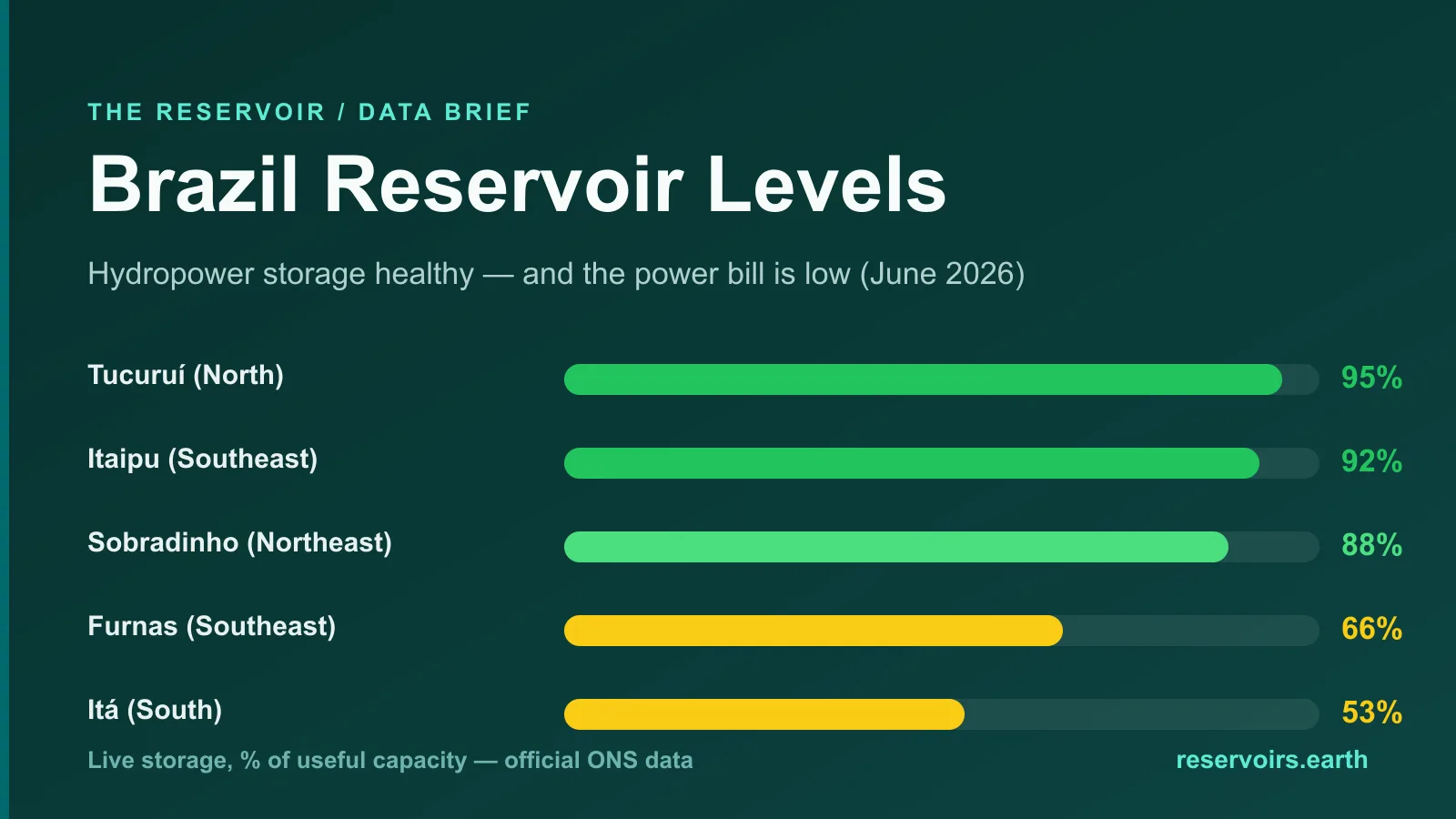
- The picture splits by subsystem. The North and Northeast are nearly full (Tucuruí around 95%, Sobradinho around 88%); the dominant Southeast/Centre-West is comfortable (Itaipu around 92%, Furnas around 66%).
- The South is the exception — its storages are the lowest in the country, with Itá around 53% and G. B. Munhoz drawn down.
- Versus other years, this is a normal-to-good June — most reservoirs are at or above their typical level for the month, a world away from the 2021 lows.
How Brazil's reservoirs become your electricity bill
Brazil's grid is unusually hydro-dependent: hydropower is still roughly half of generation (and historically up to 70%), so the national reservoir system is effectively the country's battery. The grid operator ONS dispatches it to balance the whole system, and the regulator ANEEL translates the cost of doing so into the tariff flag that is added to consumer bills:
- Green flag — reservoirs healthy, cheap hydro covers demand, no surcharge.
- Yellow / red flags — reservoirs falling, so the system dispatches expensive thermal plants (gas, coal, diesel), and a surcharge is added per 100 kWh.
So the reservoir level is a direct, public read on where power prices are heading. Brazil measures storage not just as water but as stored energy (Energia Armazenada, EAR) — the megawatt-hours the water can generate — and weights the system toward the giant Southeast/Centre-West reservoirs that hold most of that energy. reservoirs.earth mirrors the per-reservoir ONS levels and each reservoir's history on the Brazil page.
Where the reservoirs stand now
After a wet end to 2025, Brazil entered the 2026 dry season with comfortable storage, and ANEEL has signalled lower flags into the year as a result. By subsystem (mid-June 2026):
- North — nearly full. Tucuruí on the Tocantins is around 95% and Balbina is well above its norm. The Amazon basin's wet season filled these to the brim.
- Northeast — high. Sobradinho on the São Francisco, the region's anchor, is around 88% — well above its typical June level, a strong recovery for a system that has known deep droughts.
- Southeast/Centre-West — comfortable, and it matters most. This subsystem holds the majority of national storage and energy. Itaipu is around 92% and Três Marias well above normal, though the big regulating reservoirs are more mixed — Furnas around 66% and Serra da Mesa, the country's largest by volume, around 61% and below its June norm.
- South — the laggard. The southern storages are the lowest, with Itá around 53% (well below its June average) and G. B. Munhoz drawn down. The South runs on a different rainfall regime and is the part of the system to watch.
Versus previous years
This June is a normal-to-good one. Across the reservoirs we track, most are sitting at or above their typical level for June, and the standouts are on the high side — Sobradinho and Três Marias are both well above their June norms. The notable below-normal cases are concentrated in the South (Itá) and a few Southeast regulators (Serra da Mesa, Nova Ponte).
The contrast that matters is with 2021, Brazil's worst water crisis in roughly 90 years. That year the Southeast/Centre-West reservoirs fell so low that ANEEL created an emergency "water scarcity" tariff flag — the most expensive ever — and the country leaned hard on thermal generation. Mid-2026 is the opposite situation: storage is healthy, thermal dispatch is limited, and the flag is low. Each reservoir's multi-year chart on its page shows exactly where this year sits against that history.
What the percentages mean here
A Brazilian reservoir's level is reported as a percentage of its useful (live) storage — the water above the intakes that can actually generate power — which is why a reservoir page can read 95% even though a large "dead" volume sits below that. Two things to keep in mind:
- The season runs May–November dry, December–April wet. June is early in the drawdown: reservoirs are near their post-wet-season peak and will decline through the dry months, so the question for the rest of 2026 is how much cushion the South and the Southeast regulators keep.
- The national number depends on what you weight. The system's stored energy (EAR) leans on the big Southeast reservoirs; a simple volume average leans on the giants in the North. The honest read is the subsystem picture above, plus each reservoir's own page.
Why it matters
In most countries a low reservoir is a water-supply story. In Brazil it is also, immediately, an electricity-price story and an emissions story: when hydro falls, the country burns more fossil fuel and households pay a higher flag. A healthy reservoir year like 2026 means cheaper, cleaner power; the risk to watch is the South, and whether the Southeast/Centre-West regulators hold their cushion through the dry season. That is what we will track month by month.
This is the June 2026 edition. We track the major water economies month by month — see the United States, India and Australia editions, and how Brazil's data openness ranks on the Reservoir Transparency Index.