Spain's reservoirs are about 77% full in mid-July 2026 — roughly 43.2 of 56.5 km³ across the 374 reservoirs in the national bulletin, and well above where the country usually sits at this point in summer. The ten-year average for early July is around 60%, so Spain is holding some 17 points more water than normal, and about 6 points more than a year ago. The picture that dominated headlines from 2022 to 2024 — a drought-stricken peninsula, Catalonia under emergency restrictions, the south running dry — has decisively reversed: even the historically driest corner, the Mediterranean southeast, is only relatively low, while the big Atlantic-draining basins of the west and centre are brimming. As of the reading dated 6 July 2026, the story is not scarcity but an unusually comfortable summer starting point. Live figures are on the Spain page.
Key takeaways
- National fill is ~77% (reading of 6 July 2026) — about 43.2 km³ of a 56.5 km³ capacity, some 17 points above the ~60% ten-year July average and up ~6 points year-on-year. Live figures on the Spain page.
- The 2022–2024 drought has broken. Every major river-basin authority is above 58% full, and most of the large western and central basins sit in the high 70s and low 80s.
- The southeast is the only laggard — and even it isn't in crisis. The Segura basin (
58%) and Júcar (63%) are the lowest big basins, as they almost always are, but both are far from the emergency levels of recent years. - Catalonia has recovered. The internal basins of Catalonia — under a declared drought emergency in early 2024, with Barcelona on restrictions — are now about 88% full, the fullest big system in the country.
- The turnaround is visible reservoir by reservoir. Iznájar, Andalusia's largest, has gone from ~29% a year ago to ~85%; La Serena, Spain's biggest reservoir, sits at ~90% against a ~51% July norm.
Where the data comes from
Spain has one of the most complete public reservoir records we track. The MITECO national hydrological bulletin (boletín hidrológico, from the Ministerio para la Transición Ecológica y el Reto Demográfico) reports storage across the peninsular river-basin authorities — the Confederaciones Hidrográficas — covering essentially all of the country's significant surface reservoirs. reservoirs.earth mirrors that bulletin for 374 reservoirs, keeps decades of history behind each one, and rolls them up to national, river-basin and autonomous-community figures, weighted by capacity so a 3,000 hm³ dam counts for more than a 5 hm³ one. Every figure here is dated to the 6 July 2026 bulletin reading; the live numbers, the interactive map and each reservoir's multi-year chart are on the Spain page. Spain's data openness is scored in the Reservoir Transparency Index.
Full for July — and above normal almost everywhere
The single most useful comparison for a Spanish reservoir figure is not the raw percentage but the gap to the seasonal norm, because Spain draws its reservoirs down hard through the dry summer and refills them over the autumn and winter. Read that way, mid-July 2026 is not just "77% full" — it is 77% full against a ~60% norm, a surplus that runs across nearly every basin. The big Atlantic-draining systems that hold most of the country's water — the Tajo, Duero, Guadiana and Guadalquivir — are all comfortably above their July averages, and the Ebro in the northeast is too.
That is what makes 2026 a mirror image of the drought years. In 2022–2024 the same basins were the emergency, with the Guadalquivir and the Catalan systems drawing the alarm. This July the alarm is off: the question has shifted from "will there be enough water for the summer" to "how much of an unusually full store will the summer draw down."
The current picture by river basin (6 July 2026)
Sorted by capacity, the Confederaciones Hidrográficas that carry the national figure:
| River basin | Fill | Capacity | Note |
|---|---|---|---|
| Tajo | 71.4% | ~11.1 km³ | Largest system; above its ~July norm |
| Guadiana | 80.4% | ~9.5 km³ | Holds La Serena, Spain's biggest reservoir |
| Guadalquivir | 81.5% | ~8.3 km³ | Andalusia — healthy after a dry decade |
| Ebro | 78.2% | ~7.9 km³ | Northeast; Mequinenza ~85% |
| Duero | 81.3% | ~7.6 km³ | Castile and León; Almendra ~85% |
| Miño-Sil | 78.4% | ~3.0 km³ | Galicia / northwest |
| Júcar | 63.1% | ~2.8 km³ | Southeast; one of the lower reads |
| Segura | 58.1% | ~1.1 km³ | Driest big basin — as usual |
| Cataluña (internal) | 88.0% | ~0.7 km³ | Recovered from the 2024 emergency |
The two columns that matter are fill and the region's own history. On that measure the spread is compressed: in a normal July the gap between the wet north and the dry southeast is wide, but in 2026 almost everything sits in a 58–88% band, with only the southeast trailing.
The southeast: still the driest corner, not a crisis
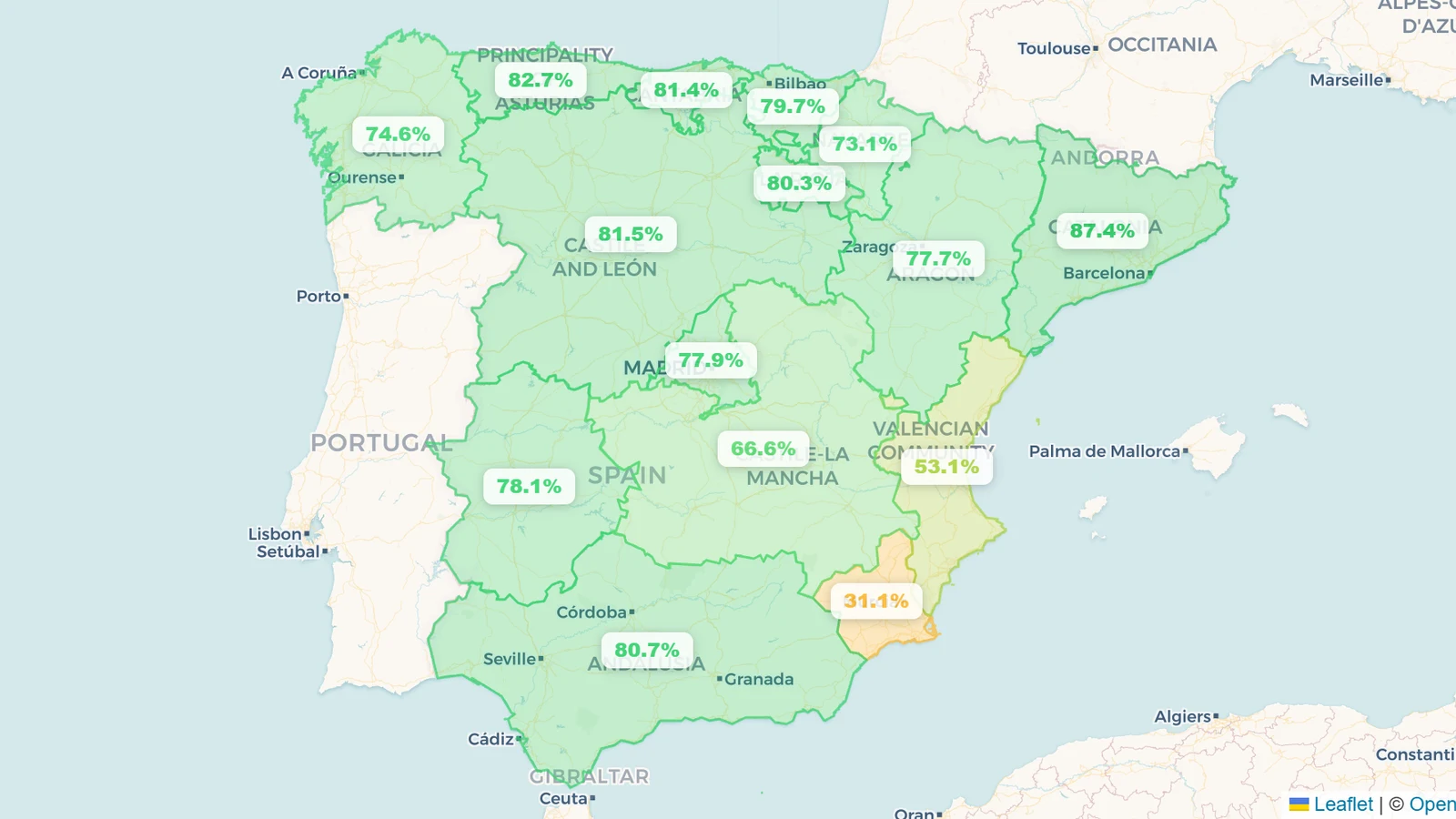
Spain's water geography always has the same shape — wet Atlantic north and west, arid Mediterranean southeast — and 2026 does not erase it. The lowest big basins are the Segura (58%) and the Júcar (63%); by autonomous community the Region of Murcia is the single driest at about 31%, though it holds very little capacity, and the larger Valencian Community sits around 53%. These are the catchments of Alicante, Murcia and Valencia, where rainfall is thinnest and demand from intensive agriculture is highest.
But "lowest in Spain" this year means a small, dry southeast against a full rest-of-country, not the peninsula-wide emergency of the recent past. The southeast is drawing on a normal-to-slightly-below-normal store rather than a depleted one, and its structural dependence on transfers like the Tajo-Segura aqueduct is easier to manage when the donor Tajo headwaters — Entrepeñas (68%, against a ~40% norm) and Buendía (56%, norm ~26%) — are themselves well above their own averages. The perennial tension over that transfer does not go away in a wet year, but the arithmetic behind it is far less tight than it was in 2023.
Catalonia's turnaround
The sharpest change from the drought years is in the northeast. The internal basins of Catalonia — the Ter-Llobregat system that supplies Barcelona, managed separately from the state-run confederations — spent early 2024 under a formally declared drought emergency, with metropolitan water restrictions and reservoirs like Sau drawn so low that the submerged village beneath it re-emerged. Eighteen months on, those same basins are about 88% full, the highest of any major system in the table above. It is the clearest single illustration of how completely the rain of the last two winters has reset Spain's water position.
Above a year ago — but not everywhere
Nationally, storage is up about 6 points on early July 2025 (~71%). The rise is not uniform, and the exceptions are instructive: a few of the largest western dams are actually lower than a year ago — Alcántara on the Tajo is ~80% against ~92% last year, and Almendra on the Duero ~85% versus ~91% — because these are big hydropower reservoirs that were deliberately drawn down over a year of strong generation and irrigation demand. That is the normal working of a reservoir, not a drought signal. Where the recovery shows up most is in the reservoirs that were genuinely stressed: Iznájar in the Guadalquivir has nearly tripled year-on-year (from ~29% to ~85%), and La Serena sits ~26 points above its July norm.
What reservoir levels do — and don't — tell you here
- Read the gap to normal, not the raw number. 77% in mid-July is high because July is a drawdown month; the same figure in March would be unremarkable. The surplus to the ~60% norm is the real signal.
- A full July doesn't guarantee a safe next year. Spanish reservoirs refill on autumn and winter rain; a dry hydrological year starting in October could still pull these levels down fast. Storage records the past two winters, not the next one.
- Basin beats nation. Spain's national average blends a wet west with an arid southeast that live on different rainfall. The Segura at 58% and Cataluña at 88% are the same country in the same week.
- Drawdown isn't drought. A big hydropower reservoir that is lower than last July may simply have been generating; the levels that matter for scarcity are the ones below their own seasonal norm, and in 2026 there are very few of those.
This is a July 2026 snapshot of Spain; for other water economies see the Norway and US editions, and for how Spain's water-data openness ranks, the Reservoir Transparency Index.