Pathfinder Reservoir, the largest water bank on Wyoming's North Platte River, was 19.8% full on 29 July 2026 — 202,000 acre-feet of a 1.02 million acre-foot reservoir, and less than half the 452,000 acre-feet it held a year ago. It is the lowest start-of-August reading in our five-year record, 23 points below the next-worst year. This matters beyond Wyoming: the Pathfinder Irrigation District, which delivers North Platte water to more than 100,000 acres across eastern Wyoming and the Nebraska panhandle, warned in July that its seasonal supply could be exhausted by the first week of August — the week that is now underway.
Key takeaways
- Pathfinder is at 19.8%, down from 44.4% a year ago and 70.3% two years ago. In volume: 202 kaf today against 452 kaf last August — the reservoir has lost more than half its water in twelve months.
- Seven of the nine reservoirs in the federal North Platte chain are at their lowest 1-August level in our record. Not just the big ones: Winters Creek Lake in the Nebraska panhandle is at 21%, nearly 38 points below its previous worst.
- The three big storage reservoirs together hold 720,000 acre-feet of 2.49 million — 29% full, against 1.18 maf (47%) a year ago. The system is 456,000 acre-feet lighter than last August, more than the entire remaining seasonal supply the district reported on 10 July.
- The full-looking reservoirs are meaningless here. Alcova reads 98.1% — and has read 98.0, 98.0, 98.2, 97.8 and 98.1 on the same date in the five previous years. It is a re-regulating pool held at a fixed level, not storage.
- The cause is upstream and last winter. Wyoming had its fifth-driest winter since records began in 1895, with roughly 45% of the state in extreme drought. Forecast 2026 runoff into the North Platte Project was around 550,000 acre-feet, against the 1.1 maf supply threshold below which allocations are imposed.
- This is a different crisis from the Colorado's, and a faster one. Where Lake Mead and Lake Powell are drawn down over decades under federal rules, the North Platte is a single irrigation season that may simply end early.
The terms, briefly
| Term |
What it means |
| Acre-foot (af) |
Enough water to cover an acre a foot deep: 1,233 m³. kaf = thousand acre-feet; maf = million. Irrigation districts budget their whole year in these. |
| Allocation |
The volume each irrigator is entitled to for the season when supply is short — rationing, set before the season from the runoff forecast. |
| Storage reservoir |
A reservoir that banks water between years. On the North Platte: Seminoe, Pathfinder, Glendo. These are the ones whose level means something. |
| Re-regulating pool |
A small reservoir held at a near-constant level to smooth deliveries downstream. Alcova, Kortes and Gray Reef are these — full every year, drought or not. |
| Seepage |
Water lost into canal banks and soil before it reaches a field. In a dry year the ground absorbs far more, so more water must be released to deliver the same amount. |
| Carryover |
Water left in storage at season's end, which becomes next year's starting balance. A season that ends at 19.8% starts 2027 with almost nothing. |
The chain, reservoir by reservoir
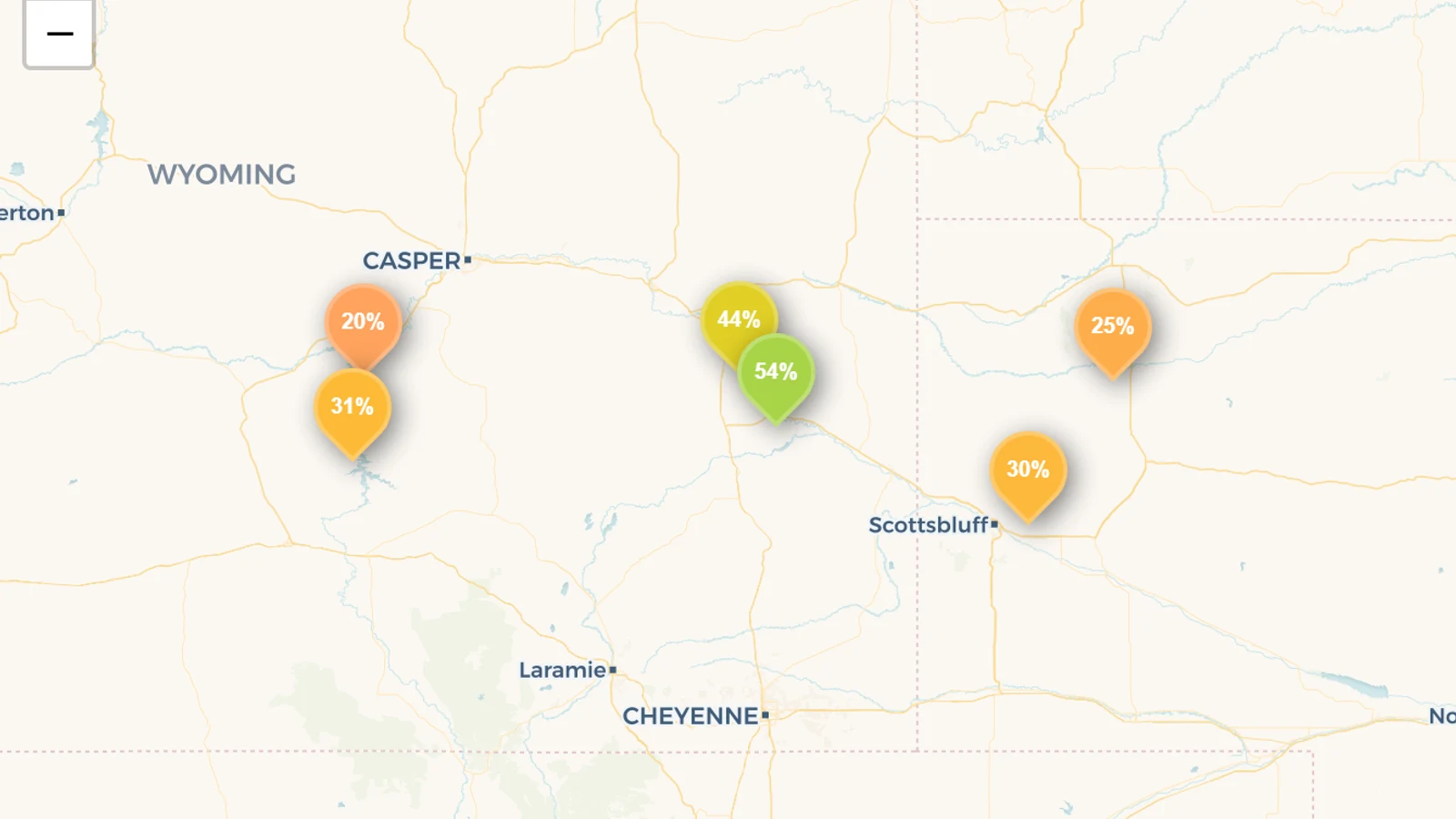
Every federal North Platte Project reservoir we track, on its 29 July 2026 reading, compared with the same date in each of the five previous years. The last column is the honest test: is this the lowest we have seen it? (The map above shows six of them — Alcova sits almost on top of Pathfinder at that scale, and the three smallest panhandle pools overlap each other.)
| Reservoir |
State |
Fill now |
2025 |
2024 |
2023 |
2022 |
2021 |
Lowest in record? |
| Pathfinder |
WY |
19.8% |
43.1% |
69.5% |
67.8% |
46.7% |
69.7% |
Yes — by 23.3 pts |
| Seminoe |
WY |
31.2% |
42.0% |
67.0% |
78.6% |
53.5% |
37.6% |
Yes — by 6.4 pts |
| Glendo |
WY |
44.4% |
61.0% |
52.2% |
78.6% |
59.2% |
56.9% |
Yes — by 7.8 pts |
| Guernsey |
WY |
53.9% |
63.9% |
59.1% |
43.2% |
58.9% |
62.2% |
No |
| Alcova |
WY |
98.1% |
98.1% |
97.8% |
98.2% |
98.0% |
98.0% |
No — held constant |
| Lake Minatare |
NE |
29.8% |
55.5% |
54.7% |
79.1% |
45.2% |
44.9% |
Yes — by 15.1 pts |
| Box Butte |
NE |
25.0% |
35.6% |
42.5% |
40.9% |
37.1% |
40.3% |
Yes — by 10.6 pts |
| Lake Alice |
NE |
18.7% |
42.8% |
31.2% |
61.6% |
37.5% |
40.8% |
Yes — by 12.5 pts |
| Winters Creek |
NE |
21.0% |
66.2% |
74.7% |
61.5% |
58.9% |
69.1% |
Yes — by 37.9 pts |
Seven of nine at a five-year low, on the same calendar date. The two exceptions are the two that were never going to move: Guernsey, which Reclamation deliberately draws down and refills each summer, and Alcova, whose six readings span a total of 0.4 percentage points across six years.
Why we compare same-date, not against a monthly average
A note on method, because it changes the answer here. Our reservoir pages carry a monthly historical average, and for most reservoirs it is a fine yardstick. On the North Platte it is not, because these reservoirs are drawn down steeply within August for irrigation: Glendo averages 78% across July and 47% across August. Measure a late-July reading against the August average and Glendo looks fine; measure it against the July average and it looks catastrophic. Neither is true.
The robust comparison for a reservoir on a steep seasonal curve is the same calendar date in previous years, which is what the table above uses. It is why we can say Glendo is genuinely at a five-year low without overstating it as a 34-point collapse — it is 7.8 points below its worst previous 1 August, which is bad, and specific, and defensible.
The 456,000 acre-feet that are not there
The three reservoirs that actually bank water for this river — Seminoe, Pathfinder and Glendo — hold 720,000 acre-feet between them, 29% of their 2.49 maf capacity. A year ago the same three held 1,176,000 acre-feet, 47% full.
|
Now (29 Jul 2026) |
One year ago |
Change |
| Pathfinder |
202 kaf |
452 kaf |
−250 kaf |
| Seminoe |
317 kaf |
429 kaf |
−113 kaf |
| Glendo |
202 kaf |
295 kaf |
−93 kaf |
| Combined |
720 kaf (29.0%) |
1,176 kaf (47.3%) |
−456 kaf |
Set that against the operational numbers. The Pathfinder Irrigation District reported roughly 393,000 acre-feet of seasonal supply remaining on 10 July 2026, against about 676,900 acre-feet at the same point in 2025. The twelve-month shortfall in upstream storage — 456,000 acre-feet — is larger than the district's entire remaining supply for the year.
That is the arithmetic behind the warning. It is not that the reservoirs are unusually low in some abstract sense; it is that there is no upstream cushion left to extend a season with.
Why the water is disappearing faster than the drought alone explains
Two mechanisms compound the shortage, and both are worth understanding because they are invisible in a reservoir percentage.
Dry ground drinks the deliveries. George Finnegan, the Bureau of Reclamation's water scheduler for the North Platte, described the problem plainly to Cowboy State Daily: "There really hasn't been a lot of water in the river filling those banks." Parched canal banks and soils behave as what he called "hungry ground — it takes up the water", so districts must push substantially more water down a canal to deliver the same volume to a field. In a drought the delivery system itself becomes a consumer.
The canals started the season damaged. A storm on 8 June 2026 caused seven breaches in the district's canal network, five of them major, pulling crews and equipment away from the pre-season preparation that would normally have reduced exactly those losses.
So the reservoirs are low, and each acre-foot released from them does less work than it would in a normal year. That is why a district can run out faster than its reservoir percentage suggests.
Downstream: the panhandle's own reservoirs are emptier still
The Nebraska side of this system is where the crop damage would land, and its own storage is in worse shape than Wyoming's. Winters Creek Lake at 21%, Lake Alice at 18.7%, Box Butte at 25% and Lake Minatare at 29.8% are all at five-year lows, and all sit below the big Wyoming storage in the same chain.
These are small reservoirs — Minatare, the largest, holds 59 million cubic metres — but they are the last buffer before the field. When they are near empty in the first week of August, there is nothing between an irrigator and the river's daily flow.
Nor is Pathfinder's the only district in trouble. Reporting from Nebraska earlier in the season had the Goshen and Gering-Fort Laramie districts working with 38 to 41 days of total supply, the Cozad Ditch Company facing possible depletion around 20 August, two to three weeks early, and the Thirty-Mile and Southside districts describing the most difficult season in fifty years of operation.
What we do not track, and why it matters here
Honesty about coverage: Lake McConaughy is not in our dataset. It is the largest reservoir on the North Platte — roughly 1.74 maf, behind Kingsley Dam in Nebraska — and it is operated by the Central Nebraska Public Power and Irrigation District rather than the Bureau of Reclamation, so it falls outside the federal sources this chain is built from. Nebraska reporting in April put it around 51% full, roughly 30 points below typical for the time of year.
That means everything above describes the federal North Platte Project, not the entire river. It is the upstream two-thirds of the system and the part that governs Wyoming and the panhandle — but a reader should know the biggest single pool downstream is missing from our figures rather than assume our 29% is the whole river's number. How openly a country publishes this kind of data, and where the gaps are, is what the Reservoir Transparency Index scores.
What to watch
- Whether the season ends early, and on what date. The district's warning was for the first week of August. A season that closes weeks early hits corn, sugar beets, dry beans and alfalfa at different stages of damage.
- Carryover on 30 September. What is left in Seminoe and Pathfinder at the end of the irrigation season is the balance 2027 starts from. From 19.8% in July, the plausible carryover is very low, which makes next year hostage to a single winter.
- This winter's snowpack in the Medicine Bow and Sierra Madre ranges. The North Platte refills from mountain snow, not summer rain. Wyoming's fifth-driest winter on record produced this; a second one in a row would put the storage reservoirs into territory they have not seen.
- The runoff forecast against the 1.1 maf allocation trigger. The 2026 forecast came in near 550,000 acre-feet — half the threshold. The first meaningful signal for 2027 arrives with the winter forecasts.
The honest summary: the North Platte's federal storage is 29% full and 456,000 acre-feet down on a year ago, seven of its nine reservoirs are at five-year lows for the date, and the irrigation district at the end of the pipe said this was the week it could run dry.
Figures on this page are 29 July 2026 readings from the U.S. Bureau of Reclamation, mirrored with multi-year history on reservoirs.earth; year-on-year comparisons use the reading nearest the same calendar date. State overviews: Wyoming and Nebraska. For the wider US picture see US reservoir levels and the driest states and the US Drought Monitor, July 2026; for the other Western river under federal cuts, Colorado River water cuts, 2026. Where every figure comes from: the official reservoir-data sources.