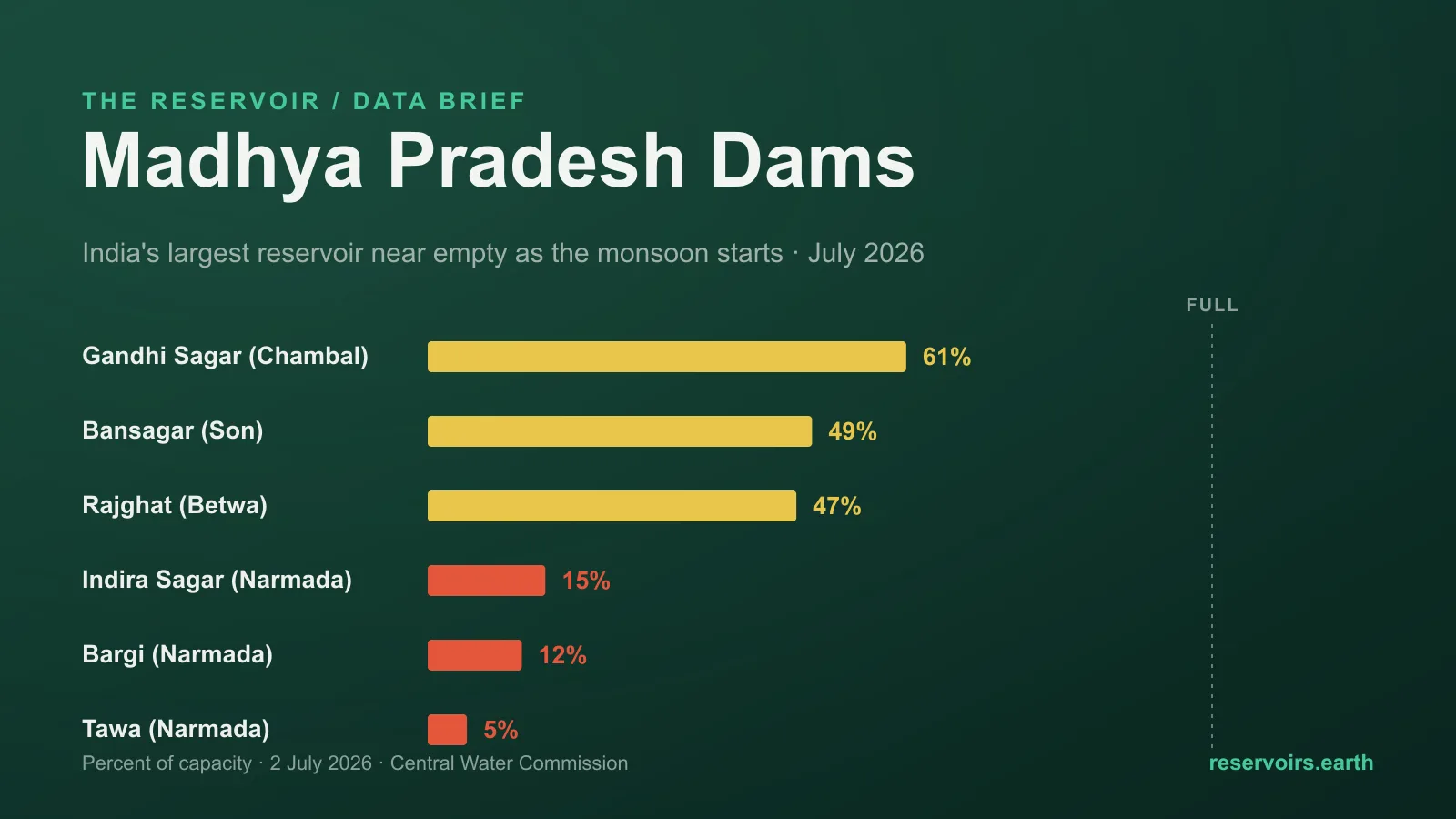
As of the CWC bulletin of 2 July 2026, Madhya Pradesh's major reservoirs are holding about 30% of their combined capacity — but that middling headline hides a stark split, because the state's biggest storages, the giants of the Narmada valley, are close to empty as the southwest monsoon begins. Indira Sagar, the largest reservoir in India by capacity, sits at about 15%; Bargi at about 12% and Tawa at just 5%. Against them, the Chambal's Gandhi Sagar at about 61% is doing the heavy lifting that keeps the state average up. Every big dam is at its seasonal floor, waiting on rain that has not yet filled the catchments. The live state figure and dam-by-dam map are on the Madhya Pradesh reservoir levels page. This is the July edition of a monthly check-in, and for Madhya Pradesh the story is the emptiness of the Narmada.
Key takeaways
- Madhya Pradesh's tracked reservoirs are about 30% full (2 July 2026) — 5 of the 12 major dams sit below 20% of capacity, and the state average is propped up by a few fuller dams outside the Narmada basin. The live figure is on the Madhya Pradesh page.
- The Narmada valley is nearly empty. The state's Narmada-system dams — Indira Sagar (
15%), Bargi (12%), Tawa (5%) and Omkareshwar (55%) — together hold only about 12% of their combined capacity.
- Indira Sagar is the number to watch. India's largest reservoir by capacity (~12 km³) is at about 15%, less than half its early-July norm near 35%.
- The Chambal and Betwa hold up better. Gandhi Sagar (
61%) on the Chambal is above its July norm, and Rajghat (47%) on the Betwa and Bansagar (~49%) on the Son are steadier — the non-Narmada rivers are carrying the state figure.
- Levels are flat. Between the 25 June and 2 July bulletins the big Narmada dams barely moved, so the seasonal inflow has not yet started in earnest.
Where Madhya Pradesh's reservoir data comes from
The figures here come from the Central Water Commission (CWC), India's national water agency, whose weekly bulletin covers the country's largest reservoirs. reservoirs.earth mirrors that bulletin and keeps each dam's multi-year history; the most recent reading in this snapshot is 2 July 2026. India's national data is harder to access than most countries we track — which is why India scores low on the Reservoir Transparency Index — but the CWC bulletin covers Madhya Pradesh's major dams well, because the state holds several of India's biggest. Every figure below is dated, because pre-monsoon levels change quickly once the rain arrives. The live state number and map are on the Madhya Pradesh page.
Why 30% is the number to expect — and still a warning
Madhya Pradesh sits in the core of the southwest monsoon, which delivers almost all of the state's rain between June and September. Early July is, by design, the low point of the year: last year's water has been drawn down through the long dry season, and the reservoirs are waiting to refill. A state average in the low 30s is not, in itself, a crisis — it is the seasonal floor.
What makes this year's floor a warning is the comparison with the same week in past years, and the fact that the shortfall is concentrated in the dams that matter most by volume. The Narmada giants are running well below their early-July norm: Indira Sagar at ~15% against ~35%, Bargi at ~12% against ~48%, Tawa at ~5% against ~44%. And week over week they are essentially flat — so the gap is not closing yet. They are not just low because it is July; they are low for July.
The Narmada valley: running on empty
More than half of Madhya Pradesh's tracked storage — about 20 of its 35 km³ of capacity — sits in the Narmada basin, and as a group those dams are only about 12% full. The chain tells the story from the top down. Indira Sagar, the Narmada Sagar and the largest reservoir in the country, is at about 15%; downstream Omkareshwar (55%) holds more because it is a run-of-river dam that refills quickly on releases from above. On the tributaries, Bargi near Jabalpur is at about 12% and Tawa, which irrigates a large command area in the Narmada valley, is at just about 5%.
Because these are the reservoirs that underwrite irrigation across central Madhya Pradesh and feed hydropower and downstream supply into Gujarat's Sardar Sarovar, a slow start to the monsoon here is an economic signal, not just a weather one. The number to watch across the next two editions is how fast Indira Sagar climbs off this floor.
The rivers holding the average up
Outside the Narmada, Madhya Pradesh's other big basins are in better shape, and they are why the state average is 30% rather than the low teens:
- Gandhi Sagar (~61%) on the Chambal is the state's second-largest reservoir and is actually above its early-July norm near 52% — a genuine bright spot, and the single biggest reason the headline holds up.
- Bansagar (~49%) on the Son, in the state's east, is close to its norm and supplies a shared irrigation system with Uttar Pradesh and Bihar.
- Rajghat (~47%) on the Betwa, on the border with Uttar Pradesh, is holding right around its July norm, and Atal Sagar (~57%) is comfortably above it.
That contrast — an empty Narmada against a comfortable Chambal — is the shape of the state this month.
What "% full" means here
Three cautions for reading these numbers, all of which July makes concrete:
- A low reading in July is expected; a low reading versus the July average is not. Levels are measured against each dam's full supply level, and Madhya Pradesh's reservoirs are supposed to bottom out just before the monsoon. What flags the Narmada valley is not that it is low but that it is well under where it usually sits in the first week of July.
- Every figure is a single dated snapshot. These are the levels in the 2 July 2026 bulletin; once the monsoon settles over the Narmada catchment, big storages can climb fast. Compare each dam to the same week in past years on its own chart.
- Run-of-river dams behave differently. Omkareshwar sits higher than the reservoirs above it because it passes water through rather than holding a full season's supply; read it against its own pattern, not against Indira Sagar.
What to watch in August
For Madhya Pradesh the whole picture turns on the monsoon reaching the Narmada catchment over the next two editions. Does Indira Sagar start to fill? It is the single largest store of water in the country, and its trajectory sets irrigation for central MP and inflows toward Gujarat downstream. Does the Chambal hold its lead? Gandhi Sagar above norm is the state's cushion this year. The honest summary: the Narmada is at its floor and running below normal, and the number that matters now is not the level but how fast it rises.
This is the July 2026 edition, following India Reservoir Levels, July 2026, which covers the national picture. We track the major water economies month by month — see the Karnataka and Maharashtra July editions — and follow Madhya Pradesh between editions on the Madhya Pradesh reservoir levels page.