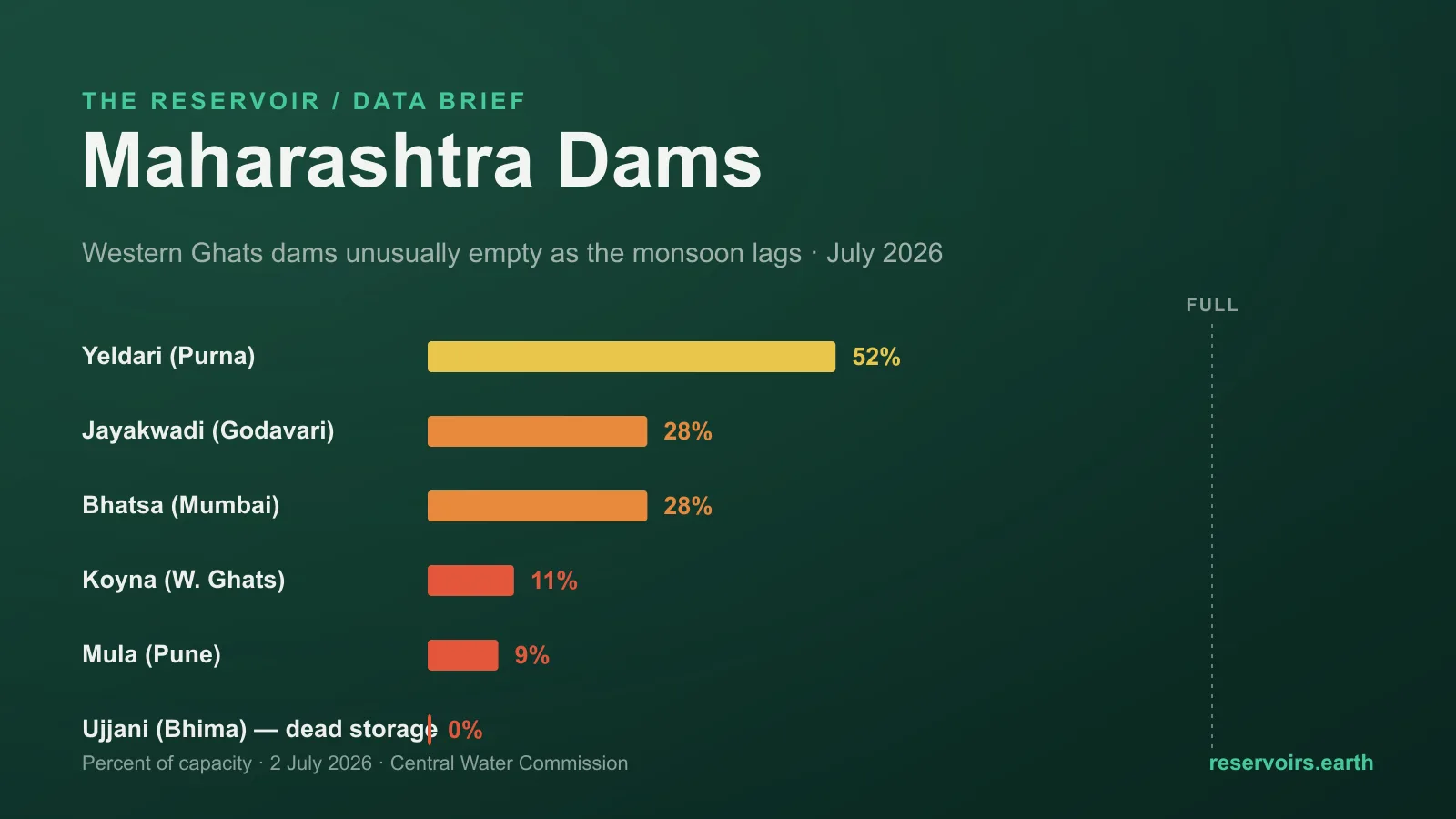
As of the CWC bulletin of 2 July 2026, Maharashtra's major reservoirs are holding only about 18% of their combined capacity — one of the lowest readings of any large Indian state as the southwest monsoon works its way up the country. The shortfall is deepest where the state's water usually comes from: Koyna, the big Western Ghats hydro reservoir, is at about 11% against an early-July norm near 63%, and Pune's supply dams Mula and Mulshi sit near 9–10%. Mumbai's Bhatsa and Marathwada's Jayakwadi are both around 28%. Fifteen of the 32 major dams are below 20%. The live state figure and dam-by-dam map are on the Maharashtra reservoir levels page. This is the July edition of a monthly check-in, and for Maharashtra the whole story is how far behind the rains are running.
Key takeaways
- Maharashtra's tracked reservoirs are about 18% full (2 July 2026) — with 15 of the 32 major dams below 20% of capacity. The live figure is on the Maharashtra page.
- The Western Ghats dams are running the deepest deficits. Koyna (
11% against a ~63% norm), Mulshi (10% vs 65%) and Bhatghar (9%) are the high-rainfall storages that normally fill first — and are furthest from normal.
- Pune and Mumbai supply is low but seasonal. Pune's Mula (
9%) and Mumbai's Bhatsa (28%) are drawn down at the usual pre-monsoon floor, waiting on the rains now arriving.
- Marathwada's Jayakwadi (~28%) on the Godavari — the drought-prone region's key dam — is close to its early-July norm, in better shape than the western storages.
- Ujjani (Bhima), the state's largest dam, is at dead storage — its live capacity reads 0%, meaning the usable water is gone until the monsoon refills it, which is normal for Ujjani at this point in a dry year.
Where Maharashtra's reservoir data comes from
The figures here come from the Central Water Commission (CWC), India's national water agency, whose weekly bulletin covers the country's largest reservoirs. reservoirs.earth mirrors that bulletin and keeps each dam's multi-year history; the most recent reading in this snapshot is 2 July 2026. India's national data is harder to access than most countries we track — which is why India scores low on the Reservoir Transparency Index — but the CWC bulletin covers Maharashtra's major dams. Every figure below is dated, because pre-monsoon levels change quickly once the rain arrives. The live state number and map are on the Maharashtra page.
Why 18% is the number to expect — and still a warning
Maharashtra depends almost entirely on the southwest monsoon (June–September) to refill its reservoirs, so early July is the bottom of the annual cycle — the dams are drawn down and waiting. A state reading in the high teens is the seasonal floor, not by itself a crisis.
What makes this year's floor a warning is how far below normal the key dams sit, and where. The Western Ghats storages — the ones with the highest rainfall and the highest July norms — show the widest gaps: Koyna at ~11% against ~63%, Mulshi at ~10% against ~65%, Upper Vaitarna at ~26% against ~73%. These catchments normally catch the first heavy monsoon rain of June; that they are still this low in early July means the rain has not yet arrived in force over the Ghats. Week over week most dams barely moved, with only small rises — the fill has not started in earnest.
A tale of two Maharashtras
The state's water splits cleanly between the wet west and the drier interior, and this month both are low but for different reasons:
- The Western Ghats and Pune (Krishna and Bhima basins) hold the deepest deficits relative to normal. Koyna (
11%), the backbone of Maharashtra's hydropower, and the Pune-area storages Mulshi (10%), Mula (9%), Bhatghar (9%) and Dudhganga (~3%) are all a fraction of their July norms.
- The Godavari basin and Marathwada are lower in absolute terms in a normal year but closer to normal now. Jayakwadi (
28%), the lifeline of drought-prone Marathwada, plus Isapur (46%), Yeldari (52%) and Pench (48%) in Vidarbha are holding near their early-July levels.
So the sharpest signal this month is not Marathwada, which usually makes the drought headlines, but the western high-rainfall dams that are unusually empty for early July.
What "% full" means here
Three cautions for reading these numbers, all of which July makes concrete:
- This is the seasonal floor, not a steady state. Levels are measured against each dam's full supply capacity, and Maharashtra's dams are meant to be low in early July — they refill through the monsoon. A low reading now is normal; a low reading relative to the early-July average, as in the Western Ghats, is the signal.
- "Dead storage" is not the same as empty. Ujjani (Bhima) reads 0% because its live (usable) storage is exhausted, but the reservoir still holds dead-storage water below the outlet; this is routine for Ujjani late in a dry season and reverses once the monsoon inflow arrives.
- Every figure is a single dated snapshot. These are the 2 July 2026 levels; high-rainfall Ghats catchments can climb very fast once the monsoon lands. Compare each dam to the same week in past years on its own chart.
What to watch in August
For Maharashtra the next two editions turn on the monsoon settling over the Western Ghats. Do Koyna and the Pune dams start to climb? Koyna and Mulshi sit more than 50 points below their July norms, and Mula about 30; their high-rainfall catchments can close that gap quickly once the rain lands, so the rate of rise is the number to watch. Does Ujjani come off dead storage? That is the clearest sign the Bhima basin is refilling. The honest summary: Maharashtra is at its seasonal floor and running below normal in the west, and the question now is not the level but how fast the monsoon closes the gap.
This is the July 2026 edition, following India Reservoir Levels, July 2026, which covers the national picture. We track the major water economies month by month — see the Karnataka and Madhya Pradesh July editions — and follow Maharashtra between editions on the Maharashtra reservoir levels page.