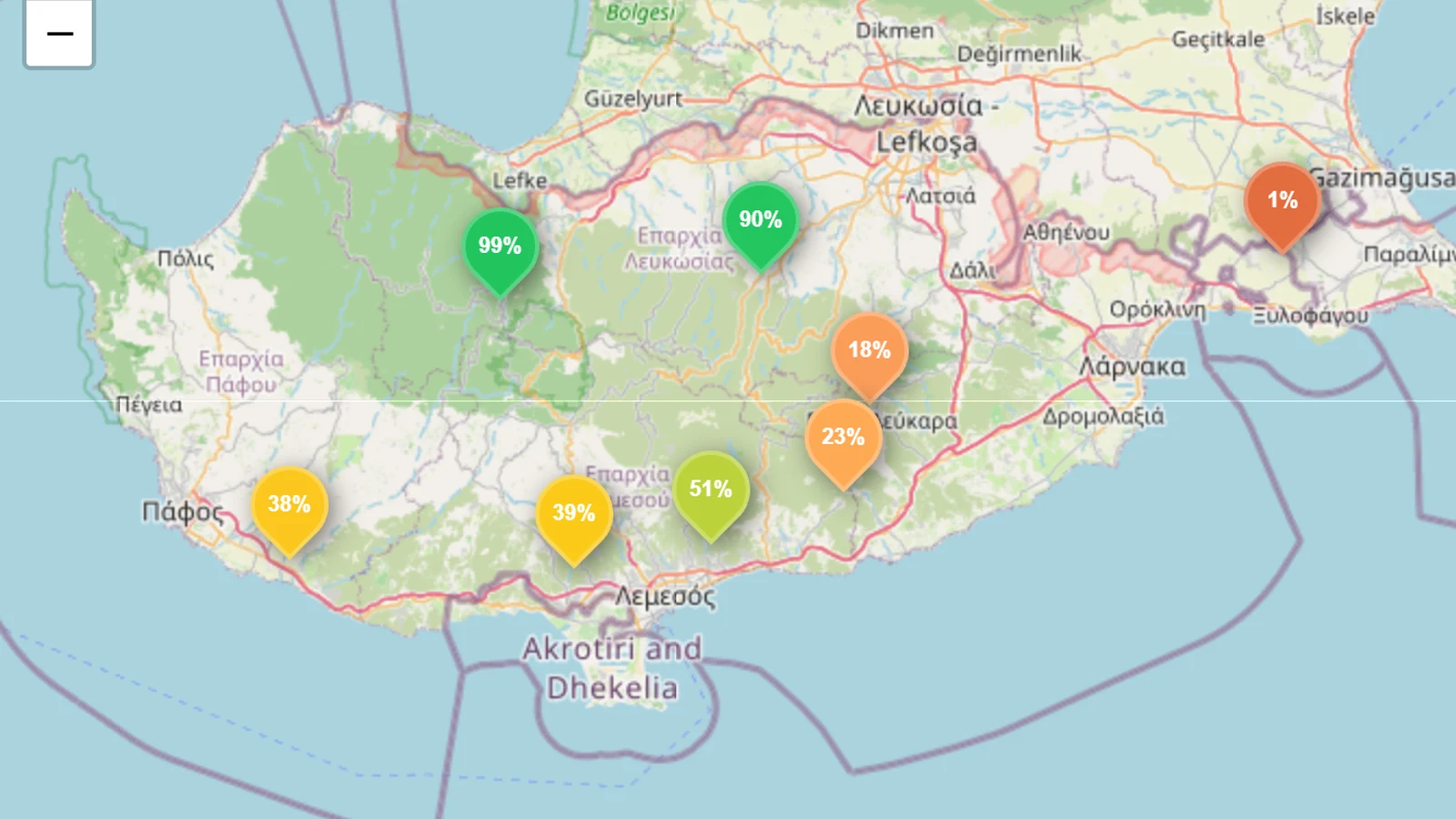
Cyprus's 21 tracked reservoirs held 116.1 hm³ on 10 September 2026 — 38.7% of their combined capacity. That is only three points below their capacity-weighted September norm of 41.9%. But the national figure hides a range from 1.2% at Achna to 98.6% at Kalopanayiotis.
The largest reservoir is close to normal
Kouris, Cyprus's largest reservoir, was 38.8% full, holding 44.6 hm³. Its September average across the historical series is 37.0%.
That makes Kouris slightly healthier than normal. The main deficit lies elsewhere.
Asprokremmos, the second-largest reservoir, was 37.5% full, compared with a September average of 52.3%. Lefkara stood at 17.6%, roughly half its 35.4% norm. Achna held only 0.08 hm³ — 1.2% of capacity, against a September average of 16.8%.
Full does not always mean much water
Several small reservoirs around Nicosia look exceptionally healthy. Klirou was 89.5% full, while Kalopanayiotis was at 98.6%.
Together, however, they can hold only 2.36 hm³. Kouris alone has almost 49 times their combined capacity. A nearly full small reservoir therefore cannot offset a moderate shortfall at one of the island's major storages.
This is why the national percentage must be weighted by capacity. Counting full reservoirs would make Cyprus look much wetter than it is.
A divided island, not an empty one
Cyprus was not uniformly dry in September 2026. Kouris was close to normal, Germasogeia was above normal, and several small mountain reservoirs were nearly full. The shortfall was concentrated in important reservoirs including Asprokremmos, Lefkara, Kalavasos and Achna.
Across all 21 reservoirs, the gap from their weighted September norm was approximately 9.6 hm³. The island was below normal, but not because every reservoir was low.
The figures come from Cyprus's Water Development Department. Our comparison uses each reservoir's September history, with records extending back to 1988. Current levels and the complete map are available on the Cyprus reservoir page.